A Model of AI-Integrated Supervision of Teaching for Learning Management of Teachers in Extra-Large Secondary Schools Under the Office of the Basic Education Commission
Article Sidebar
Main Article Content
Abstract
This research aimed to; 1) study the current state and problems of artificial intelligence-enhanced instructional supervision for learning management of teachers in large special secondary schools under the Office of the Basic Education Commission, 2) develop a model for AI-enhanced instructional supervision, and 3) examine and evaluate the appropriateness of the developed model. This study employed a mixed-methods research design. The population consisted of 2,363 large special secondary schools under the Office of the Basic Education Commission. Stratified sampling was used to select the sample group, which included school administrators and personnel responsible for internal instructional supervision, totaling 360 respondents. The research instruments were questionnaires and evaluation forms. Statistical analyses included mean, standard deviation, and content analysis.
The results revealed that:
1. The overall conditions and challenges of AI-based instructional supervision were at a high level, indicating progressive implementation efforts but also limitations in real-time monitoring and access to digital tools.
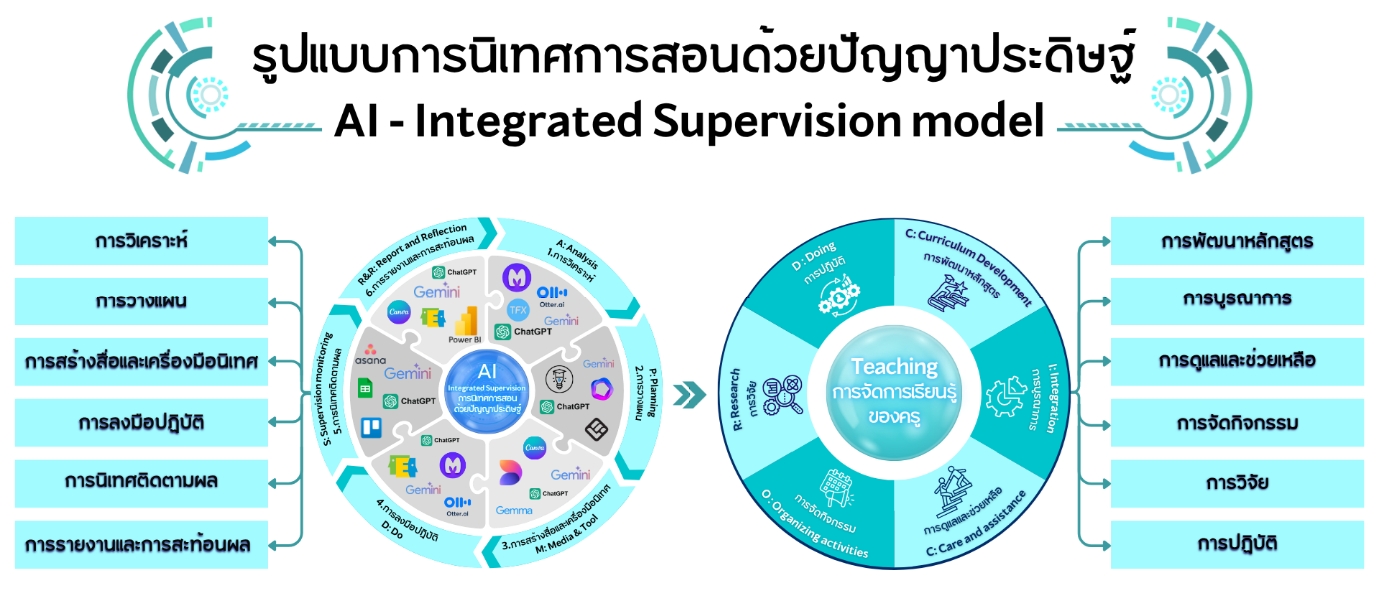
2. The AI-enhanced instructional supervision model for learning management of teachers in large special secondary schools under the Office of the Basic Education Commission consisted of 6 steps: Step 1 - Analysis (A), Step 2 - Planning (P), Step 3 - Media & Tools creation (M), Step 4 - Implementation/Doing (D), Step 5 - Supervision monitoring (S), and Step 6 - Report and Reflection (2R).
3. The evaluation results showed that the appropriateness was at high to highest levels (M = 4.40-4.70) and the feasibility was at a high level (M = 4.20-4.35). However, support in terms of resources and training is still needed to ensure effective implementation.
Article Details

This work is licensed under a Creative Commons Attribution-NonCommercial-NoDerivatives 4.0 International License.
เพื่อให้เป็นไปตามกฎหมายลิขสิทธิ์ ผู้นิพนธ์ทุกท่านต้องลงลายมือชื่อในแบบฟอร์มใบมอบลิขสิทธิ์บทความ ให้แก่วารสารฯ พร้อมกับบทความต้นฉบับที่ได้แก้ไขครั้งสุดท้าย นอกจากนี้ ผู้นิพนธ์ทุกท่านต้องยืนยันว่าบทความ ต้นฉบับที่ส่งมาตีพิมพ์นั้น ได้ส่งมาตีพิมพ์เฉพาะในวารสาร วิชาการธรรม ทรรศน์ เพียงแห่งเดียวเท่านั้น หากมีการใช้ ภาพหรือตารางของผู้นิพนธ์อื่นที่ปรากฏในสิ่งตีพิมพ์อื่นมาแล้ว ผู้นิพนธ์ต้องขออนุญาตเจ้าของลิขสิทธิ์ก่อน พร้อมทั้ง แสดงหนังสือที่ได้รับการยินยอมต่อบรรณาธิการ ก่อนที่บทความจะได้รับการตีพิมพ์References
ธนัฏฐา วุฒิวณิชย์. (2563). รูปแบบการนิเทศที่มีประสิทธิผลต่อการจัดการเรียนการสอนในศตวรรษที่ 21 ของโรงเรียนเทศบาลวัดท่าสะต๋อย อำเภอเมือง จังหวัดเชียงใหม่. วารสารการศึกษาและการพัฒนาสังคม, 15(2), 302-314.
วรลักษณ์ หิมะกลัส. (2566). การทบทวนวรรณกรรมว่าด้วยการใช้ AI ในการศึกษา Literature review on the use of AI in education. รายงานฉบับสมบูรณ์ภายใต้แผนงานยุทธศาสตร์เป้าหมาย (Spearhead) ด้านสังคม แผนงานคนไทย 4.0. กรุงเทพฯ: สำนักงานการวิจัยแห่งชาติ (วช.).
ศักดิ์ชัย ไชยรักษ์ และปณิตา วรรณพิรุณ. (2563). เทคโนโลยีทางปัญญาเพื่อการศึกษาอัจฉริยะ. วารสารปัญญาภิวัฒน์, 12(3), 315-328.
ศิลา สงอาจินต์, นพรัตน์ ชัยเรือง และจำเริญ ชูช่วยสุวรรณ. (2561). การพัฒนารูปแบบการนิเทศการสอนเพื่อพัฒนาสมรรถภาพการจัดการเรียนรู้ของครูตามทักษะการเรียนรู้ในศตวรรษที่ 21 ของสถานศึกษาในสังกัดเทศบาลนครตรัง. วารสารศรีนครินทรวิโรฒวิจัยและพัฒนา สาขามนุษยศาสตร์และสังคมศาสตร์, 10(20), 160-175.
ศุภลักษณ์ มีปาน, เสาวณีย์ สิกขาบัณฑิต และขวัญหญิง ศรีประเสริฐภาพ. (2562). รูปแบบการนิเทศภายในสำหรับการจัดการเรียนร่วมในโรงเรียนสังกัดกรุงเทพมหานคร. วารสารวิชาการศึกษาศาสตร์, 20(1), 87-101.
สำนักงานคณะกรรมการการศึกษาขั้นพื้นฐาน. (2554). แนวทางการประเมินคุณภาพตามมาตรฐานการศึกษาขั้นพื้นฐานเพื่อการประกันคุณภาพภายในของสถานศึกษา. กรุงเทพฯ: สำนักงานพระพุทธศาสนาแห่งชาติ.
สำนักงานคณะกรรมการการศึกษาขั้นพื้นฐาน. (2555). แนวทางการจัดการเรียนการสอนในโรงเรียนมาตรฐานสากล (ฉบับปรับปรุง). กรุงเทพฯ: สำนักงานคณะกรรมการการศึกษาขั้นพื้นฐาน.
Beach, D. M., & Reinhartz, J. (2000). Supervision leadership: Focus on instruction. Boston, MA: Allyn & Bacon.
Brown, S. (2021). Machine learning, explained. Cambridge, MA: MIT Sloan School of Management.
Harris, B. M. (1985). Supervision behavior in education. (2nd ed.). Englewood Cliffs, NJ: Prentice-Hall.
Huang, L. H., Zhu, H. L., Li, Y., Wu, Q., Chen, X., & Zhang, M. (2021). Digital transformation and management of enterprises: Research framework and prospects. Journal of Management Science, 24, 26-35.
Mark, J. R., & King, S. (1985). Handbook of educational supervision: A guide to practice. (3rd ed.). Boston, MA: Allyn & Bacon.
Mishra, P., & Koehler, M. J. (2006). Technological pedagogical content knowledge: A framework for teacher knowledge. Teachers College Record, 108(6), 1017-1054. https://doi.org/10.1111/j.1467-9620.2006.00684.x
Robinson, M., Nobles, J., Barbosa, E. C., Hamid, A., Thompson, C., Sherk, A., Stockwell, T., Zhao, J., Naimi, T. S., & Lim, A. (2021). Evaluating theories of change for public health policies using computer model discovery methods. Addiction, 116(10), 2709-2711.
Sergiovanni, T. J., & Starratt, R. J. (2007). Supervision: A redefinition. (8th ed.). New York, NY: McGraw-Hill.
Smith, J., Doe, A., & Roe, B. (2020). Impact of online pedagogical feedback on academic performance: A comparative study. Journal of Educational Psychology, 15, 123-136.
Wang, D., & Chen, S. (2022). Digital transformation and enterprise resilience: Evidence from China. Sustainability, 14, 14218. https://doi.org/10.3390/su142114218
Zhai, X., Chu, X., Chai, C. S., Jong, M. S. Y., Istenic, A., Spector, M., Liu, J.-B., Yuan, J., & Li, Y. (2021). A review of artificial intelligence (AI) in education from 2010 to 2020. Complexity, 2021, 1-18.
Zhang, F., Wang, M., Xi, J., Yang, J., & Li, A. (2019). A novel method for identifying essential genes by fusing dynamic protein–protein interaction networks. Genes, 10(1), 31.
