Development of Indicators for Teachers’ Active Learning Management Competency in Schools under Primary Educational Service Area Offices in Northeastern Thailand
Article Sidebar
Main Article Content
Abstract
This study aimed to: (1) develop indicators of teachers’ active learning management competency; (2) examine the congruence of the structural model of the indicators with empirical data; and (3) develop a manual for using the indicators. The study employed a survey research design and was conducted in three phases. In Phase 1, the components were synthesized from relevant documents and research studies. Operational definitions and indicators were then developed and evaluated for appropriateness by seven experts. In Phase 2, the model was tested using data collected from 500 school administrators and teachers selected through multistage random sampling. The research instrument was a five-point rating scale questionnaire. The item-objective congruence indices ranged from 0.80 to 1.00, the discrimination indices ranged from 0.271 to 0.725, and the reliability coefficient was 0.946. The data were analyzed using confirmatory factor analysis. In Phase 3, a manual for using the indicators was developed and evaluated for appropriateness by five experts. The data were analyzed using the mean and standard deviation.
The findings revealed that:
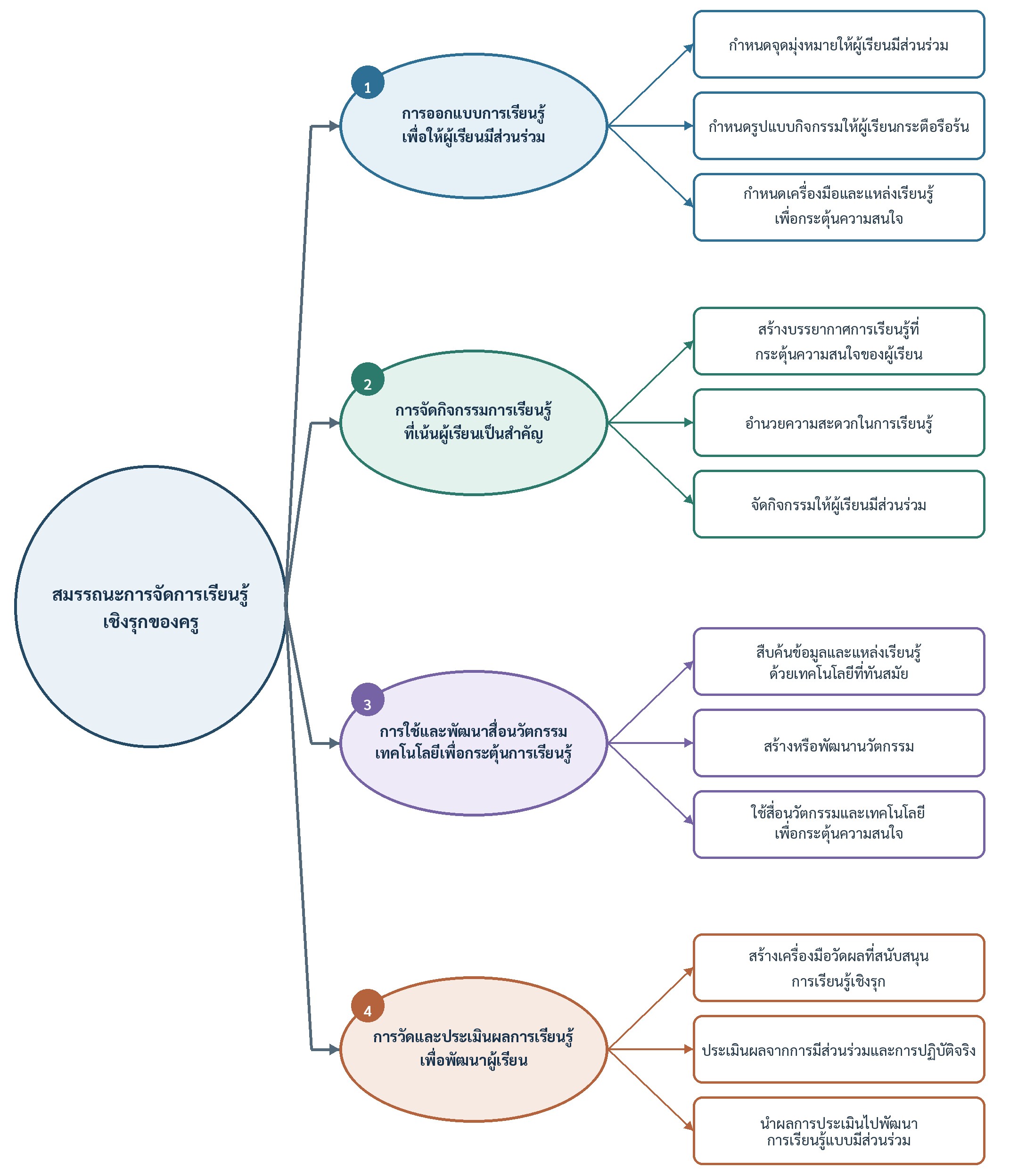
1. The indicators of teachers’ active learning management competency consisted of four main components, 12 subcomponents, and 72 indicators. The overall appropriateness was rated at the highest level (x̄ = 4.56, S.D. = 0.26).
2. The structural model of the indicators was congruent with the empirical data (χ² = 25.43, p = .65, df = 29, GFI = .92, AGFI = .97, RMSEA = .00). The factor loadings of the subcomponents ranged from .29 to .56.
3. The manual for using the indicators was rated as highly appropriate overall (x̄ = 4.10, S.D. = 0.67).
Article Details

This work is licensed under a Creative Commons Attribution-NonCommercial-NoDerivatives 4.0 International License.
เพื่อให้เป็นไปตามกฎหมายลิขสิทธิ์ ผู้นิพนธ์ทุกท่านต้องลงลายมือชื่อในแบบฟอร์มใบมอบลิขสิทธิ์บทความ ให้แก่วารสารฯ พร้อมกับบทความต้นฉบับที่ได้แก้ไขครั้งสุดท้าย นอกจากนี้ ผู้นิพนธ์ทุกท่านต้องยืนยันว่าบทความ ต้นฉบับที่ส่งมาตีพิมพ์นั้น ได้ส่งมาตีพิมพ์เฉพาะในวารสาร วิชาการธรรม ทรรศน์ เพียงแห่งเดียวเท่านั้น หากมีการใช้ ภาพหรือตารางของผู้นิพนธ์อื่นที่ปรากฏในสิ่งตีพิมพ์อื่นมาแล้ว ผู้นิพนธ์ต้องขออนุญาตเจ้าของลิขสิทธิ์ก่อน พร้อมทั้ง แสดงหนังสือที่ได้รับการยินยอมต่อบรรณาธิการ ก่อนที่บทความจะได้รับการตีพิมพ์References
จิราภรณ์ ยกอินทร์. (2560). การจัดการเรียนรู้ผ่านการลงมือปฏิบัติ. กรุงเทพฯ: มหาวิทยาลัยสวนดุสิต.
ชัยวัฒน์ สุทธิรัตน์. (2564). การพัฒนาหลักสูตร: ทฤษฎีสู่การปฏิบัติ. นนทบุรี: ออล กราฟิก.
เทียมจันทร์ พานิชย์ผลินไชย. (2560). การศึกษาสมรรถนะการจัดการเรียนรู้ในศตวรรษที่ 21 ของนิสิตระดับปริญญาตรี ในโครงการจัดการศึกษาเพื่อพัฒนาครูในถิ่นทุรกันดารบนเขตพื้นที่สูงชายแดน ไทย-เมียนมา ด้านจังหวัดตาก คณะศึกษาศาสตร์ มหาวิทยาลัยนเรศวร. วารสารศึกษาศาสตร์ มหาวิทยาลัยนเรศวร, 19(4), 123-132.
ธนา ธุศรีวรรณ. (2562). การพัฒนารูปแบบการชี้แนะเพื่อส่งเสริมทักษะการจัดการเรียนรู้ในศตวรรษที่ 21 สำหรับครูระดับมัธยมศึกษา. (วิทยานิพนธ์ปรัชญาดุษฎีบัณฑิต). มหาสารคาม: มหาวิทยาลัยมหาสารคาม.
เพชรจันทร์ ภูทะวัง. (2565). การพัฒนาโปรแกรมเสริมสร้างสมรรถะการจัดการเรียนรู้เชิงรุกของครูโรงเรียนประถมศึกษา สังกัดสำนักงานคณะกรรมการการศึกษาขั้นพื้นฐาน. (วิทยานิพนธ์การศึกษาดุษฎีบัณฑิต). มหาสารคาม: มหาวิทยาลัยมหาสารคาม.
วราลักษณ์ อาจวิชัย. (2565). การพัฒนารูปแบบการนิเทศแบบมีส่วนร่วมเพื่อเสริมสร้างสมรรถนะการวัด และประเมินผลการเรียนรู้ของครูในโรงเรียนประถมศึกษา สังกัดสำนักงานคณะกรรมการการศึกษาขั้นพื้นฐาน ในภาคตะวันออกเฉียงเหนือ. (วิทยานิพนธ์ปรัชญาดุษฎีบัณฑิต). สกลนคร: มหาวิทยาลัยราชภัฎสกลนคร.
สุภัทรา ภูษิตรัตนาวลี. (2560). รูปแบบการจัดการเรียนรู้เชิงรุกสำหรับคณาจารย์วิทยาลัยเทคโนโลยีภาคใต้. (วิทยานิพนธ์ปรัชญาดุษฎีบัณฑิต). กรุงเทพฯ: มหาวิทยาลัยศรีนครินทรวิโรฒ.
สำนักงานคณะกรรมการการศึกษาขั้นพื้นฐาน. (2562). แนวทางการนิเทศเพื่อพัฒนาและส่งเสริม การจัดการเรียนรู้เชิงรุก (Active Learning) ตามนโยบายลดเวลาเรียน เพิ่มเวลารู้. กรุงเทพฯ: หน่วยศึกษานิเทศก์ สำนักงานคณะกรรมการการศึกษาขั้นพื้นฐาน.
