Career Sustainability Guidelines for Academic Staff in Public Autonomous Universities
Article Sidebar
Main Article Content
Abstract
This study aimed to explore career sustainability guidelines for academic staff in public autonomous universities. A qualitative research approach was employed using semi-structured in-depth interviews with 20 key informants who were purposively selected from academic personnel working in public autonomous universities. The research instrument was an in-depth interview guide, and the data were analyzed using content analysis.
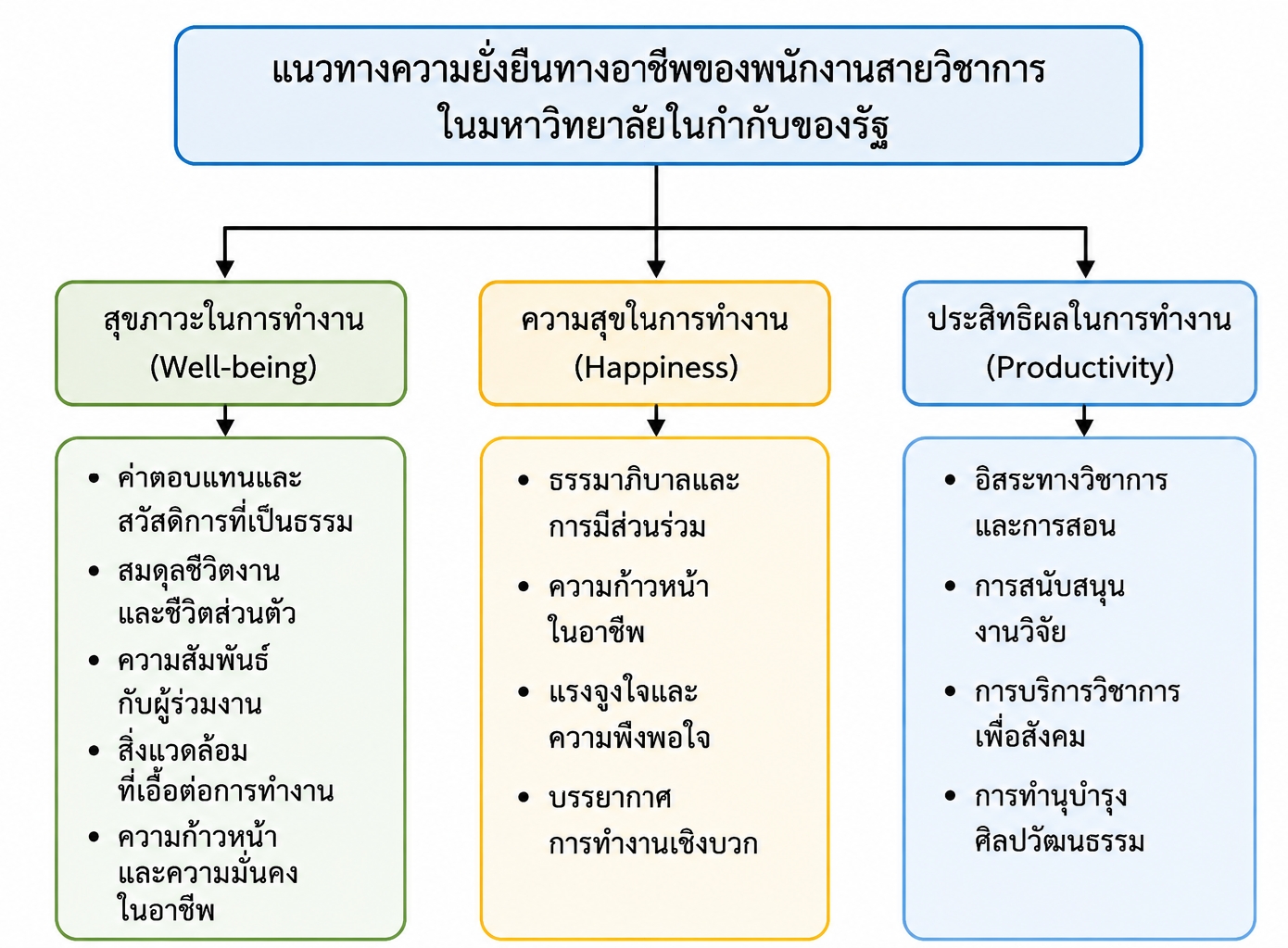
The findings revealed that: career sustainability for academic staff in public autonomous universities consists of three key dimensions. The first dimension, well-being at work, includes fair compensation and welfare benefits, work–life balance, positive relationships with colleagues, a supportive work environment, and career advancement opportunities. The second dimension, happiness at work, comprises good governance, participation in decision-making, career progression, and a positive organizational climate. The third dimension, work productivity, includes the promotion of academic freedom, research support, community-engaged academic services, and cultural preservation activities that are aligned with the context and mission of each institution. The findings indicate that career sustainability among academic staff is achieved through a balanced development of well-being, happiness, and work productivity. These findings may serve as a guideline for policy formulation and human resource management in public autonomous universities to enhance employee retention and support the sustainable professional development of academic staff.
Article Details

This work is licensed under a Creative Commons Attribution-NonCommercial-NoDerivatives 4.0 International License.
เพื่อให้เป็นไปตามกฎหมายลิขสิทธิ์ ผู้นิพนธ์ทุกท่านต้องลงลายมือชื่อในแบบฟอร์มใบมอบลิขสิทธิ์บทความ ให้แก่วารสารฯ พร้อมกับบทความต้นฉบับที่ได้แก้ไขครั้งสุดท้าย นอกจากนี้ ผู้นิพนธ์ทุกท่านต้องยืนยันว่าบทความ ต้นฉบับที่ส่งมาตีพิมพ์นั้น ได้ส่งมาตีพิมพ์เฉพาะในวารสาร วิชาการธรรม ทรรศน์ เพียงแห่งเดียวเท่านั้น หากมีการใช้ ภาพหรือตารางของผู้นิพนธ์อื่นที่ปรากฏในสิ่งตีพิมพ์อื่นมาแล้ว ผู้นิพนธ์ต้องขออนุญาตเจ้าของลิขสิทธิ์ก่อน พร้อมทั้ง แสดงหนังสือที่ได้รับการยินยอมต่อบรรณาธิการ ก่อนที่บทความจะได้รับการตีพิมพ์References
เกศริน ธารีเทียน และศศิธร ลบล้ำเลิศ. (2557). แนวปฏิบัติที่ดีในการขอตำแหน่งทางวิชาการของบุคลากรสายวิชาการ คณะสังคมศาสตร์และมนุษยศาสตร์ มหาวิทยาลัยมหิดล. วารสารสังคมศาสตร์บูรณาการ มหาวิทยาลัยมหิดล, 1(2), 98-112.
เครือข่ายพนักงานมหาวิทยาลัย. (2556). เปรียบเทียบสถานะพนักงานมหาวิทยาลัยกับข้าราชการ. เข้าถึงได้จาก http://u-staff.blogspot.com/
เจษฎา คูงามมาก และพาชิตชนัต ศิริพานิช. (2557). ความเครียดในการทำงานของอาจารย์มหาวิทยาลัยรัฐ. เข้าถึงได้จาก http://repository.nida.ac.th/handle/662723737/504
ชาย โพธิสิตา. (2559). ศาสตร์และศิลป์แห่งการวิจัยเชิงคุณภาพ. (พิมพ์ครั้งที่ 7). กรุงเทพฯ: อัมรินทร์ พริ้นติ้ง แอนด์ พับลิชชิ่ง.
ธนพร พิมพ์แมน. (2567). การลาออกของบุคลากรมหาวิทยาลัยขอนแก่น ประจำปี 2561-2565. ขอนแก่น: กองทรัพยากรบุคคล มหาวิทยาลัยขอนแก่น.
มหาวิทยาลัยมหาสารคาม. (2566). รายงานผลการบริหารทรัพยากรบุคคล ประจำปีงบประมาณ 2566. มหาสารคาม: มหาวิทยาลัยมหาสารคาม.
วัฒนา พัดเกตุ. (2548). การศึกษาเจตคติในการทำวิจัยและปัญหาอุปสรรคในการทำวิจัยของอาจารย์คณะมนุษยศาสตร์ มหาวิทยาลัยนเรศวร. วารสารคณะมนุษยศาสตร์ มหาวิทยาลัยนเรศวร, 3(1), 44-57.
สำนักงานเลขาธิการสภาการศึกษา. (2560). แผนการศึกษาแห่งชาติ พ.ศ. 2560-2579. กรุงเทพฯ: พริกหวานกราฟฟิค.
สิทธา กิจเจริญ. (2560). สภาพปัญหาและแนวทางการพัฒนาบุคลากรสายวิชาการเพื่อขอกำหนดตำแหน่งทางวิชาการของมหาวิทยาลัยเทคโนโลยีราชมงคลรัตนโกสินทร์. (วิทยานิพนธ์บริหารธุรกิจมหาบัณฑิต). กรุงเทพฯ: มหาวิทยาลัยศิลปากร.
สุรพล นิติไกรพจน์ และกฤติน ดิ่งแก้ว. (2559). มหาวิทยาลัยไทย: พัฒนาการมหาวิทยาลัยในกำกับของรัฐและกฎหมายที่เกี่ยวข้องกับการบริหารงาน. กรุงเทพฯ: มหาวิทยาลัยธรรมศาสตร์.
Ahsan, N., Abdullah, Z., Fie, D. Y. G., & Alam, S. S. (2009). A study of job stress on job satisfaction among university staff in Malaysia: Empirical study. European Journal of Social Sciences, 8(1), 121-131.
De Vos, A., van der Heijden, B. I. J. M., & Akkermans, J. (2020). Sustainable careers: Towards a conceptual model. Journal of Vocational Behavior, 117, 103196. https://doi.org/10.1016/j.jvb.2018.06.011
McCallum, F. (2021). Teacher and staff wellbeing: Understanding the experiences of school staff. In M. L. Kern & M. L. Wehmeyer (Eds.), The Palgrave handbook of positive education (pp. 715-740). Cham, Switzerland: Palgrave Macmillan. https://doi.org/10.1007/978-3-030-64537-3_28
Skaalvik, E. M., & Skaalvik, S. (2020). Teacher burnout: Relations between dimensions of burnout, perceived school context, job satisfaction and motivation for teaching. A longitudinal study. Teachers and Teaching, 26(7-8), 602-616. https://doi.org/10.1080/13540602.2021.1913404
Van der Heijden, B. I. J. M., & De Vos, A. (2015). Sustainable careers: Introductory chapter. In B. I. J. M. Van der Heijden & A. De Vos (Eds.), Handbook of research on sustainable careers (pp. 1-19). Cheltenham, UK: Edward Elgar Publishing.
