Synthesis of Components of School Quality Management
Article Sidebar
Main Article Content
Abstract
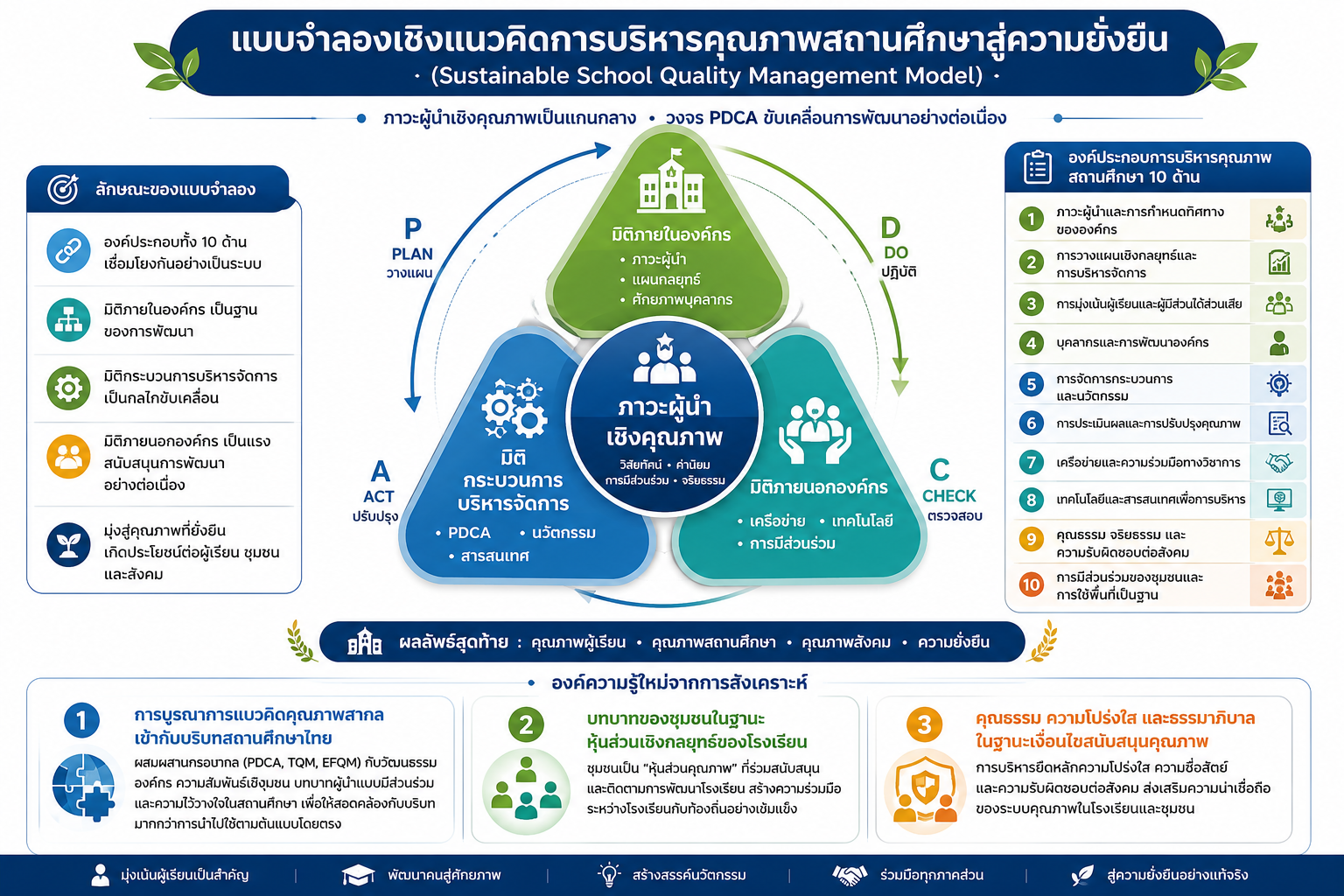
This study aimed to synthesize the components of school quality management using a qualitative documentary research approach. A total of 15 academic documents and research studies published between 2017 and 2025 were analyzed using a document analysis record form and descriptive content analysis.
The findings revealed that: ten components of school quality management, comprising six core components (1) leadership and organizational direction, (2) strategic planning and management, (3) student and stakeholder focus, (4) personnel and organizational development, (5) process management and innovation, and (6) evaluation and quality improvement and four supporting components: (7) academic networks and collaboration, (8) technology and information for management, (9) ethics and social responsibility, and (10) community participation and place-based engagement. The synthesis generated a conceptual model entitled the Sustainable School Quality Management Model, which organizes the ten components into three interrelated dimensions: the internal organizational dimension, the process management dimension, and the external organizational dimension. The model is driven by quality leadership as the central element and the PDCA cycle as the mechanism for continuous improvement. Its distinctive feature lies in the integration of leadership, management processes, innovation, and community-based collaboration into a coherent framework. This model can be applied as a practical guide for school administrators in planning, developing, and enhancing school quality management systems toward long-term sustainability.
Article Details

This work is licensed under a Creative Commons Attribution-NonCommercial-NoDerivatives 4.0 International License.
เพื่อให้เป็นไปตามกฎหมายลิขสิทธิ์ ผู้นิพนธ์ทุกท่านต้องลงลายมือชื่อในแบบฟอร์มใบมอบลิขสิทธิ์บทความ ให้แก่วารสารฯ พร้อมกับบทความต้นฉบับที่ได้แก้ไขครั้งสุดท้าย นอกจากนี้ ผู้นิพนธ์ทุกท่านต้องยืนยันว่าบทความ ต้นฉบับที่ส่งมาตีพิมพ์นั้น ได้ส่งมาตีพิมพ์เฉพาะในวารสาร วิชาการธรรม ทรรศน์ เพียงแห่งเดียวเท่านั้น หากมีการใช้ ภาพหรือตารางของผู้นิพนธ์อื่นที่ปรากฏในสิ่งตีพิมพ์อื่นมาแล้ว ผู้นิพนธ์ต้องขออนุญาตเจ้าของลิขสิทธิ์ก่อน พร้อมทั้ง แสดงหนังสือที่ได้รับการยินยอมต่อบรรณาธิการ ก่อนที่บทความจะได้รับการตีพิมพ์References
ขวัญจิรา จำปา และสุวดี อุปปินใจ. (2567). การบริหารจัดการโรงเรียนคุณภาพชุมชน. วารสารรัชตภาคย์, 17(51), 205-216.
บัญชา ยุทไธสง, กฤษกนก ดวงชาทม และอุรสา พรหมทา. (2564). การพัฒนารูปแบบการบริหารคุณภาพโรงเรียนมาตรฐานสากลในภาคตะวันออกเฉียงเหนือ. วารสารสังคมศาสตร์เพื่อการพัฒนาท้องถิ่น มหาวิทยาลัยราชภัฏมหาสารคาม, 5(1), 87-94.
พนารัตน์ สนิทรักษ์, อโนทัย ประสาน และบูรินทร์ภัฏ พรหมมาศ. (2565). การพัฒนารูปแบบการบริหารสถานศึกษาสู่ความเป็นเลิศของโรงเรียนเทศบาล สังกัดองค์กรปกครองส่วนท้องถิ่น ภาคใต้ฝั่งอันดามัน. วารสารสังคมศาสตร์เพื่อการพัฒนาท้องถิ่น มหาวิทยาลัยราชภัฏมหาสารคาม, 6(3), 275-283.
พรพิมล แม้นญาติ, สฎายุ ธีระวณิชตระกูล และชัยพจน์ รักงาม. (2563). รูปแบบการบริหารงานโรงเรียนมัธยมศึกษาสู่มาตรฐานสากล สังกัดสำนักงานเขตพื้นที่การศึกษามัธยมศึกษา เขต 7. วารสารครุศาสตร์ปริทรรศน์, 7(3), 156-170.
พัชรัตน์ วุฒิญาณ, หยกแก้ว กมลวรเดช และมานี แสงหิรัญ. (2564). ถอดบทเรียนความสำเร็จการบริหารคุณภาพการจัดการศึกษาสู่โรงเรียนมาตรฐานสากล: พหุกรณีศึกษา สังกัดสำนักงานเขตพื้นที่การศึกษามัธยมศึกษา เขต 39. Journal of Roi Kaensarn Academi, 6(8), 253-265.
รังสันต์ นุสติ, ทีปพิพัฒน์ สันตะวัน และสุพัฒนา หอมบุปผา. (2568). รูปแบบการบริหารสู่ความเป็นเลิศของสถานศึกษา สังกัดสำนักงานคณะกรรมการการอาชีวศึกษา. สักทอง: วารสารมนุษยศาสตร์และสังคมศาสตร์ (สทมส.), 31(2), 182-198.
วิจิตรา สอนทะ. (2563). การบริหารคุณภาพในโรงเรียนมัธยมศึกษา. วารสารสถาบันวิจัยญาณสังวร, 12(1), 34-44.
วุฒินัย วังหอม, สมคิด สร้อยน้ำ และประพรทิพย์ คุณากรพิทักษ์. (2562). การพัฒนารูปแบบการบริหารคุณภาพของโรงเรียนมัธยมศึกษาขนาดกลาง ภาคตะวันออกเฉียงเหนือ. วารสารครุศาสตร์ จุฬาลงกรณ์มหาวิทยาลัย, 47(3), 422-436. https://so02.tci-thaijo.org/index.php/EDUCU/article/view/218896
สมาพร ลี้ภัยรัตน์, ธานี เกสทอง และนันทิยา น้อยจันทร์. (2560). รูปแบบการบริหารคุณภาพโรงเรียนมาตรฐานสากล ระดับประถมศึกษา. วารสารสุทธิปริทัศน์, 31(100), 261-273.
สำนักงานคณะกรรมการการศึกษาขั้นพื้นฐาน. (2563). เกณฑ์รางวัลคุณภาพการศึกษาขั้นพื้นฐาน (OBECQA). กรุงเทพฯ: สำนักพัฒนานวัตกรรมการจัดการศึกษา.
สำนักงานเลขาธิการสภาการศึกษา. (2565). รายงานนโยบายและแผนการศึกษาแห่งชาติ พ.ศ. 2563-2570. กรุงเทพฯ: กระทรวงศึกษาธิการ.
______. (2566). แผนการศึกษาแห่งชาติ พ.ศ. 2566-2570. กรุงเทพฯ: กระทรวงศึกษาธิการ.
สำนักงานสภาพัฒนาการเศรษฐกิจและสังคมแห่งชาติ. (2561). ยุทธศาสตร์ชาติ พ.ศ. 2561-2580. กรุงเทพฯ: สำนักนายกรัฐมนตรี.
สุมาลี จันทรมาตร, ธีระพล เพ็งจันทร์ และพิมพ์พร จารุจิตร์. (2563). รูปแบบการบริหารโรงเรียนคุณภาพ สังกัดสำนักงานคณะกรรมการการศึกษาขั้นพื้นฐาน. Journal of Roi Kaensarn Academi, 9(12), 838-852.
อณัส ซาดัดคาน, นัลรัตน์ นวกิจไพบูลย์ และบูรินทร์ภัฏ พรหมมาศ. (2565). การบริหารสถานศึกษาสู่โรงเรียนมาตรฐานสากล สังกัดสำนักงานเขตพื้นที่การศึกษามัธยมศึกษานครศรีธรรมราช. วารสารพุทธสังคมวิทยาปริทรรศน์, 7(2), 223-237.
อร่าม วัฒนะ, นันนิยา น้อยจันทร์ และสาธร ทรัพย์รวงทอง. (2562). รูปแบบการบริหารสถานศึกษาสู่ความเป็นเลิศของโรงเรียนสังกัดองค์การบริหารส่วนจังหวัด. วารสารมหาจุฬาวิชาการ, 7(1), 55-71.
Baldrige Performance Excellence Program. (2021). Baldrige excellence framework (2021-2022): Proven leadership and management practices for high performance. Gaithersburg, MD: National Institute of Standards and Technology.
Deming, W. E. (1986). Out of the crisis. Cambridge, MA: MIT Press.
European Foundation for Quality Management (EFQM). (2020). EFQM Model 2020. Brussels, Belgium: EFQM.
Juran, J. M. (1988). Juran on planning for quality. New York, NY: Free Press.
Oakland, J. S. (2014). Total quality management and operational excellence: Text with cases. London, UK: Routledge.
Organisation for Economic Co-operation and Development (OECD). (2022). Education at a glance 2022: OECD indicators. Paris, France: OECD Publishing.
