The Development on Digital Leadership Model of Administrator of Royal Irrigation
Article Sidebar
Main Article Content
Abstract
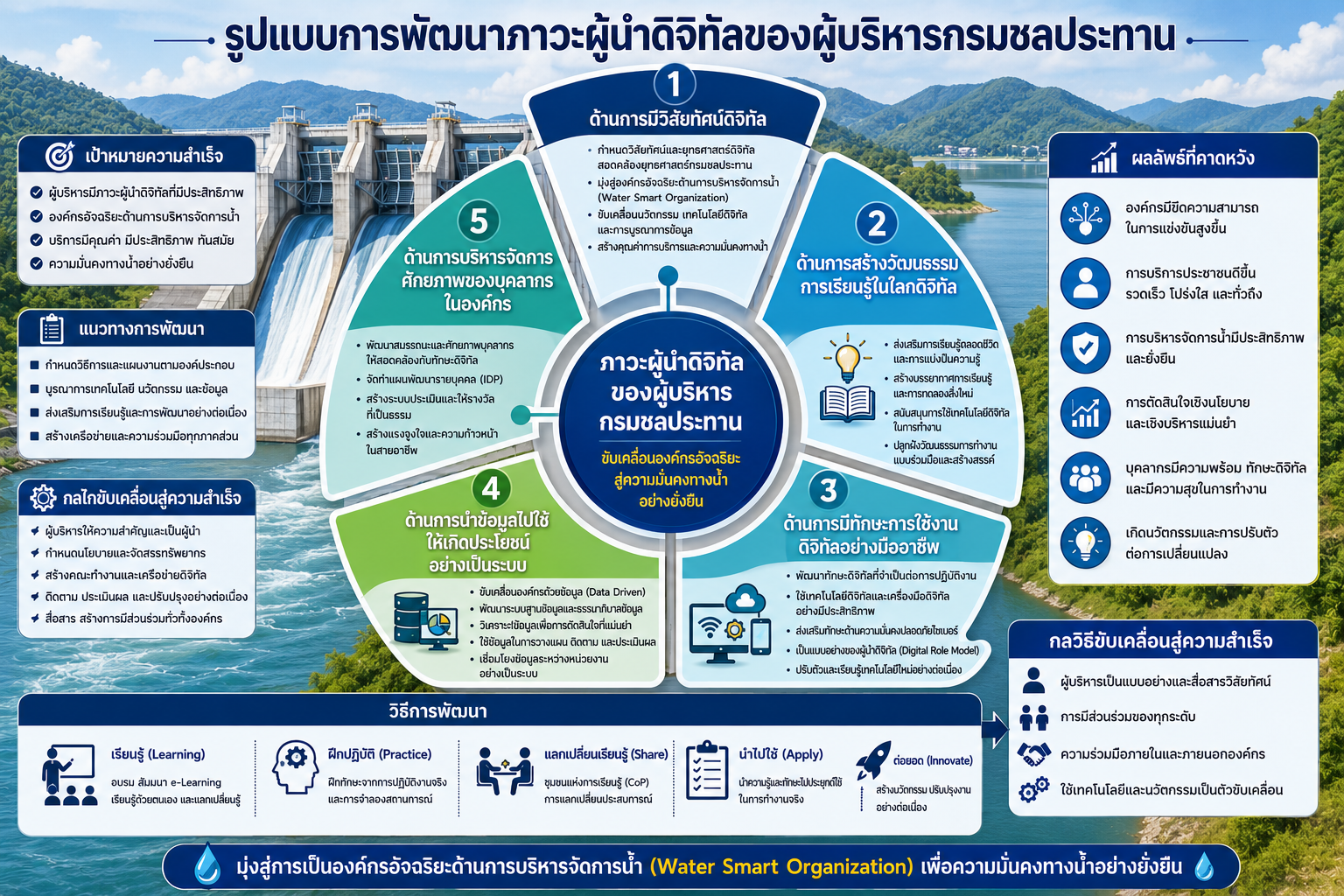
The objectives of this research were to: 1) examine the components of digital leadership; 2) investigate the current conditions, desirable conditions, and priority needs for digital leadership development among administrators of the Royal Irrigation Department; and 3) develop a digital leadership development model for administrators of the Royal Irrigation Department. This study employed a mixed-methods research design. The sample consisted of 127 administrators under the Medium-Scale Water Resources Development Division, selected through multi-stage sampling. Key informants were administrators from Medium-Scale Irrigation Construction Offices 1-16, selected through purposive sampling. The research instruments included a dual-response questionnaire, a semi-structured interview form, and a model evaluation form. Data were analyzed using mean, standard deviation, the Modified Priority Needs Index (PNI Modified), and content analysis.
The findings revealed that:
1. The digital leadership of administrators in the Royal Irrigation Department comprised five components: digital vision, systematic digital skills, professional data utilization, personnel capacity management, and the creation of a digital learning culture.
2. The overall current condition of digital leadership was at a high level, while the overall desirable condition was at the highest level.
3. The overall priority need for digital leadership development had a PNI Modified value of 0.294, with the highest priority needs being digital vision, the creation of a digital learning culture, and systematic digital skills, respectively
4. The developed digital leadership model consisted of five major components, including success indicators, success goals, development approaches, and implementation strategies. The evaluation results indicated that the model was appropriate, feasible, and useful for enhancing the digital leadership of administrators in the Royal Irrigation Department and could be adapted for organizational development in other contexts.
Article Details

This work is licensed under a Creative Commons Attribution-NonCommercial-NoDerivatives 4.0 International License.
เพื่อให้เป็นไปตามกฎหมายลิขสิทธิ์ ผู้นิพนธ์ทุกท่านต้องลงลายมือชื่อในแบบฟอร์มใบมอบลิขสิทธิ์บทความ ให้แก่วารสารฯ พร้อมกับบทความต้นฉบับที่ได้แก้ไขครั้งสุดท้าย นอกจากนี้ ผู้นิพนธ์ทุกท่านต้องยืนยันว่าบทความ ต้นฉบับที่ส่งมาตีพิมพ์นั้น ได้ส่งมาตีพิมพ์เฉพาะในวารสาร วิชาการธรรม ทรรศน์ เพียงแห่งเดียวเท่านั้น หากมีการใช้ ภาพหรือตารางของผู้นิพนธ์อื่นที่ปรากฏในสิ่งตีพิมพ์อื่นมาแล้ว ผู้นิพนธ์ต้องขออนุญาตเจ้าของลิขสิทธิ์ก่อน พร้อมทั้ง แสดงหนังสือที่ได้รับการยินยอมต่อบรรณาธิการ ก่อนที่บทความจะได้รับการตีพิมพ์References
กรมชลประทาน กองแผนงาน. (2564). นโยบายการกำกับดูแลองค์การที่ดี กรมชลประทาน ประจำปีงบประมาณ พ.ศ. 2564. กรุงเทพฯ: กระทรวงเกษตรและสหกรณ์.
กรมชลประทาน. (2560). ยุทธศาสตร์กรมชลประทาน 20 ปี (พ.ศ. 2560-2579). กรุงเทพฯ: กระทรวงเกษตรและสหกรณ์.
_______. (2564). รายงานประจำปี 2564 กรมชลประทาน. กรุงเทพฯ: กระทรวงเกษตรและสหกรณ์.
กาญจดินทร์ สระประทุม. (2560). แผนยุทธศาสตร์ด้านต่างประเทศกรมชลประทาน พ.ศ. 2560-2564. กรุงเทพฯ: กรมชลประทาน.
เจษฎา ชวนะไพศาล. (2563). แนวทางการพัฒนาภาวะผู้นำเชิงเทคโนโลยีของผู้บริหารสถานศึกษากลุ่มสหวิทยาเขตทวารวดี สังกัดสำนักงานเขตพื้นที่การศึกษามัธยมศึกษาสุพรรณบุรี. (การค้นคว้าอิสระศึกษาศาสตรมหาบัณฑิต). กรุงเทพฯ: มหาวิทยาลัยศิลปากร.
ภารดี อนันต์นาวี. (2565). ผู้บริหารสถานศึกษา: ภาวะผู้นำดิจิทัล. วารสารวิชาการมหาวิทยาลัยนอร์ทกรุงเทพ, 11(2), 1-12. https://so02.tci-thaijo.org/
index.php/JRKSA/article/view/270210
มณีรัตน์ สุดเต้. (2563). แนวทางการพัฒนาภาวะผู้นำทางวิชาการในยุคดิจิทัลของผู้บริหารสถานศึกษา โรงเรียนขยายโอกาสทางการศึกษา สังกัดสำนักงานเขตพื้นที่การศึกษาประถมศึกษาอุตรดิตถ์ เขต 2. ภัฏอุตรดิตถ์: สำนักวิทยบริการและเทคโนโลยีสารสนเทศ มหาวิทยาลัยราชภัฏอุตรดิตถ์.
มลฤดี เพ็งสง่า และมัทนา วังถนอมศักดิ์. (2566). การบริหารสถานศึกษายุคดิจิทัล. วารสารวิชาการศึกษาศาสตร์ ศรีนครินทรวิโรฒ, 24(2), 1-15. https://so13.tci-thaijo.org/index.php/SWU_JEd/article/view/1367
รุ่งธรรม บ่อเกิด, ขวัญเรือน สมบัติบาล และณฐมน ทุมวิภาต. (2567). การพัฒนาภาวะผู้นำสมัยใหม่ของผู้บริหารกรมชลประทานกระทรวงเกษตรและสหกรณ์. วารสารรัฐศาสตร์ มหาวิทยาลัยราชภัฏสวนสุนันทา, 7(2), 112-125. https://so04.tci-thaijo.org/index.php/polssru/article/view/275581
รุ่งรัตน์ พลชัย. (2563). ภาวะผู้นำกับการบริหารในยุคดิจิทัล. วารสารมนุษยศาสตร์และสังคมศาสตร์ มมร. วิทยาเขตอีสาน, 1(3), 53-62. https://ojs.mbu.ac.th/
index.php/hsjs/article/view/1045
สำนักงานสภาพัฒนาการเศรษฐกิจและสังคมแห่งชาติ. (2564). แผนพัฒนาเศรษฐกิจและสังคมแห่งชาติ ฉบับที่ 13 (พ.ศ. 2566-2570). เข้าถึงได้จาก https://www.nesdc.go.th/nscr/main
สำนักเลขานุการของคณะกรรมการยุทธศาสตร์ชาติ. (2561). ยุทธศาสตร์ชาติ พ.ศ. 2561-2580. กรุงเทพฯ:สำนักงานสภาพัฒนาการเศรษฐกิจและสังคมแห่งชาติ.
อริญญา เถลิงศรี (2563). เปิดโลกยุค population Disruption ต้องเร็วและเรียนรู้ตลอดชีวิต. เข้าถึงได้จาก https://thaipublica.org/2020/02/thaipublica-forum-2020-population-disruption02/
Bendarzsevszkij, A., Eszterhai, V., Gere, L., Klemensits, P., & Polyák, E. (2017). The digital revolution and cultural transformation. Retrieved from http://www.geopolitika.hu/en/2017/10/24/world-economic-forum-2017/
Eberl, J., & Drews, P. (2021). Digital leadership - Mountain or molehill? A literature review. Proceedings of the International Conference on Information Systems (ICIS), 1-16.
Gibson, K. (2024). 5 digital leadership skills that can help advance your career. Harvard Business School Online. Retrieved from https://online.hbs.edu/blog/post/digital-leadership-skills
International Society for Technology in Education. (2009). ISTE standards for administrators. Retrieved from https://shorturl.asia/aU5Zr
Kapure, V. (2021). Digital leadership in the era of fourth industrial revolution. International Journal of Management, 12(3), 245-254. https://doi.org/10.34218/IJM.12.3.2021.023
Krejcie, R. V., & Morgan, D. W. (1970). Determining sample size for research activities. Educational and Psychological Measurement, 30(3), 607-610.
Promsri, C. (2017). Multivariate analysis of hierarchical level associated with the use of humor styles of Thai managers in a real estate firm. International Journal of Research in Business Studies and Management, 4(11), 22-29.
