The Development on Instructional Leadership of the Administrator in Digital Era at secondary school in the Northeastern, Thailand
Article Sidebar
Main Article Content
Abstract
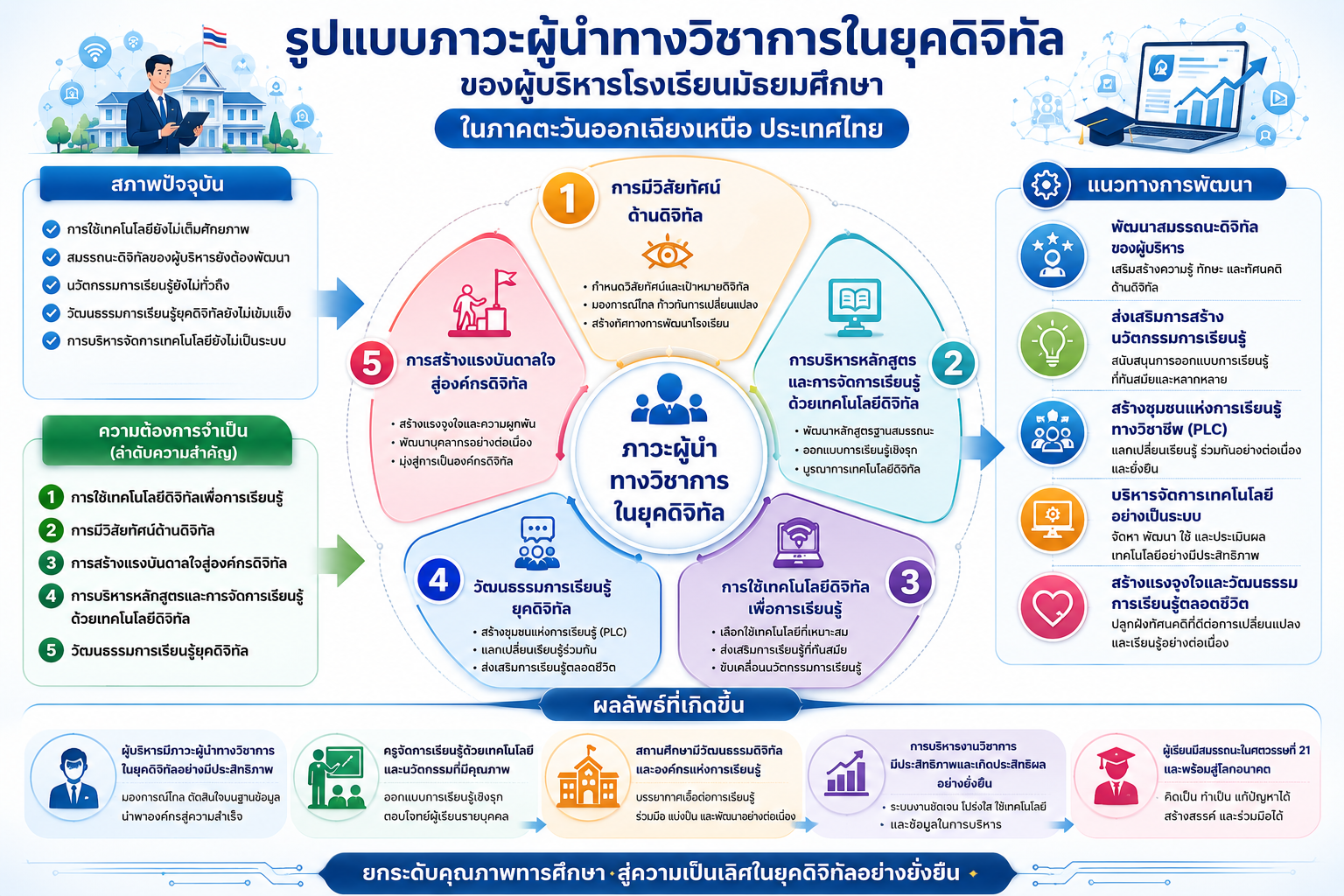
This research aimed to: 1) examine the components of digital-age instructional leadership of secondary school administrators; 2) investigate the current conditions, desirable conditions, and priority needs for the development of digital-age instructional leadership; and 3) develop a model for enhancing digital-age instructional leadership among secondary school administrators in Northeastern Thailand. The study employed a research and development approach using mixed methods. The population consisted of 1,866 school administrators and deputy directors for academic affairs from 285 secondary schools in Northeastern Thailand. The sample comprised 328 participants from 164 schools. Research instruments included a dual-response questionnaire, a semi-structured interview form, and in-depth interviews with experts for model validation. Data were analyzed using mean, standard deviation, the Priority Needs Index Modified (PNI Modified), and content analysis.
The findings revealed that:
1. The components of digital-age instructional leadership among secondary school administrators consisted of five dimensions: digital vision, curriculum and instructional management through digital technology, utilization of digital technology for learning, digital learning culture, and inspiration toward a digital organization.
2. The overall current condition was at a high level, while the overall desirable condition was at the highest level. The overall priority need for developing digital-age instructional leadership showed a PNI Modified value of 0.283. The highest priority need was the utilization of digital technology for learning, followed by digital vision and inspiration toward a digital organization.
3. The model for developing digital-age instructional leadership emphasized enhancing digital competencies, promoting learning innovation, establishing digital visions and goals, fostering professional learning communities, implementing systematic digital technology management, and cultivating motivation and a lifelong learning culture. These strategies contribute to strengthening the effectiveness and sustainability of instructional leadership in the digital era.
Article Details

This work is licensed under a Creative Commons Attribution-NonCommercial-NoDerivatives 4.0 International License.
เพื่อให้เป็นไปตามกฎหมายลิขสิทธิ์ ผู้นิพนธ์ทุกท่านต้องลงลายมือชื่อในแบบฟอร์มใบมอบลิขสิทธิ์บทความ ให้แก่วารสารฯ พร้อมกับบทความต้นฉบับที่ได้แก้ไขครั้งสุดท้าย นอกจากนี้ ผู้นิพนธ์ทุกท่านต้องยืนยันว่าบทความ ต้นฉบับที่ส่งมาตีพิมพ์นั้น ได้ส่งมาตีพิมพ์เฉพาะในวารสาร วิชาการธรรม ทรรศน์ เพียงแห่งเดียวเท่านั้น หากมีการใช้ ภาพหรือตารางของผู้นิพนธ์อื่นที่ปรากฏในสิ่งตีพิมพ์อื่นมาแล้ว ผู้นิพนธ์ต้องขออนุญาตเจ้าของลิขสิทธิ์ก่อน พร้อมทั้ง แสดงหนังสือที่ได้รับการยินยอมต่อบรรณาธิการ ก่อนที่บทความจะได้รับการตีพิมพ์References
กนกอร สมปราชญ์. (2562). ภาวะผู้นำกับคุณภาพการศึกษา. ขอนแก่น: มหาวิทยาลัยขอนแก่น.
กระแส ชนะวงศ์. (2564). 88 ปี ที่ฝันใฝ่ให้ความรักและความสุข. ขอนแก่น: เพ็ญพรินติ้ง.
กุหลาบ ปุริสาร. (2565). ภาวะผู้นำทางวิชาการของผู้บริหารในยุคดิจิทัล. วารสารวิทยาลัยบัณฑิตเอเซีย, 12(4), 174-185. https://so16.tci-thaijo.org/index.php/CS_J/article/view/276
จิณณวัตร ปะโคทัง. (2561). ภาวะผู้นำยุคดิจิทัล สำหรับผู้บริหารสถานศึกษามืออาชีพ. อุบลราชธานี: ศิริธรรมออฟเซ็ท.
จินดารัตน์ แย้มวงษ์. (2560). กลยุทธ์การพัฒนาภาวะผู้นำของผู้บริหารโรงเรียนมัธยมศึกษาตามแนวคิดการพัฒนานักเรียนให้มีภาวะผู้นำแบบโลกาภิวัตน์. (วิทยานิพนธ์ครุศาสตรดุษฎีบัณฑิต). กรุงเทพฯ: จุฬาลงกรณ์มหาวิทยาลัย.
ณิรดา เวชญาลักษณ์. (2560). ภาวะผู้นำทางการบริหาร. กรุงเทพฯ: แห่งจุฬาลงกรณ์มหาวิทยาลัย.
ประวิตร เอราวรรณ. (2565). การบริหารทรัพยากรมนุษย์ยุคดิจิทัล [เอกสารประกอบการบรรยาย]. กรุงเทพฯ: สำนักงานคณะกรรมการข้าราชการครูและบุคลากรทางการศึกษา (ก.ค.ศ.).
ภาวพรรณ ขำทับ และเนาวนิตย์ สงคราม. (2563). การพัฒนารูปแบบการเรียนรู้ด้วยเทคโนโลยีเสมือนจริงโดยใช้การฝึกหัดทางปัญญาจากต้นแบบเพื่อเสริมสร้างความสามารถด้านมิติสัมพันธ์ในการออกแบบบรรจุภัณฑ์สำหรับนักศึกษาปริญญาบัณฑิต. วารสารวิชาการครุศาสตร์อุตสาหกรรม พระจอมเกล้าพระนครเหนือ, 11(1), 21-22.
ศิริพงษ์ กลั่นไพฑูรย์. (2564). รูปแบบการพัฒนาภาวะผู้นำทางวิชาการในยุคดิจิทัลของผู้บริหารสถานศึกษาขั้นพื้นฐาน. (วิทยานิพนธ์การศึกษาดุษฎีบัณฑิต). พิษณุโลก: มหาวิทยาลัยนเรศวร.
สันติ แสนเป็ก และสถิรพร เชาวน์ชัย. (2565). การวิเคราะห์องค์ประกอบภาวะผู้นำทางวิชาการของผู้บริหารสถานศึกษาในยุคดิจิทัล สำนักงานเขตพื้นที่การศึกษาประถมศึกษาแพร่ เขต 2. วารสารบัณฑิตศึกษา มหาวิทยาลัยราชภัฏสกลนคร, 19(87), 115-126.
สุดา สุวรรณาภิรมย์. (2554). จิตวิทยาการศึกษา. กรุงเทพฯ: วิทยพัฒน์.
อัจฉรา นิยมาภา. (2561). ภาวะผู้นำทางวิชาการศักยภาพผู้บริหารยุคใหม่. กรุงเทพฯ: วิสต้า อินเตอร์ปริ้นท์.
Alig-Mielcarek, J. M., & Hoy, W. K. (2005). A theoretical and empirical analysis of the nature, meaning, and influence of instructional leadership. (Doctoral dissertation). Columbus, OH: The Ohio State University.
Allen, S. & Hartman, N. (2008). Leadership Development: An Exploration of Sources of Learning. Advanced Management Journal, 73(1), 10-62.
Bellibaş, M. Ş., Gümüş, S., & Kılınç, A. Ç. (2020). Principals supporting teacher leadership: The effects of learning‐centred leadership on teacher leadership practices with the mediating role of teacher agency. European journal of education, 55(2). 200-216.
Dweck, C. S. (2006). Mindset: The new psychology of success. New York: Random House.
Fry, L. W. (2003). Toward a theory of spiritual leadership. The Leadership Quarterly, 14(6), 693-727.
Hattie, J. (2012). Visible learning for teachers: Maximizing impact on learning. London: Routledge.
Zohar, D., & Marshall, I. (2000). SQ: Spiritual intelligence, the ultimate intelligence. London: Bloomsbury Publishing.
