Factors Influencing the Transition to Digital Government among Subdistrict and Village Leaders: A Systems Analysis
Article Sidebar
Main Article Content
Abstract
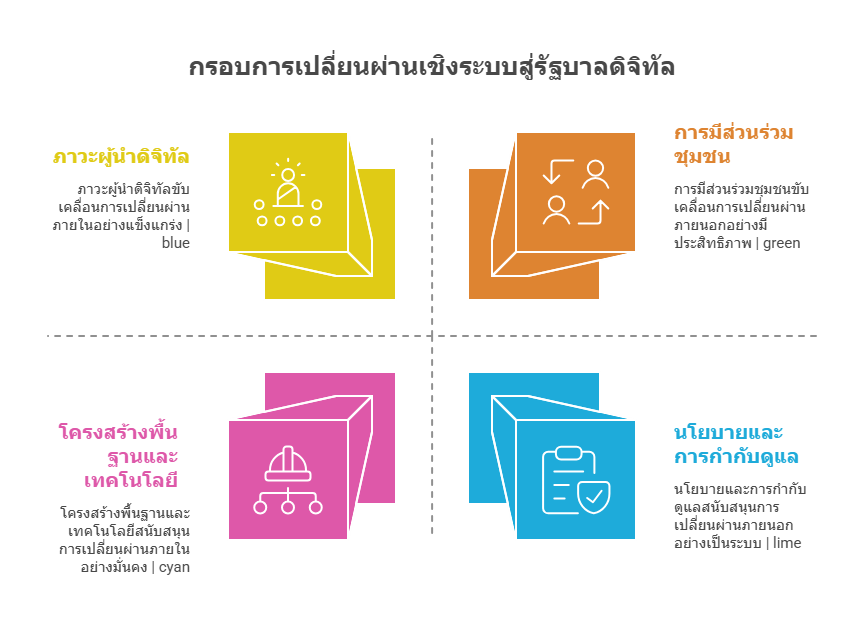
This academic article aims to explain the mechanisms of factors influencing the transition to digital government among village headmen and subdistrict headmen by employing a systemic analysis framework to understand the dynamic relationships among factors at the local leadership level. The study is based on a synthesis of digital government, systemic transition, and transformational leadership theories, demonstrating that the transition to digital government is neither a linear process nor driven solely by technological adoption, but rather represents a structural transformation resulting from interactions among multiple levels of influencing factors. The findings propose a systemic transition framework conceptualized as a dynamic ecosystem, in which successful digital government transition depends on the balance among four core systems: digital leadership; technological infrastructure and systems; social systems, organizational culture, and human resource competencies; and policy frameworks, governance mechanisms, and community participation. These systems are interconnected through continuous learning and improvement mechanisms. This newly developed body of knowledge advances the understanding of digital government transition at the local level and provides a systematic conceptual foundation for both policy formulation and practical implementation.
Article Details

This work is licensed under a Creative Commons Attribution-NonCommercial-NoDerivatives 4.0 International License.
เพื่อให้เป็นไปตามกฎหมายลิขสิทธิ์ ผู้นิพนธ์ทุกท่านต้องลงลายมือชื่อในแบบฟอร์มใบมอบลิขสิทธิ์บทความ ให้แก่วารสารฯ พร้อมกับบทความต้นฉบับที่ได้แก้ไขครั้งสุดท้าย นอกจากนี้ ผู้นิพนธ์ทุกท่านต้องยืนยันว่าบทความ ต้นฉบับที่ส่งมาตีพิมพ์นั้น ได้ส่งมาตีพิมพ์เฉพาะในวารสาร วิชาการธรรม ทรรศน์ เพียงแห่งเดียวเท่านั้น หากมีการใช้ ภาพหรือตารางของผู้นิพนธ์อื่นที่ปรากฏในสิ่งตีพิมพ์อื่นมาแล้ว ผู้นิพนธ์ต้องขออนุญาตเจ้าของลิขสิทธิ์ก่อน พร้อมทั้ง แสดงหนังสือที่ได้รับการยินยอมต่อบรรณาธิการ ก่อนที่บทความจะได้รับการตีพิมพ์References
ณรงค์ เพชรประเสริฐ. (2563). ภาวะผู้นำท้องถิ่นกับการพัฒนาชุมชนในยุคดิจิทัล. กรุงเทพฯ: จุฬาลงกรณ์มหาวิทยาลัย.
พรทิพย์ ศรีสุวรรณ. (2565). ปัจจัยที่ส่งผลต่อความสำเร็จของรัฐบาลดิจิทัลในระดับองค์กรปกครองส่วนท้องถิ่น. วารสารการบริหารรัฐกิจ, 14(2), 85-104.
สมชาย อินทร์แปลง. (2564). การประยุกต์ใช้เทคโนโลยีดิจิทัลในการบริหารงานหมู่บ้าน. วารสารการพัฒนาท้องถิ่น, 10(1), 45-62.
สำนักงานพัฒนารัฐบาลดิจิทัล (องค์การมหาชน). (2566). ยุทธศาสตร์รัฐบาลดิจิทัล พ.ศ. 2566-2570. กรุงเทพฯ: สำนักงานพัฒนารัฐบาลดิจิทัล (องค์การมหาชน).
Ansell, C., & Gash, A. (2008). Collaborative governance in theory and practice. Journal of Public Administration Research and Theory, 18(4), 543-571. https://doi.org/10.1093/jopart/mum032
Bass, B. M. (1985). Leadership and performance beyond expectations. New York, NY: Free Press.
Bass, B. M., & Riggio, R. E. (2006). Transformational leadership. (2nd ed.). Mahwah, NJ: Lawrence Erlbaum Associates.
Burns, J. M. (1978). Leadership. New York, NY: Harper & Row.
Davis, F. D. (1989). Perceived usefulness, perceived ease of use, and user acceptance of information technology. MIS Quarterly, 13(3), 319-340. https://doi.org/10.2307/249008
Dunleavy, P., Margetts, H., Bastow, S., & Tinkler, J. (2006). New public management is dead Long live digital-era governance. Journal of Public Administration Research and Theory, 16(3), 467-494. https://doi.org/10.1093/jopart/mui057
Fernandez, S., & Rainey, H. G. (2006). Managing successful organizational change in the public sector. Public Administration Review, 66(2), 168-176. https://doi.org/10.1111/j.1540-6210.2006.00570.x
Fountain, J. E. (2001). Building the virtual state: Information technology and institutional change. Washington, DC: Brookings Institution Press.
Geels, F. W. (2002). Technological transitions as evolutionary reconfiguration processes. Research Policy, 31(8-9), 1257-1274. https://doi.org/10.1016/S0048-7333(02)00062-8
Geels, F. W. (2011). The multi-level perspective on sustainability transitions. Environmental Innovation and Societal Transitions, 1(1), 24-40. https://doi.org/10.1016/j.eist.2011.02.002
Geels, F. W., & Schot, J. (2007). Typology of sociotechnical transition pathways. Research Policy, 36(3), 399-417. https://doi.org/10.1016/j.respol.2007.01.003
Heeks, R. (2006). Implementing and managing eGovernment. London: SAGE Publications.
Heeks, R. (2018). Information and communication technology for development (ICT4D). Routledge Handbook of Development Management. London, England: Routledge.
Helsper, E. J. (2021). The digital disconnect: The social causes and consequences of digital inequalities. London, England: Routledge.
Janssen, M., Charalabidis, Y., & Zuiderwijk, A. (2012). Benefits, adoption barriers and myths of open data and open government. Information Systems Management, 29(4), 258-268. https://doi.org/10.1080/10580530.2012.716740
Kattel, R., & Mergel, I. (2019). Estonia’s digital transformation. Public Administration Review, 79(5), 773-779. https://doi.org/10.1111/puar.13005
Kettunen, P., & Kallio, J. (2019). Digital transformation and leadership. International Journal of Information Management, 45, 128-139. https://doi.org/10.1016/j.ijinfomgt.2018.10.011
Layne, K., & Lee, J. (2001). Developing fully functional e-government. Government Information Quarterly, 18(2), 122-136. https://doi.org/10.1016/S0740-624X(01)00066-1
Meijer, A., & Bekkers, V. (2015). A metatheory of e-government. Government Information Quarterly, 32(3), 237-245. https://doi.org/10.1016/j.giq.2015.04.003
Meijer, A., & Bolívar, M. P. R. (2016). Governing the smart city. Information Polity, 21(1), 3-17. https://doi.org/10.3233/IP-150361
Mergel, I., Edelmann, N., & Haug, N. (2019). Defining digital transformation. Government Information Quarterly, 36(4), 101385. https://doi.org/10.1016/j.giq.2019.06.002
Nam, T. (2019). Does e-government raise effectiveness and efficiency? Government Information Quarterly, 36(4), 101408. https://doi.org/10.1016/j.giq.2019.101408
OECD. (2014). Recommendation of the Council on digital government strategies. Paris: OECD Publishing.
OECD. (2020). The digital government policy framework. Paris: OECD Publishing.
Osborne, S. P. (2010). The new public governance? London, England: Routledge.
Rotmans, J., Kemp, R., & van Asselt, M. (2001). More evolution than revolution: Transition management in public policy. Foresight, 3(1), 15-31. https://doi.org/10.1108/14636680110803003
United Nations. (2020). United Nations e-government survey 2020. New York, NY: United Nations.
Van Dijk, J. (2020). The digital divide. Cambridge: Polity Press.
Venkatesh, V., & Davis, F. D. (2000). A theoretical extension of the technology acceptance model. Management Science, 46(2), 186-204. https://doi.org/10.1287/mnsc.46.2.186.11926
Vial, G. (2019). Understanding digital transformation. Journal of Strategic Information Systems, 28(2), 118-144. https://doi.org/10.1016/j.jsis.2019.01.003
