ปัจจัยที่ส่งผลต่อการเปลี่ยนผ่านสู่รัฐบาลดิจิทัลของกำนันและผู้ใหญ่บ้าน: การวิเคราะห์เชิงระบบ
Article Sidebar
Main Article Content
บทคัดย่อ
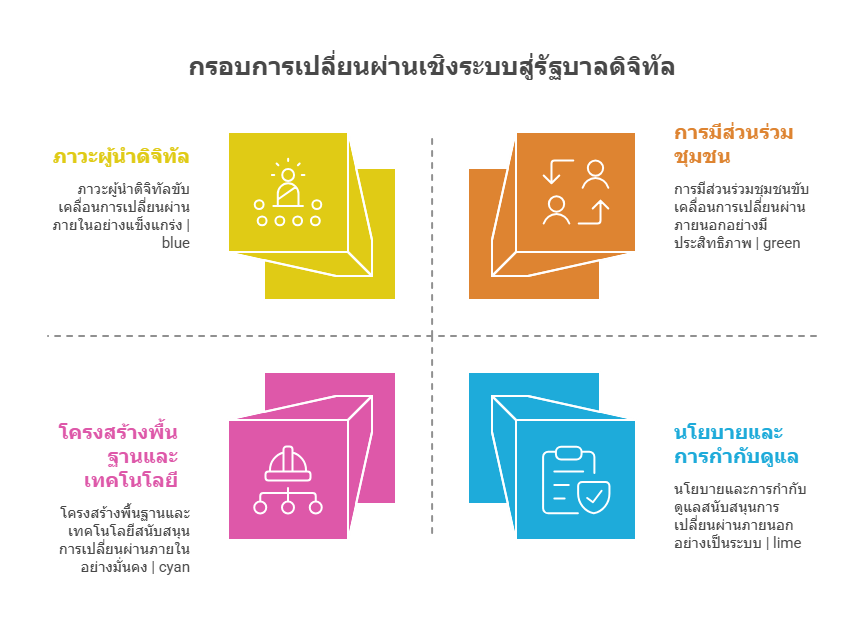
บทความวิชาการนี้ มีวัตถุประสงค์เพื่ออธิบายกลไกของปัจจัยที่ส่งผลต่อการเปลี่ยนผ่านสู่รัฐบาลดิจิทัลของกำนันและผู้ใหญ่บ้าน โดยใช้กรอบการวิเคราะห์เชิงระบบเป็นฐานในการทำความเข้าใจความสัมพันธ์เชิงพลวัตของปัจจัยในระดับผู้นำปกครองท้องที่ การศึกษาอาศัยการสังเคราะห์แนวคิดรัฐบาลดิจิทัล การเปลี่ยนผ่านเชิงระบบ และภาวะผู้นำการเปลี่ยนแปลง เพื่ออธิบายว่าการเปลี่ยนผ่านสู่รัฐบาลดิจิทัลมิใช่กระบวนการเชิงเส้นหรือการนำเทคโนโลยีมาใช้เพียงมิติเดียว หากแต่เป็นการเปลี่ยนแปลงเชิงโครงสร้างที่เกิดจากปฏิสัมพันธ์ของปัจจัยหลายระดับ ผลการศึกษาเสนอกรอบแนวคิดการเปลี่ยนผ่านเชิงระบบในลักษณะระบบนิเวศเชิงพลวัต ซึ่งความสำเร็จขึ้นอยู่กับความสมดุลของ 4 ระบบหลัก ได้แก่ ระบบภาวะผู้นำดิจิทัล ระบบโครงสร้างพื้นฐานและเทคโนโลยี ระบบสังคม วัฒนธรรมองค์กร และสมรรถนะบุคลากร และระบบนโยบาย การกำกับดูแล และการมีส่วนร่วมของชุมชน โดยทั้งสี่ระบบเชื่อมโยงกันผ่านกลไกการเรียนรู้และการปรับปรุงอย่างต่อเนื่อง องค์ความรู้ใหม่นี้ช่วยยกระดับการอธิบายการเปลี่ยนผ่านสู่รัฐบาลดิจิทัลในระดับพื้นที่ และสามารถใช้เป็นกรอบอ้างอิงเชิงนโยบายและเชิงปฏิบัติได้อย่างเป็นระบบ
Article Details

อนุญาตภายใต้เงื่อนไข Creative Commons Attribution-NonCommercial-NoDerivatives 4.0 International License.
เพื่อให้เป็นไปตามกฎหมายลิขสิทธิ์ ผู้นิพนธ์ทุกท่านต้องลงลายมือชื่อในแบบฟอร์มใบมอบลิขสิทธิ์บทความ ให้แก่วารสารฯ พร้อมกับบทความต้นฉบับที่ได้แก้ไขครั้งสุดท้าย นอกจากนี้ ผู้นิพนธ์ทุกท่านต้องยืนยันว่าบทความ ต้นฉบับที่ส่งมาตีพิมพ์นั้น ได้ส่งมาตีพิมพ์เฉพาะในวารสาร วิชาการธรรม ทรรศน์ เพียงแห่งเดียวเท่านั้น หากมีการใช้ ภาพหรือตารางของผู้นิพนธ์อื่นที่ปรากฏในสิ่งตีพิมพ์อื่นมาแล้ว ผู้นิพนธ์ต้องขออนุญาตเจ้าของลิขสิทธิ์ก่อน พร้อมทั้ง แสดงหนังสือที่ได้รับการยินยอมต่อบรรณาธิการ ก่อนที่บทความจะได้รับการตีพิมพ์เอกสารอ้างอิง
ณรงค์ เพชรประเสริฐ. (2563). ภาวะผู้นำท้องถิ่นกับการพัฒนาชุมชนในยุคดิจิทัล. กรุงเทพฯ: จุฬาลงกรณ์มหาวิทยาลัย.
พรทิพย์ ศรีสุวรรณ. (2565). ปัจจัยที่ส่งผลต่อความสำเร็จของรัฐบาลดิจิทัลในระดับองค์กรปกครองส่วนท้องถิ่น. วารสารการบริหารรัฐกิจ, 14(2), 85-104.
สมชาย อินทร์แปลง. (2564). การประยุกต์ใช้เทคโนโลยีดิจิทัลในการบริหารงานหมู่บ้าน. วารสารการพัฒนาท้องถิ่น, 10(1), 45-62.
สำนักงานพัฒนารัฐบาลดิจิทัล (องค์การมหาชน). (2566). ยุทธศาสตร์รัฐบาลดิจิทัล พ.ศ. 2566-2570. กรุงเทพฯ: สำนักงานพัฒนารัฐบาลดิจิทัล (องค์การมหาชน).
Ansell, C., & Gash, A. (2008). Collaborative governance in theory and practice. Journal of Public Administration Research and Theory, 18(4), 543-571. https://doi.org/10.1093/jopart/mum032
Bass, B. M. (1985). Leadership and performance beyond expectations. New York, NY: Free Press.
Bass, B. M., & Riggio, R. E. (2006). Transformational leadership. (2nd ed.). Mahwah, NJ: Lawrence Erlbaum Associates.
Burns, J. M. (1978). Leadership. New York, NY: Harper & Row.
Davis, F. D. (1989). Perceived usefulness, perceived ease of use, and user acceptance of information technology. MIS Quarterly, 13(3), 319-340. https://doi.org/10.2307/249008
Dunleavy, P., Margetts, H., Bastow, S., & Tinkler, J. (2006). New public management is dead Long live digital-era governance. Journal of Public Administration Research and Theory, 16(3), 467-494. https://doi.org/10.1093/jopart/mui057
Fernandez, S., & Rainey, H. G. (2006). Managing successful organizational change in the public sector. Public Administration Review, 66(2), 168-176. https://doi.org/10.1111/j.1540-6210.2006.00570.x
Fountain, J. E. (2001). Building the virtual state: Information technology and institutional change. Washington, DC: Brookings Institution Press.
Geels, F. W. (2002). Technological transitions as evolutionary reconfiguration processes. Research Policy, 31(8-9), 1257-1274. https://doi.org/10.1016/S0048-7333(02)00062-8
Geels, F. W. (2011). The multi-level perspective on sustainability transitions. Environmental Innovation and Societal Transitions, 1(1), 24-40. https://doi.org/10.1016/j.eist.2011.02.002
Geels, F. W., & Schot, J. (2007). Typology of sociotechnical transition pathways. Research Policy, 36(3), 399-417. https://doi.org/10.1016/j.respol.2007.01.003
Heeks, R. (2006). Implementing and managing eGovernment. London: SAGE Publications.
Heeks, R. (2018). Information and communication technology for development (ICT4D). Routledge Handbook of Development Management. London, England: Routledge.
Helsper, E. J. (2021). The digital disconnect: The social causes and consequences of digital inequalities. London, England: Routledge.
Janssen, M., Charalabidis, Y., & Zuiderwijk, A. (2012). Benefits, adoption barriers and myths of open data and open government. Information Systems Management, 29(4), 258-268. https://doi.org/10.1080/10580530.2012.716740
Kattel, R., & Mergel, I. (2019). Estonia’s digital transformation. Public Administration Review, 79(5), 773-779. https://doi.org/10.1111/puar.13005
Kettunen, P., & Kallio, J. (2019). Digital transformation and leadership. International Journal of Information Management, 45, 128-139. https://doi.org/10.1016/j.ijinfomgt.2018.10.011
Layne, K., & Lee, J. (2001). Developing fully functional e-government. Government Information Quarterly, 18(2), 122-136. https://doi.org/10.1016/S0740-624X(01)00066-1
Meijer, A., & Bekkers, V. (2015). A metatheory of e-government. Government Information Quarterly, 32(3), 237-245. https://doi.org/10.1016/j.giq.2015.04.003
Meijer, A., & Bolívar, M. P. R. (2016). Governing the smart city. Information Polity, 21(1), 3-17. https://doi.org/10.3233/IP-150361
Mergel, I., Edelmann, N., & Haug, N. (2019). Defining digital transformation. Government Information Quarterly, 36(4), 101385. https://doi.org/10.1016/j.giq.2019.06.002
Nam, T. (2019). Does e-government raise effectiveness and efficiency? Government Information Quarterly, 36(4), 101408. https://doi.org/10.1016/j.giq.2019.101408
OECD. (2014). Recommendation of the Council on digital government strategies. Paris: OECD Publishing.
OECD. (2020). The digital government policy framework. Paris: OECD Publishing.
Osborne, S. P. (2010). The new public governance? London, England: Routledge.
Rotmans, J., Kemp, R., & van Asselt, M. (2001). More evolution than revolution: Transition management in public policy. Foresight, 3(1), 15-31. https://doi.org/10.1108/14636680110803003
United Nations. (2020). United Nations e-government survey 2020. New York, NY: United Nations.
Van Dijk, J. (2020). The digital divide. Cambridge: Polity Press.
Venkatesh, V., & Davis, F. D. (2000). A theoretical extension of the technology acceptance model. Management Science, 46(2), 186-204. https://doi.org/10.1287/mnsc.46.2.186.11926
Vial, G. (2019). Understanding digital transformation. Journal of Strategic Information Systems, 28(2), 118-144. https://doi.org/10.1016/j.jsis.2019.01.003
