Effects of Participatory Design Planning in Public Service Delivery on Students’ Skills in the Innovation in Public Governance and Administration Course, Master of Public Administration Program, A Private University
Article Sidebar
Main Article Content
Abstract
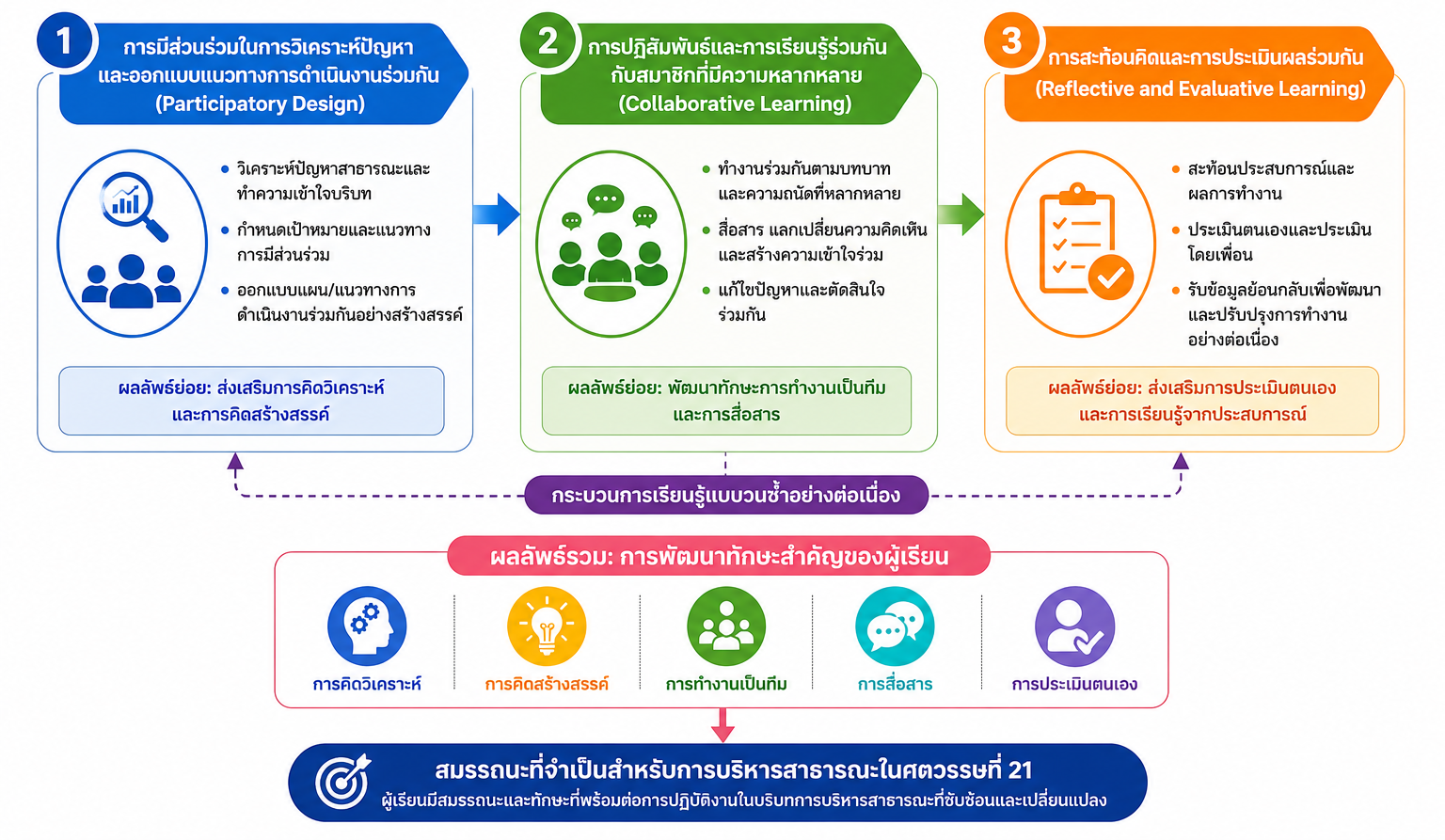
This research aimed to: 1) examine students’ analytical thinking and creative thinking skills before and after the implementation of a public service participation plan; 2) evaluate the effects of the public service participation plan on the development of students’ teamwork and communication skills; and 3) investigate recommendations regarding the design and implementation of the public service participation plan. A mixed-methods research design was employed. For the quantitative phase, data were collected from 80 Master of Public Administration students enrolled in the Public Governance and Administration course during the 2024 academic year. A questionnaire was used as the research instrument. Data were analyzed using mean, standard deviation, and paired-samples t-test. For the qualitative phase, data were collected from 30 key informants through observation and in-depth interviews and were analyzed using content analysis.
The findings revealed that: after participating in activities based on the public service participation plan, students demonstrated significantly higher levels of analytical thinking and creative thinking skills than before participation at the .05 level of statistical significance. The mean score for analytical thinking increased from 3.061 to 4.441 (t = -15.660), while the mean score for creative thinking increased from 2.672 to 4.813 (t = -17.315). In addition, students showed improvement in teamwork and communication skills. They were better able to exchange ideas, collaborate with others, and communicate more effectively. Furthermore, participants provided recommendations for improving the design and implementation of the participation plan to enhance learning effectiveness. The study concludes that the public service participation plan is an effective learning tool for promoting students’ thinking skills, collaborative skills, and self-directed learning. The findings are consistent with Buddhist principles emphasizing mutual support in collaborative work and rational thinking, which can be appropriately applied to the development of learning processes in the field of public administration.
Article Details

This work is licensed under a Creative Commons Attribution-NonCommercial-NoDerivatives 4.0 International License.
เพื่อให้เป็นไปตามกฎหมายลิขสิทธิ์ ผู้นิพนธ์ทุกท่านต้องลงลายมือชื่อในแบบฟอร์มใบมอบลิขสิทธิ์บทความ ให้แก่วารสารฯ พร้อมกับบทความต้นฉบับที่ได้แก้ไขครั้งสุดท้าย นอกจากนี้ ผู้นิพนธ์ทุกท่านต้องยืนยันว่าบทความ ต้นฉบับที่ส่งมาตีพิมพ์นั้น ได้ส่งมาตีพิมพ์เฉพาะในวารสาร วิชาการธรรม ทรรศน์ เพียงแห่งเดียวเท่านั้น หากมีการใช้ ภาพหรือตารางของผู้นิพนธ์อื่นที่ปรากฏในสิ่งตีพิมพ์อื่นมาแล้ว ผู้นิพนธ์ต้องขออนุญาตเจ้าของลิขสิทธิ์ก่อน พร้อมทั้ง แสดงหนังสือที่ได้รับการยินยอมต่อบรรณาธิการ ก่อนที่บทความจะได้รับการตีพิมพ์References
มยุรา ลีหัวสระ, สพล ณภัทรศรี แสนยงค์ และเชษฐ์ ศิริสวัสดิ์. (2556). ผลการจัดกิจกรรมการเรียนรู้วิชาวิทยาศาสตร์ตามทฤษฎีการเรียนรู้เพื่อสร้างสรรค์ด้วยปัญญาเพื่อพัฒนาทักษะกระบวนการวิทยาศาสตร์ขั้นพื้นฐานทักษะการคิดวิเคราะห์และ ผลสัมฤทธิ์ของนักเรียนชั้นประถมศึกษาปีที่ 6. วารสารการศึกษาและการพัฒนาสังคม มหาวิทยาลัยบูรพา, 9(2), 127-138.
ฤทัย สมบัติเจริญไทย, พาที เกศธนากร และณรงค์ พันธุ์คง. (2567). ผลการจัดกิจกรรมการเรียนรู้สาระเทคโนโลยี ด้วยการจัดการเรียนรู้กระบวนการคิดเชิงคำนวณร่วมกับกระบวนการกลุ่มเทคนิค TAI เพื่อส่งเสริมความรู้เกี่ยวกับทักษะการคิดเชิงระบบและทักษะการคิดเชิงสร้างสรรค์ของนักเรียนชั้นประถมศึกษสปีที่ 4. วารสาร มจร. กาญจนปริทรรศน์, 4(2), 211-225.
สถาพร จะนุ, อนิรุทธ์ สติมั่น, ฐาปนีย์ ธรรมเมธา และศิวนิต อรรถวุฒิกุล. (2565). การพัฒนารูปแบบการเรียนออนไลน์แบบสร้างความสัมพันธ์ตามแนวคิดเกมมิฟิเคชันเพื่อเสริมสร้างแรงจูงใจใฝ่สัมฤทธิ์และทักษะการทำงานเป็นทีมในการเขียนโปรแกรมของนักศึกษาระดับปริญญาตรี มหาวิทยาลัยราชภัฏ. วารสารมหาวิทยาลัยราชภัฏยะลา, 17(3), 99-108.
สรรชัย ชูชีพ. (2564). การใช้สถานการณ์จำลองเพื่อพัฒนาทักษะด้านการทำงานเป็นทีมของนักศึกษาครู มหาวิทยาลัยราชภัฏเทพสตรี: การใช้สถานการณ์จำลองเพื่อพัฒนาทักษ ด้านการทำงานเป็นทีมของนักศึกษาครู มหาวิทยาลัยราชภัฏเทพสตรี. วารสารลวะศรี, 5(1), 109-116.
Arnstein, S. R. (1969). A Ladder of Citizen Participation. Journal of the American Institute of Planners, 35(4), 216-224. https://doi.org/10.1080/01944366908977225
Beard, C., & Wilson, J. P. (2013). Experiential learning: A handbook for education, training and coaching. London: Kogan Page Publishers.
Bryson, J. M., Crosby, B. C., & Bloomberg, L. (2014). Public Value Governance: Moving Beyond Traditional Public Administration and the New Public Management. Public Administration Review, 74(4), 445-456. https://doi.org/10.1111/puar.12238
Creswell, J. W., & Plano Clark, V. L. (2018). Designing and Conducting Mixed Methods Research. (3rd ed.). Thousand Oaks, CA: SAGE.
Cronbach, L. J. (1951). Coefficient alpha and the internal structure of tests. Psychometrika, 16, 297-334. https://doi.org/10.1007/BF02310555
Innes, J. E., & Booher, D. E. (2004). Reframing Public Participation: Strategies for the 21st Century. Planning Theory & Practice, 5(4), 419-436. https://doi.org/10.1080/1464935042000293170
Kolb, D. A. (1984). Experiential learning: Experience as the source of learning and development. New Jersey: Prentice-Hall.
Moon, J. A. (2004). A handbook of reflective and experiential learning: Theory and practice. London: Routledge.
Nabatchi, T. (2012). A Manager’s Guide to Evaluating Citizen Participation. Washington, DC: IBM Center for the Business of Government.
Nunnally, J. C., & Bernstein, I. H. (1994). Psychometric Theory. (3rd ed.). New York: McGraw-Hill.
Organisation for Economic Co-operation and Development. (2023). OECD Skills Outlook 2023: Skills for a Resilient Green and Digital Transition. Paris: OECD Publishing.
Office of the National Economic and Social Development Council. (2023). The Thirteenth National Economic and Social Development Plan (2023-2027). Bangkok: Office of the Prime Minister.
Osborne, S. P. (2010). The New Public Governance? Emerging Perspectives on the Theory and Practice of Public Governance. London: Routledge.
Panadero, E., Broadbent, J., Boud, D., & Lodge, J. M. (2019). Using formative assessment to influence self- and co-regulated learning: The role of evaluative judgement. European Journal of Psychology of Education, 34(3), 535-557. https://doi.org/10.1007/s10212-018-0407-8
