Factors Influencing Money Mule Account Opening: A Qualitative Documentary Analysis through Deterrence Theory and General Strain Theory Frameworks
Article Sidebar
Main Article Content
Abstract
This research was motivated by the concern that, despite the enactment of the Emergency Decree on Measures for the Prevention and Suppression of Technology Crime B.E. 2566 (2023), as amended by B.E. 2568 (2025), which imposes criminal penalties on individuals who open or permit others to use mule accounts, such offenses continue to occur. This situation reflects limitations in the effectiveness of legal enforcement. The objectives of this study were: (1) to examine the factors influencing money mule account opening at both the individual and structural levels; (2) to investigate legal issues relating to money mule accounts under the Civil and Commercial Code, the Penal Code, and the Emergency Decree on Measures for the Prevention and Suppression of Technology Crime B.E. 2566 (2023) and B.E. 2568 (2025); (3) to analyze the factors influencing money mule account opening in conjunction with the aforementioned legal issues; and (4) to propose appropriate measures for addressing the problem of money mule accounts. This study employed a qualitative documentary research methodology. Data were collected through a systematic review of relevant literature, statutory provisions, Supreme Court decisions, and criminal case statistics obtained from law enforcement agencies. The analysis was conducted within the theoretical frameworks of the Perceptual Deterrence Framework developed by Paternoster and Bachman and Agnew’s General Strain Theory.
The findings revealed that:
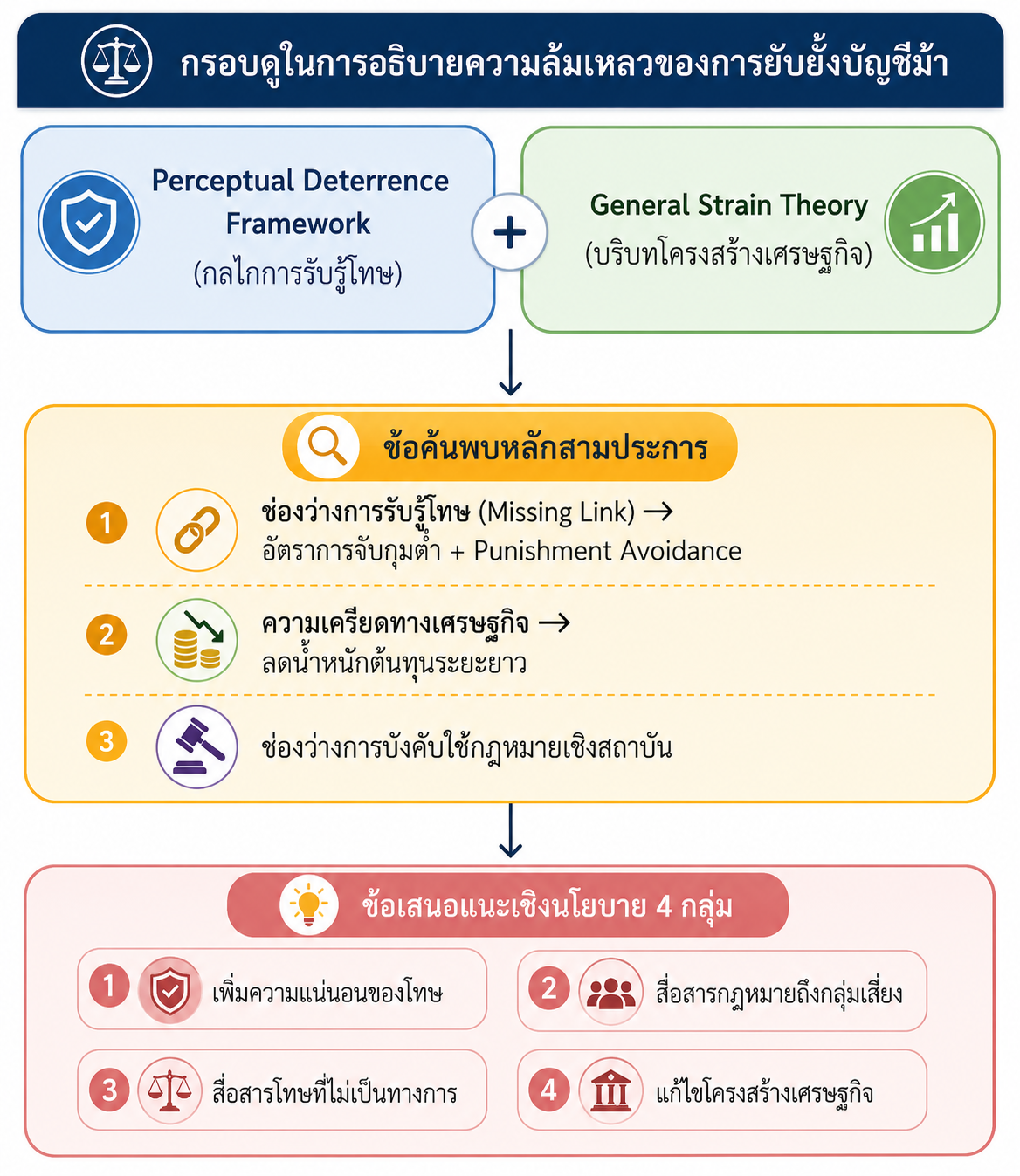
1. The gap between statutory penalties and offenders’ perceptions constitutes the primary mechanism explaining the failure of deterrence, as low arrest rates and punishment avoidance reduce the perceived certainty of punishment below the level required to produce a deterrent effect.
2. Economic vulnerability and limited opportunities diminish the perceived weight of long-term legal costs, while financial pressure encourages vulnerable individuals to accept legal risks in exchange for short-term economic benefits.
3. Institutional deficiencies in law enforcement remain a significant obstacle to legal effectiveness, indicating the need for real-time information-sharing systems between financial institutions and law enforcement agencies, expanded account-freezing measures, and increased investigative resources.
4. Section 9 of the Emergency Decree should be amended to incorporate a statutory definition of “money mule account” and to establish graduated penalties based on the offender’s level of intent and transaction value, alongside measures aimed at enhancing the certainty of law enforcement.
Article Details

This work is licensed under a Creative Commons Attribution-NonCommercial-NoDerivatives 4.0 International License.
เพื่อให้เป็นไปตามกฎหมายลิขสิทธิ์ ผู้นิพนธ์ทุกท่านต้องลงลายมือชื่อในแบบฟอร์มใบมอบลิขสิทธิ์บทความ ให้แก่วารสารฯ พร้อมกับบทความต้นฉบับที่ได้แก้ไขครั้งสุดท้าย นอกจากนี้ ผู้นิพนธ์ทุกท่านต้องยืนยันว่าบทความ ต้นฉบับที่ส่งมาตีพิมพ์นั้น ได้ส่งมาตีพิมพ์เฉพาะในวารสาร วิชาการธรรม ทรรศน์ เพียงแห่งเดียวเท่านั้น หากมีการใช้ ภาพหรือตารางของผู้นิพนธ์อื่นที่ปรากฏในสิ่งตีพิมพ์อื่นมาแล้ว ผู้นิพนธ์ต้องขออนุญาตเจ้าของลิขสิทธิ์ก่อน พร้อมทั้ง แสดงหนังสือที่ได้รับการยินยอมต่อบรรณาธิการ ก่อนที่บทความจะได้รับการตีพิมพ์References
กรมประชาสัมพันธ์. (2566). ศูนย์ปฏิบัติการต่อต้านอาชญากรรมออนไลน์ (1441) เปิดให้บริการประชาชน 1 พฤศจิกายนนี้. เข้าถึงได้จาก https://www.prd.go.th/th/content/category/detail/id/9/iid/227171
ช่อลัดดา ควรประเสริฐ และอัคคกร ไชยพงษ์. (2568). การคุ้มครองผู้เสียหายจาก การถูกฉ้อโกงให้โอนเงินเข้าบัญชีม้า: ศึกษาเปรียบเทียบกฎหมายไทย อังกฤษ และญี่ปุ่น. วารสารกฎหมายและสังคมท้องถิ่น, 9(2), 1-40.
ธนาคารแห่งประเทศไทย. (2569). วิวัฒนาการการจัดการและป้องกันภัยทุจริตทางการเงินของธปท. เข้าถึงได้จาก https://www.bot.or.th/th/fraud/fraud-measure-development.html
นิรัฐกานต์ บุญรอด และวิวรรธน์ ดำรงค์กุลนันท์. (2568). การบัญญัติ ความรับผิดทางอาญาเพื่อป้องกันความเสียหาย: ศึกษากรณีความเหมาะสมของการบัญญัติความรับผิดทางอาญาเกี่ยวกับบัญชีม้า. วารสารนิติศาสตร์ มหาวิทยาลัยแม่ฟ้าหลวง, 8(1), 85-119.
พระราชกำหนดมาตรการป้องกันและปราบปรามอาชญากรรมทางเทคโนโลยี (ฉบับที่ 2) พ.ศ. 2568. (2568). ราชกิจจานุเบกษา. เล่ม 142 ตอนที่ 27 ก, หน้า 1-20.
พระราชกำหนดมาตรการป้องกันและปราบปรามอาชญากรรมทางเทคโนโลยี พ.ศ. 2566. (2566). ราชกิจจานุเบกษา. เล่ม 140 ตอนที่ 18 ก, หน้า 1-16.
มนัสนันท์ ปิ่นพิทักษ์. (2566). บัญชีม้า: ปัญหาและแนวทางแก้ไขทางกฎหมาย. วารสารมหาวิทยาลัยราชภัฏเพชรบูรณ์, 10(2), 45-62.
ศีรวิษ สุขชัย และปริญญา ศรีเกตุ. (2567). การอายัดบัญชีและความรับผิดของผู้ใช้ บัญชีม้าตามกฎหมายไทย: ปัญหาและแนวทางแก้ไขเชิงเปรียบเทียบ. วารสารนวัตกรรมการศึกษาและการวิจัย, 8(4), 1-25.
Agnew, R. (1992). Foundation for a general strain theory of crime and delinquency. Criminology, 30(1), 47-87. https://doi.org/10.1111/j.1745-9125.1992.tb01093.x
Akers, R. L. (1973). Deviant behavior: A social learning approach. Belmont, CA: Wadsworth Publishing Company.
Apel, R., & Paternoster, R. (2009). Understanding "criminogenic" corporate culture. In S. Simpson & D. Weisburd (Eds.), The criminology of white-collar crime (pp. 15-33). New York, NY: Springer.
Beccaria, C. (1986). On crimes and punishments (D. Young, Trans.). Indianapolis, IN: Hackett Publishing Company. (Original work published 1764).
Becker, G. S. (1968). Crime and punishment: An economic approach. Journal of Political Economy, 76(2), 169-217. https://doi.org/10.1086/259394
Bekkers, L., Leukfeldt, R., & Stol, W. (2024). Recruiting money mules: An experimental study on social media advertising. Journal of Experimental Criminology. https://doi.org/10.1007/s11292-024-09596-0
Bekkers, L., Leukfeldt, R., Stol, W., & Verhoeven, M. (2025). The prevalence of money mule recruitment among Dutch youth. European Journal of Criminology, 22(1), 1-22. https://doi.org/10.1177/14773708241238765
Bentham, J. (1907). An introduction to the principles of morals and legislation. Oxford: Clarendon Press. (Original work published 1789).
Cornish, D. B., & Clarke, R. V. (1986). The reasoning criminal: Rational choice perspectives on offending. New York, NY: Springer-Verlag.
Fink, A. (2019). Conducting research literature reviews: From the internet to paper. (5th ed.). Thousand Oaks, CA: SAGE Publications.
Hovav, A., & D'Arcy, J. (2012). Applying an extended model of deterrence across cultures. Information & Management, 49(2), 99-110. https://doi.org/10.1016/j.im.2011.12.005
Kleck, G., Sever, B., Li, S., & Gertz, M. (2005). The missing link in general deterrence research. Criminology, 43(3), 623-660. https://doi.org/10.1111/ j.0011-1348.2005.00019.x
Nagin, D. S. (2013). Deterrence in the twenty-first century. Crime and Justice, 42(1), 199-263. https://doi.org/10.1086/670398
Nagin, D. S., & Pogarsky, G. (2001). Integrating celerity, impulsivity, and extralegal sanction threats into a model of general deterrence. Criminology, 39(4), 865-892.
Paternoster, R. (1987). The deterrent effect of the perceived certainty and severity of punishment. Justice Quarterly, 4(2), 173-217.
Paternoster, R. (2010). How much do we really know about criminal deterrence? Journal of Criminal Law and Criminology, 100(3), 765-824.
Paternoster, R., & Bachman, R. (2012). Perceptual deterrence theory. In F. Cullen & P. Wilcox (Eds.), The Oxford handbook of criminological theory (pp. 649-671). New York, NY: Oxford University Press.
Pogarsky, G. (2002). Identifying deterrable offenders. Justice Quarterly, 19(3), 431-452.
Pogarsky, G., & Piquero, A. R. (2003). Can punishment encourage offending? Investigating the "resetting" effect. Journal of Research in Crime and Delinquency, 40(1), 92-117.
Pound, R. (1910). Law in books and law in action. American Law Review, 44(1), 12-36.
Pratt, T. C., & Cullen, F. T. (2006). The empirical status of deterrence theory: A meta-analysis. In F. Cullen, J. Wright, & K. Blevins (Eds.), Taking stock: The status of criminological theory (pp. 367-395). New Brunswick, NJ: Transaction Publishers.
Rani, M., Chen, I. A., Keng, T. C., & Tanveer, M. (2024). Money mule in financial crimes: A systematic literature review. Journal of Financial Crime. https://doi.org/10.1108/JFC-09-2023-0252
Raskolnikov, A. (2020). Deterrence theory in law. Supreme Court Economic Review, 27(1), 167-201.
Stafford, M. C., & Warr, M. (1993). A reconceptualization of general and specific deterrence. Journal of Research in Crime and Delinquency, 30(2), 123-135.
Weisburd, D., Waring, E., & Chayet, E. (1995). Specific deterrence in a sample of offenders convicted of white-collar crimes. Criminology, 33(4), 587-607.
