Servant Leadership of School Administrators, Organizational Support and Teachers’ Creative Self-Efficacy Affecting Innovative Work Behavior of Teachers under the Rayong Primary Educational Service Area Office 1
Article Sidebar
Main Article Content
Abstract
This research aimed to: 1) examine the levels of servant leadership of school administrators, organizational support, teachers’ creative self-efficacy, and innovative work behavior; 2) investigate the relationships among these variables; and 3) identify the predictive factors influencing teachers’ innovative work behavior under the Rayong Primary Educational Service Area Office 1. The predictor variables included servant leadership of school administrators, organizational support, and teachers’ creative self-efficacy. This study employed a quantitative research design. The sample consisted of teachers working in schools under the Rayong Primary Educational Service Area Office 1 during the 2025 academic year. The research instrument was a five-point rating scale questionnaire with item-objective congruence (IOC) indices ranging from 0.60 to 1.00 and an overall Cronbach’s alpha coefficient of 0.980. The data were analyzed using frequency, percentage, mean, standard deviation, Pearson’s product-moment correlation coefficient, and stepwise multiple regression analysis.
The findings revealed that:
1. Servant leadership of school administrators, organizational support, teachers’ creative self-efficacy, and teachers’ innovative work behavior were overall at a high level.
2. All variables were positively correlated at a high level, with statistical significance at the .01 level (r = 0.741–0.784).
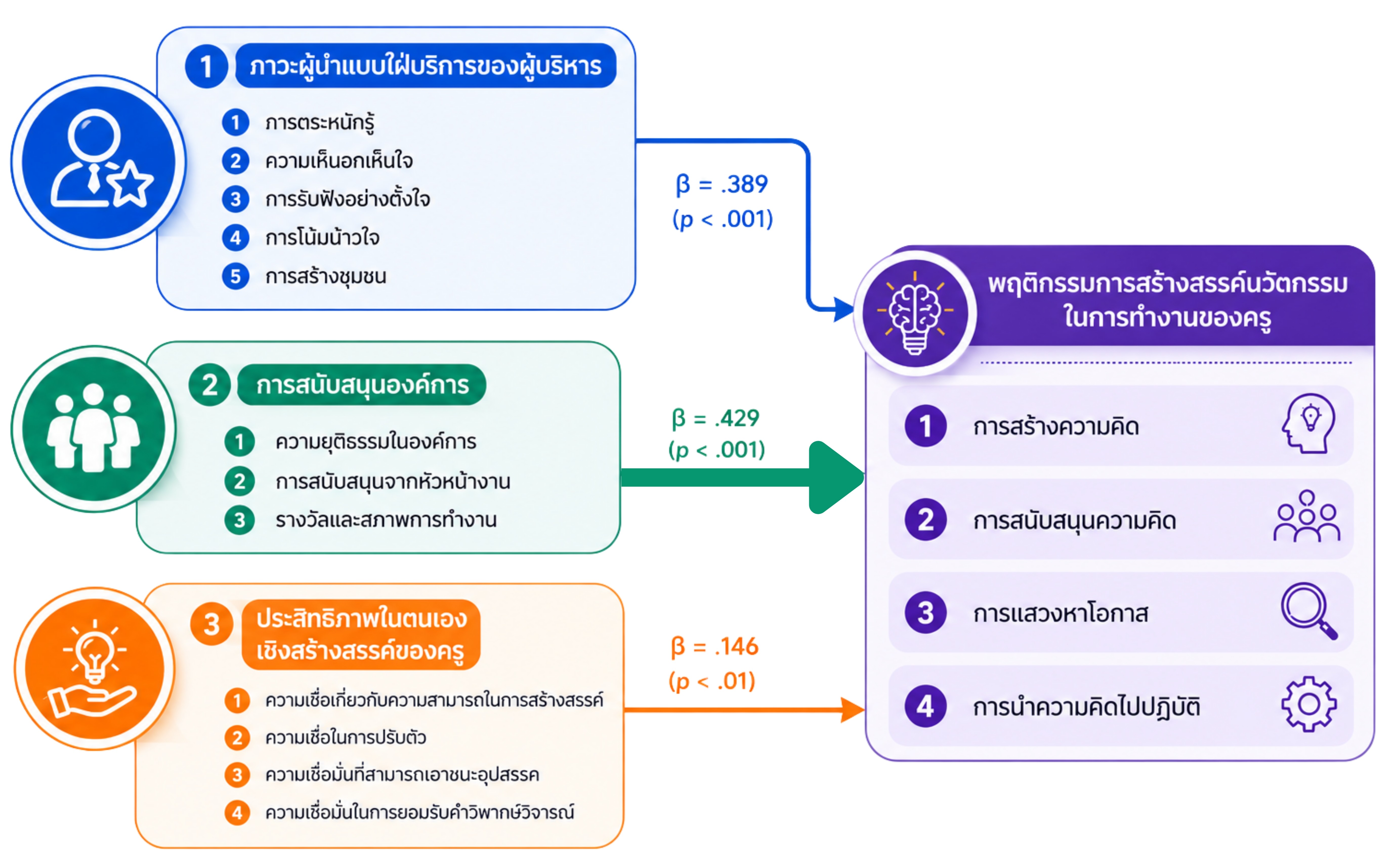
3. Servant leadership of school administrators, organizational support, and teachers’ creative self-efficacy jointly predicted teachers’ innovative work behavior at 74.90 percent, with statistical significance at the .001 level. The findings suggest that school administrators should promote servant leadership alongside strengthening organizational support systems and enhancing teachers’ creative self-efficacy in order to foster innovative work behavior in educational settings more effectively.
Article Details

This work is licensed under a Creative Commons Attribution-NonCommercial-NoDerivatives 4.0 International License.
เพื่อให้เป็นไปตามกฎหมายลิขสิทธิ์ ผู้นิพนธ์ทุกท่านต้องลงลายมือชื่อในแบบฟอร์มใบมอบลิขสิทธิ์บทความ ให้แก่วารสารฯ พร้อมกับบทความต้นฉบับที่ได้แก้ไขครั้งสุดท้าย นอกจากนี้ ผู้นิพนธ์ทุกท่านต้องยืนยันว่าบทความ ต้นฉบับที่ส่งมาตีพิมพ์นั้น ได้ส่งมาตีพิมพ์เฉพาะในวารสาร วิชาการธรรม ทรรศน์ เพียงแห่งเดียวเท่านั้น หากมีการใช้ ภาพหรือตารางของผู้นิพนธ์อื่นที่ปรากฏในสิ่งตีพิมพ์อื่นมาแล้ว ผู้นิพนธ์ต้องขออนุญาตเจ้าของลิขสิทธิ์ก่อน พร้อมทั้ง แสดงหนังสือที่ได้รับการยินยอมต่อบรรณาธิการ ก่อนที่บทความจะได้รับการตีพิมพ์References
กวินวัชญ์ ชิงชัย, วัลนิกา ฉลากบาง และพรเทพ เสถียรนพเก้า. (2567). องค์ประกอบภาวะผู้นำแบบใฝ่บริการของผู้บริหารโรงเรียน สังกัดสำนักงานคณะกรรมการการศึกษาขั้นพื้นฐาน. วารสารนวัตกรรมการศึกษาและการวิจัย, 8(1), 174-188.
เกษสุดา บูรณศักดิ์สถิตย์. (2562). พฤติกรรมสร้างสรรค์นวัตกรรมของพนักงานสายสนับสนุนวิชาการมหาวิทยาลัยราชภัฏกลุ่มรัตนโกสินทร์. (วิทยานิพนธ์บริหารธุรกิจมหาบัณฑิต). กรุุงเทพฯ: มหาวิทยาลัยศิลปากร.
เกียรติศักดิ์ ศุภรัตน์ และกล้าหาญ ณ น่าน. (2566). สภาพแวดล้อมในการทำงานที่ส่งผลต่อพฤติกรรมการสร้างนวัตกรรม ในการทำงานของข้าราชการครูประถมศึกษา. Strategic Perspectives on Business and Marketing Management, 10(1), 20-35. https://so05.tci-thaijo.org/index.php/mmr/article/view/262691
ชลัดดา บุญมาก. (2565). การศึกษาพฤติกรรมสร้างสรรค์นวัตกรรมและแนวทางการส่งเสริมพฤติกรรมสร้างสรรค์นวัตกรรมของครูโรงเรียน สังกัดสำนักงานเขตพื้นที่การศึกษาประถมศึกษานครสวรรค์ เขต 3. (การค้นคว้าอิสระการศึกษามหาบัณฑิต). พิษณุโลก: มหาวิทยาลัยนเรศวร.
ณัฎฐา ปัทมานุสรณ์. (2565). ภาวะผู้นำแบบใฝ่บริการของผู้บริหารสถานศึกษาที่ส่งผลต่อแรงจูงใจในการทำงานของครูสังกัดสำนักงานเขตพื้นที่การศึกษามัธยมศึกษา เขต 2. ศึกษาศาสตร์ มมร, 10(2), 9-24. https://so04.tci-thaijo.org/index.php/edj/article/view/258082
นริศ บุญญานุพงศ์. (2565). การรับรู้การสนับสนุนจากองค์การและแรงจูงใจภายในที่พยากรณ์ประสิทธิภาพการสอนของครูในโรงเรียนสังกัดสำนักงานเขตพื้นที่การศึกษาประถมศึกษานครศรีธรรมราช เขต 4. (วิทยานิพนธ์ศิลปศาสตรมหาบัณฑิต). กรุุงเทพฯ: มหาวิทยาลัยเทคโนโลยีพระจอมเกล้าพระนครเหนือ.
วรนารี ใจงาม. (2566). ความยืดหยุ่นทางจิตใจในฐานะตัวแปรคั่นกลางที่มีอิทธิพลระหว่างการรับรู้การสนับสนุนจากองค์การและพฤติกรรมการสร้างนวัตกรรมในการทำงานของบุคลากรสายสนับสนุน มหาวิทยาลัยเทคโนโลยีราชมงคล เขตจังหวัดภาคกลาง. (วิทยานิพนธ์บริหารธุรกิจมหาบัณฑิต). ปทุมธานี: มหาวิทยาลัยเทคโนโลยีราชมงคลธัญบุรี.
ศิริพร หนานแก้ว. (2567). การศึกษาภาวะผู้นำใฝ่บริการ และแนวทางการพัฒนาภาวะผู้นำผู้บริหารสถานศึกษากลุ่ม 5 สำนักบริหารงานการศึกษาพิเศษ. (การค้นคว้าอิสระการศึกษามหาบัณฑิต). พิษณุโลก: มหาวิทยาลัยนเรศวร.
สำนักงานเลขานุการของคณะกรรมการยุทธศาสตร์ชาติ. (2561). ยุทธศาสตร์ชาติ พ.ศ. 2561-2580. กรุงเทพฯ: สำนักงานคณะกรรมการพัฒนาการเศรษฐกิจและสังคมแห่งชาติ.
สำนักงานเขตพื้นที่การศึกษาประถมศึกษาระยอง เขต 1. (2568). แผนพัฒนาการศึกษาขั้นพื้นฐาน พ.ศ. 2566-2570 (ฉบับปรับปรุง พ.ศ. 2568). ระยอง: สำนักงานเขตพื้นที่การศึกษาประถมศึกษาระยอง เขต 1.
สิรภพ สมอุดร และสุชาดา นันทะไชย. (2562). ปัจจัยที่ส่งผลต่อพฤติกรรมนวัตกรรมของครูโรงเรียนมัธยมศึกษา สังกัดสำนักงานเขตพื้นที่การศึกษามัธยมศึกษา เขต 3 จังหวัดนนทบุรี. Journal of Education Studies, Chulalongkorn University, 47(Suppl. 1), 391-406. https://so02.tci-thaijo.org/index.php/EDUCU/article/view/198851
สุทธิพงศ์ เสมสูงเนิน. (2567). ความสัมพันธ์ระหว่างภาวะผู้นำแบบใฝ่บริการของผู้อำนวยการสถานศึกษา กับแรงจูงใจในการปฏิบัติหน้าที่ของครู สังกัดสำนักงานเขตพื้นที่การศึกษามัธยมศึกษาปทุมธานี. วารสารการบริหารและนิเทศการศึกษา, 15(3), 49-66.
Balkar, B. (2015). The relationships between organizational climate, innovative behavior and job performance of teachers. International Online Journal of Educational Sciences, 7(2), 81-92.
Chen, Y. (2024). Teacher autonomy, creative self-efficacy, and innovative behavior: Perspectives from Chinese university EFL teachers. Arab World English Journal, 15(2), 73-86.
Endarwati, I. S., & Riani, A. L. (2022). The effect of inclusive leadership on innovative work behavior: Creative self-efficacy mediation variable in Indonesian private university workers. Journal of Economics, Finance and Management Studies, 5(7), 2092-2097.
Farmer, S. M., & Tierney, P. (2017). Considering creative self-efficacy: Its current state and ideas for future inquiry. In M. Karwowski & J. C. Kaufman (Eds.), The creative self: Effect of beliefs, self-efficacy, mindset, and identity (pp. 23-47). London, England: Academic Press.
Krejcie, R. V., & Morgan, D. W. (1970). Determining sample size for research activities. Educational and Psychological Measurement, 30(3), 607-610.
Haudan, J. (2018). 6 reasons why servant leadership is best. Retrieved from https://www.linkedin.com/pulse/why-servant-leadership-really-works-jim-haudan
Jong, S., & Hattie, J. (2022). Innovative teaching strategies: A meta-analysis of their impact on student learning outcomes. Journal of Educational Psychology, 144(3), 465-480.
Limbong, L., & Saragih, S. (2023). The effectiveness of servant leadership in enhancing innovative work behavior: The art of job engagement. Journal Manajemen Maranatha, 23(1), 33-44.
Mahajan, A., & Kaushal, K. (2017). Impact of innovative pedagogical teaching methods on students' academic performance. New Nigerian Journal of Clinical Research, 6(10), 41-47.
Nayır, F. (2013). Perceived organizational support scale-short form validity-reliability study. Mehmet Akif Ersoy Üniversitesi Eğitim Fakültesi Dergisi, 89-106.
Nemeržitski, S., & Heinla, E. (2020). Teachers’ creative self-efficacy, self-esteem, and creative teaching in Estonia: A framework for understanding teachers' creativity-supportive behaviour. Journal of Creativity, 30(4), 100085.
Ordu, A., & Sarı, T. (2022). The role of innovative work behaviour in the relationship between organizational support and organizational happiness. Research in Educational Administration & Leadership, 7(4), 899-935.
Shailja, K. P., & Singla, H. (2023). Impact of servant leadership on innovative work behaviour: A moderation mediation analysis. Leadership & Organization Development Journal, 44(3), 330-349.
Sherly, E., Sihombing, H. B. M., Romy, E., & Sudirman, A. (2024). Model for strengthening teachers' innovative work behavior in facing the challenges of the Society 5.0 era in Indonesia. Kardiovaskulyarnaya Terapiya i Profilaktika, 23(4S), 4292.
Siahaan, M. (2024). Inspirasi servant leadership. Banyumas, Indonesia: PT. Pena Persada Kerta Utama.
Van Dierendonck, D., Lv, F., & Xiu, L. (2024). Servant leadership, meaningfulness and flow: An upward spiral. The Journal of Positive Psychology, 19(8), 1-15.
Vhalery, R., Prasetyono, H., Ramdayana, I. P., Salmin, & Anggraini, W. P. (2024). The total contribution of the direct and indirect influence of servant leadership on innovative work behavior. International Journal of Evaluation and Research in Education, 13(3), 1492-1501.
Yoshida, D., Sendjaya, S., Hirst, G., & Cooper, B. (2014). Does servant leadership foster creativity and innovation? A multi-level mediation study of identification and prototypicality. Journal of Business Research, 67(7), 1395-1404.
