The Development of an Instructional Model Based on Constructivist Theory and Phenomenon-Based Learning to Enhance Curriculum Development and Learning Management Abilities of Pre-Service Teachers
Article Sidebar
Main Article Content
Abstract
This study aimed to 1) develop and validate an instructional model based on constructivist theory and Phenomenon-based Learning, and 2) examine the effectiveness of the developed model. A quasi-experimental research design was employed. The sample, obtained through cluster random sampling, consisted of 60 second-year pre-service teachers at the University of Phayao in the 2023 academic year. They were divided into an experimental group of 30 students who learned through the developed model and a control group of 30 students who received lecture-based instruction with guided practice. The research instruments included the instructional model, an achievement test, and rubric-based assessments of curriculum development and instructional design competencies. Data were analyzed using mean, standard deviation, t-test, and analysis of covariance (ANCOVA).
The findings were as follows:
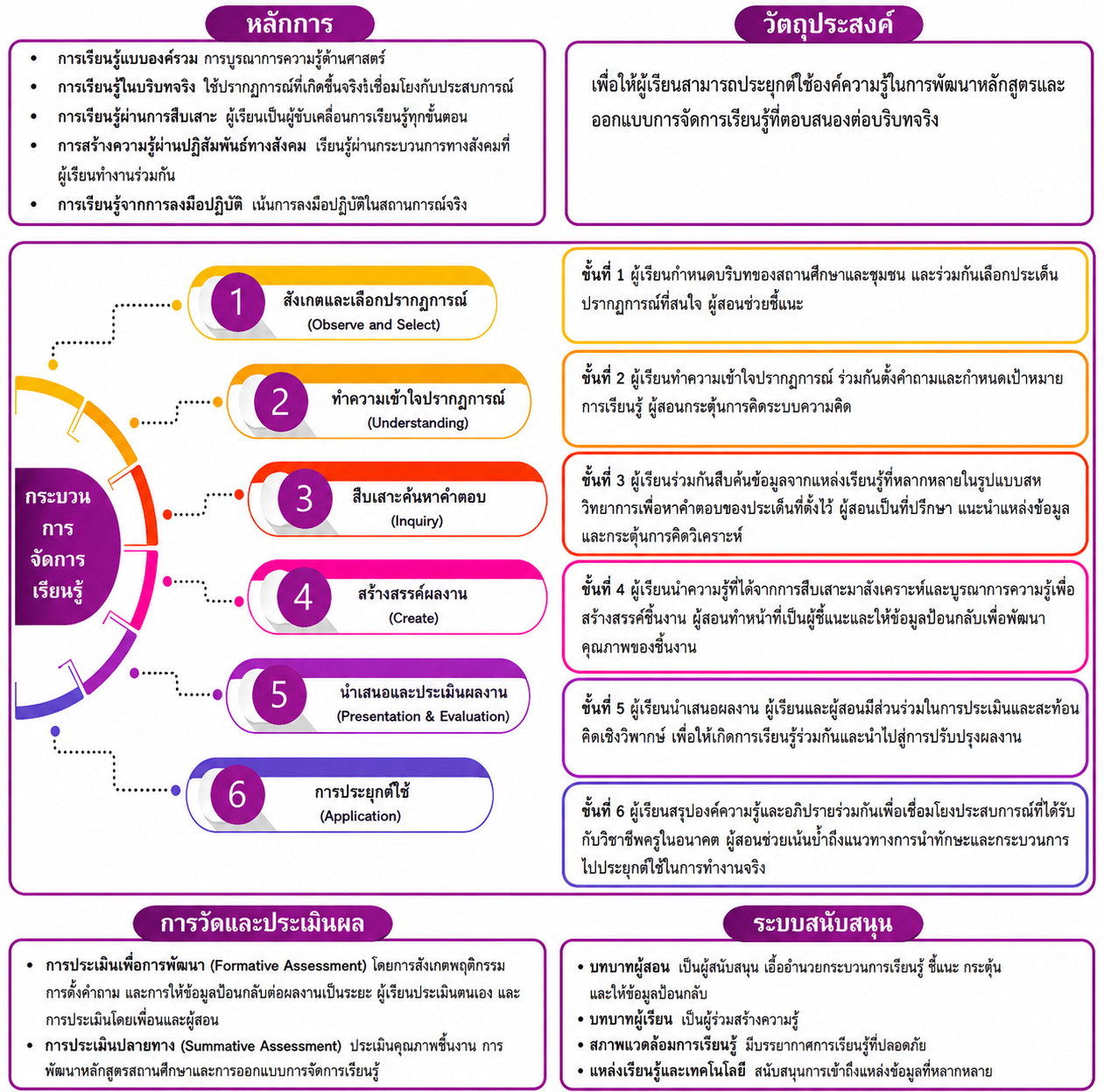
1. The developed instructional model was rated at the highest level of appropriateness and feasibility. The model comprised five components: principles, objectives, a learning process, assessment, and a support system, with a six-step learning process: 1) observing and selecting a phenomenon, 2) understanding the phenomenon, 3) investigating for answers, 4) creating products, 5) presenting and evaluating products, and 6) applying knowledge.
2. Regarding the model’s effectiveness, pre-service teachers in both groups showed significantly higher post-test achievement scores than pre-test scores at the .01 level of significance. When comparing post-test achievement scores between the two groups using analysis of covariance, a statistically significant difference was found at the .05 level, with the experimental group outperforming the control group. Furthermore, the experimental group demonstrated significantly higher competencies in curriculum development and instructional design than the control group at the .05 level of significance.
Article Details

This work is licensed under a Creative Commons Attribution-NonCommercial-NoDerivatives 4.0 International License.
เพื่อให้เป็นไปตามกฎหมายลิขสิทธิ์ ผู้นิพนธ์ทุกท่านต้องลงลายมือชื่อในแบบฟอร์มใบมอบลิขสิทธิ์บทความ ให้แก่วารสารฯ พร้อมกับบทความต้นฉบับที่ได้แก้ไขครั้งสุดท้าย นอกจากนี้ ผู้นิพนธ์ทุกท่านต้องยืนยันว่าบทความ ต้นฉบับที่ส่งมาตีพิมพ์นั้น ได้ส่งมาตีพิมพ์เฉพาะในวารสาร วิชาการธรรม ทรรศน์ เพียงแห่งเดียวเท่านั้น หากมีการใช้ ภาพหรือตารางของผู้นิพนธ์อื่นที่ปรากฏในสิ่งตีพิมพ์อื่นมาแล้ว ผู้นิพนธ์ต้องขออนุญาตเจ้าของลิขสิทธิ์ก่อน พร้อมทั้ง แสดงหนังสือที่ได้รับการยินยอมต่อบรรณาธิการ ก่อนที่บทความจะได้รับการตีพิมพ์References
กฎกระทรวง มาตรฐานคุณวุฒิระดับอุดมศึกษา พ.ศ. 2565. (31 มีนาคม 2565). ราชกิจจานุเบกษา. เล่ม 139 ตอนที่ 20 ก, หน้า 28-31.
ข้อบังคับคุรุสภาว่าด้วยมาตรฐานวิชาชีพ (ฉบับที่ 4) พ.ศ. 2562. (20 มีนาคม 2562). ราชกิจจานุเบกษา. เล่ม 136 ตอนพิเศษ 68 ง, หน้า 18-20.
จริยา ตะลังวิทย์. (2566). การพัฒนาแผนการจัดกิจกรรมการเรียนรู้โดยใช้ปรากฏการณ์เป็นฐาน รายวิชาการพัฒนาหลักสูตรของนักศึกษาชั้นปีที่ 2 คณะศิลปศึกษา สถาบันบัณฑิตพัฒนศิลป์. วารสารพัฒนศิลป์วิชาการ, 7(2), 1-18.
ชนาธิป บุบผามาศ. (2566). การพัฒนารูปแบบการเรียนการสอนตามแนวคิดปรากฏการณ์เป็นฐานเพื่อเสริมสร้างความสามารถในการจัดประสบการณ์ของนักศึกษาครู. (วิทยานิพนธ์ปรัชญาดุษฎีบัณฑิต). นครปฐม: มหาวิทยาลัยศิลปากร.
ชุติกานต์ เอี่ยวเล็ก และอรทัย อนุรักษ์วัฒนะ. (2565). ผลการจัดประสบการณ์การเรียนการสอนโดยใช้ปรากฏการณ์เป็นฐานเพื่อพัฒนาทักษะการคิดอย่างมีวิจารณญาณของนักศึกษาครู. วารสารศึกษาศาสตร์ มหาวิทยาลัยศิลปากร, 20(1), 177-191.
นันทญ์ณภัค พรมมา และอุบลวรรณ ส่งเสริม. (2567). แนวคิดการจัดการเรียนรู้โดยใช้ปรากฏการณ์เป็นฐานกับทิศทางความเหมาะสมในบริบทการศึกษาของสังคมไทย. วารสารครุศาสตร์ ราชภัฏเชียงใหม่, 3(2), 1-15.
พงศธร มหาวิจิตร. (2562). การประยุกต์ใช้แนวคิดการเรียนรู้โดยใช้ปรากฏการณ์เป็นฐานร่วมกับการเรียนรู้เชิงรุกในรายวิชาการประถมศึกษาเพื่อเสริมสร้างทักษะการเรียนรู้ในศตวรรษที่ 21. วารสารศึกษาศาสตร์ มหาวิทยาลัยขอนแก่น, 42(2), 73-90.
เรวณี ชัยเชาวรัตน์, ชาริณี ตรีวรัญญู และอัมพร ม้าคนอง. (2561). ผลการเสริมสร้างความสามารถในการออกแบบการเรียนการสอนของนักศึกษาปฏิบัติการวิชาชีพครูตามแนวคิดชุมชนการเรียนรู้ทางวิชาชีพ. วารสารครุศาสตร์ จุฬาลงกรณ์มหาวิทยาลัย, 46(4), 318-338.
วารินท์พร ฟันเฟื่องฟู. (2566). ผลการจัดการเรียนรู้โดยใช้ปรากฏการณ์เป็นฐานตามรูปแบบ READS วิชาการพัฒนาหลักสูตร ระดับปริญญาตรีชั้นปีที่ 2. วารสารนิสิตวัง, 25(2), 102-109.
วิไลภรณ์ ฤทธิคุปต์ และลำไย สีหามาตย์. (2565). การจัดการเรียนรู้โดยใช้ปรากฏการณ์เป็นฐานเพื่อเสริมสร้างทักษะการเรียนรู้ในศตวรรษที่ 21 ของนิสิตบัณฑิตศึกษา. วารสารราชพฤกษ์, 20(1), 116-127.
ศรัณยา ฤกษ์ขำ. (2565). การประยุกต์ใช้แนวคิดการเรียนรู้โดยใช้ปรากฏการณ์เป็นฐานในรายวิชาวิวัฒนาการสำหรับครูเพื่อเสริมสร้างทักษะการเรียนรู้ทางวิทยาศาสตร์: กรณีศึกษานักศึกษาสาขาชีววิทยาและวิทยาศาสตร์ทั่วไป คณะครุศาสตร์ มหาวิทยาลัยราชภัฏวไลยอลงกรณ์ ในพระบรมราชูปถัมภ์. วารสารมนุษยศาสตร์และสังคมศาสตร์ มหาวิทยาลัยราชภัฏสุรินทร์, 24(2), 65-80.
สำนักงานคณะกรรมการการศึกษาขั้นพื้นฐาน. (2553). คู่มือการประเมินสมรรถนะครู สำนักงานคณะกรรมการการศึกษาขั้นพื้นฐาน (ฉบับปรับปรุง). กรุงเทพฯ: สำนักงานคณะกรรมการการศึกษาขั้นพื้นฐาน.
Almeida, S. de, & Viana, J. (2022). Teachers as curriculum designers: What knowledge is needed? The Curriculum Journal, 34(3), 357-374. https://doi.org/10.1002/curj.199
Bada, S. O. (2015). Constructivism learning theory: A paradigm for teaching and learning. IOSR Journal of Research & Method in Education, 5(6), 66-70.
Fong-Yee, D., & Normore, A. H. (2013). The impact of quality teachers on student achievement. Retrieved from https://digitalcommons.fiu.edu/cgi/viewcontent.cgi?article=1054&context=sferc
Fosnot, C. T. (Ed.). (2005). Constructivism: Theory, perspectives, and practice. (2nd ed.). New York: Teachers College Press.
Joyce, B., Weil, M., & Calhoun, E. (2015). Models of teaching. (9th ed.). Boston: Pearson.
Kiraly, D. C. (2000). A social constructivist approach to translator education: Empowerment from theory to practice. Manchester: St. Jerome Publishing.
Symeonidis, V., & Schwarz, J. F. (2016). Phenomenon-based teaching and learning through the pedagogical lenses of phenomenology: The recent curriculum reform in Finland. Forum Oświatowe, 28(2), 31-47.
