The Development Model of Creative Leadership for School Administrators in Promoting Teachers’ Educational Innovation under Nakhon Si Thammarat Primary Educational Service Area Office 4
Article Sidebar
Main Article Content
Abstract
This study aimed to: (1) examine the current conditions, desired conditions, and priority needs of school administrators’ creative leadership in promoting teachers’ instructional innovation; (2) develop a model; and (3) validate the developed model. A multi-phase mixed-methods research design was employed. The quantitative sample consisted of 206 school administrators and heads of academic affairs, with the sample size determined using Krejcie and Morgan’s table. The research instruments included a questionnaire, interview forms, and evaluation forms. The questionnaire had a reliability coefficient of 0.992. Data were analyzed using frequency, percentage, mean, standard deviation, and the modified Priority Needs Index (PNI modified).
The research results found that:
1. The current conditions of creative leadership, the development process, and the promotion of teachers’ instructional innovation were at a moderate level, whereas the desired conditions were at the highest level. The PNI modified values were 0.38, 0.49, and 0.42, respectively.
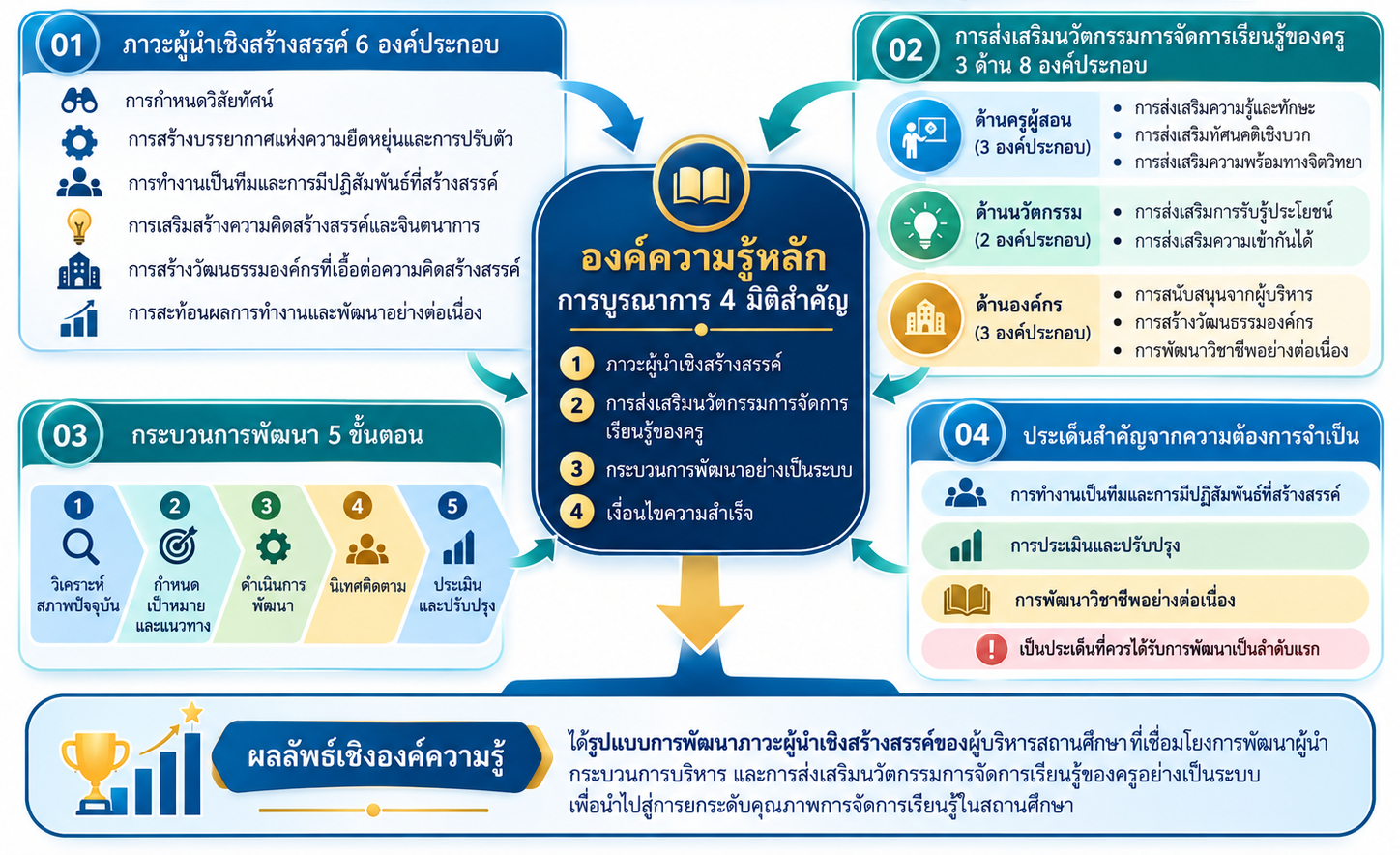
2. The developed model was validated for accuracy and appropriateness through connoisseurship and comprised five components: (1) model principles; (2) model objectives; (3) six components of creative leadership and eight components of promoting teachers’ instructional innovation across teacher, innovation, and organizational dimensions; (4) a five-step development process consisting of current-state analysis, goal and guideline setting, implementation, supervision and monitoring, and evaluation and improvement; and (5) conditions for success.
3. The model validation results for accuracy, appropriateness, feasibility, and utility were at the highest level in all aspects.
Article Details

This work is licensed under a Creative Commons Attribution-NonCommercial-NoDerivatives 4.0 International License.
เพื่อให้เป็นไปตามกฎหมายลิขสิทธิ์ ผู้นิพนธ์ทุกท่านต้องลงลายมือชื่อในแบบฟอร์มใบมอบลิขสิทธิ์บทความ ให้แก่วารสารฯ พร้อมกับบทความต้นฉบับที่ได้แก้ไขครั้งสุดท้าย นอกจากนี้ ผู้นิพนธ์ทุกท่านต้องยืนยันว่าบทความ ต้นฉบับที่ส่งมาตีพิมพ์นั้น ได้ส่งมาตีพิมพ์เฉพาะในวารสาร วิชาการธรรม ทรรศน์ เพียงแห่งเดียวเท่านั้น หากมีการใช้ ภาพหรือตารางของผู้นิพนธ์อื่นที่ปรากฏในสิ่งตีพิมพ์อื่นมาแล้ว ผู้นิพนธ์ต้องขออนุญาตเจ้าของลิขสิทธิ์ก่อน พร้อมทั้ง แสดงหนังสือที่ได้รับการยินยอมต่อบรรณาธิการ ก่อนที่บทความจะได้รับการตีพิมพ์References
จักรกฤษ ภิรมย์, กฤษกนก ดวงชาทม และชยากานต์ เรืองสุวรรณ. (2567). รูปแบบการพัฒนาภาวะผู้นำเชิงสร้างสรรค์ของผู้บริหารสถานศึกษา สังกัดสำนักงานอาชีวศึกษา จังหวัดกาฬสินธุ์. วารสารพุทธปรัชญาวิวัฒน์, 8(2), 552-566.
เฉลิมพล สุปัญญาบุตร. (2567). กลยุทธ์การพัฒนาการเป็นองค์กรแห่งนวัตกรรมของโรงเรียนมัธยมศึกษา สังกัดสำนักงานคณะกรรมการการศึกษาขั้นพื้นฐาน. (ดุษฎีนิพนธ์ครุศาสตรดุษฎีบัณฑิต). พิษณุโลก: มหาวิทยาลัยนเรศวร.
สำนักงานเลขาธิการสภาการศึกษา. (2561). แผนการศึกษาแห่งชาติ พ.ศ. 2561-2580. กรุงเทพฯ: สำนักงานเลขาธิการสภาการศึกษา.
Bass, B. M., & Riggio, R. E. (2006). Transformational leadership. (2nd ed.). New Jersey: Lawrence Erlbaum Associates.
Dubrin, A. J. (2022). Leadership: Research findings, practice, and skills. Boston: Cengage Learning.
Krejcie, R. V., & Morgan, D. W. (1970). Determining sample size for research activities. Educational and Psychological Measurement, 30(3), 607-610.
Leithwood, K., & Jantzi, D. (2005). A review of transformational school leadership research 1996-2005. Leadership and Policy in Schools, 4(3), 177-199.
Mainemelis, C., Kark, R., & Epitropaki, O. (2024). The role of creative leadership manifestations in creativity and innovation. Journal of Management Inquiry, 35(1), 101-115.
Sternberg, R. J. (2012). A systems model of leadership: WICS. Oxford Handbook of Positive Psychology and Work, 34-45.
