Waste Management for Sustainable Development in the Dimensions of Community, Public Policy, and Environmental Ethics: A Bibliometric Analysis from the Scopus Database
Article Sidebar
Main Article Content
Abstract
The objectives of this research were: 1) to analyze publication trends in waste management for sustainable development; 2) to examine the knowledge structure, academic collaboration networks, and major research topics in this field; and 3) to synthesize knowledge on waste management for sustainable development in relation to community participation, public policy, and environmental ethics. This study employed bibliometric analysis using data retrieved from the Scopus database from 2015 to 2025. A total of 1,644 research articles were analyzed using the Bibliometrix and Biblioshiny programs.
The results were as follows:
1. Publications on waste management for sustainable development increased continuously, with an average annual growth rate of 78.53%. The studies were conducted across a range of disciplines, including environmental studies, social sciences, economics, and public policy.
2. The knowledge structure of the field consisted of several major topics, including waste management, sustainable development, circular economy, climate change, and recycling. The results also indicated a high level of international academic collaboration and extensive research networks among scholars and institutions.
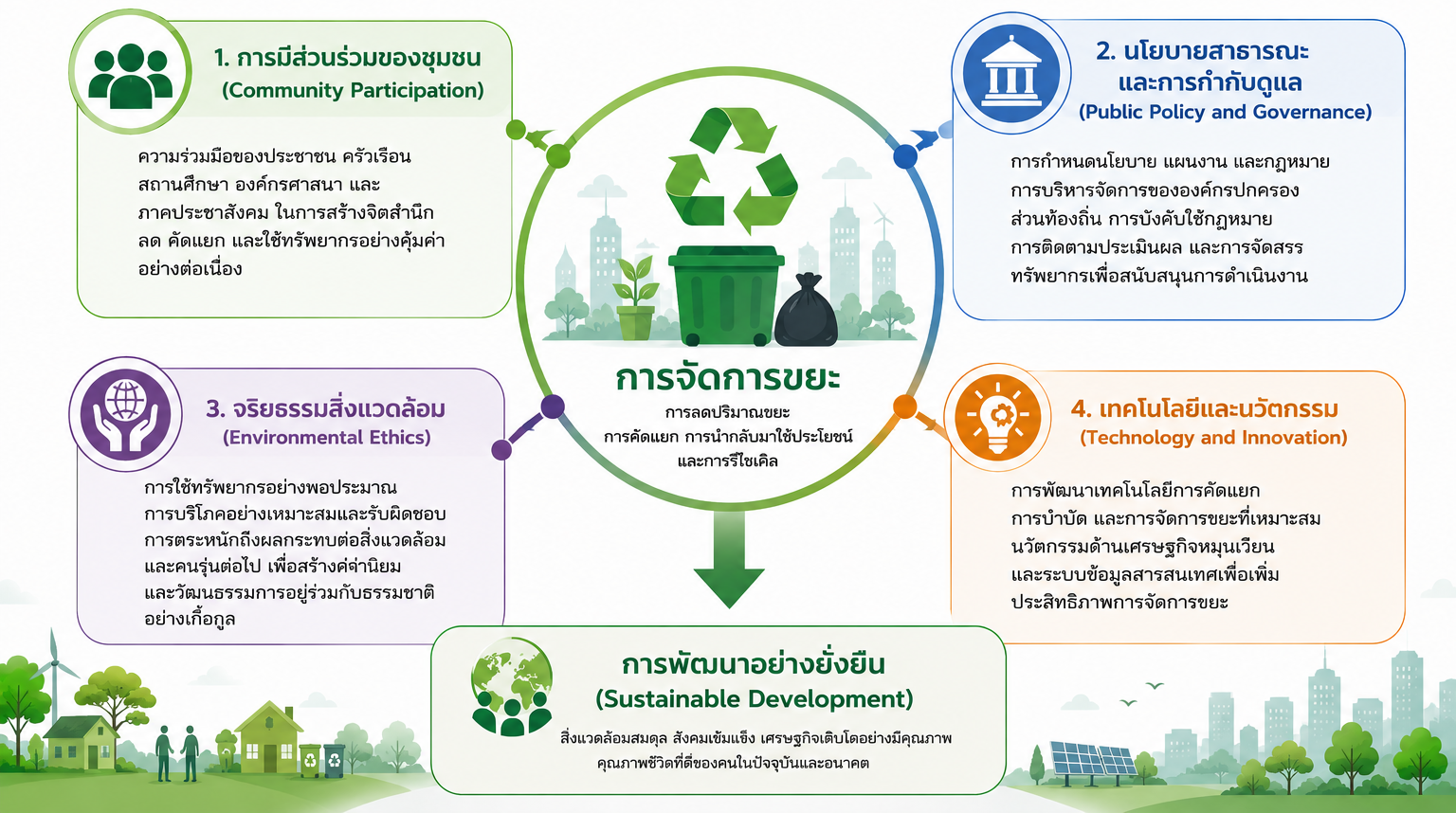
3. The synthesis of knowledge showed that research on waste management for sustainable development has increasingly focused on community participation, public policy, local government administration, consumption behavior, and environmental ethics. These topics have frequently appeared together in the literature and have contributed substantially to the development of this field of study.
Article Details

This work is licensed under a Creative Commons Attribution-NonCommercial-NoDerivatives 4.0 International License.
เพื่อให้เป็นไปตามกฎหมายลิขสิทธิ์ ผู้นิพนธ์ทุกท่านต้องลงลายมือชื่อในแบบฟอร์มใบมอบลิขสิทธิ์บทความ ให้แก่วารสารฯ พร้อมกับบทความต้นฉบับที่ได้แก้ไขครั้งสุดท้าย นอกจากนี้ ผู้นิพนธ์ทุกท่านต้องยืนยันว่าบทความ ต้นฉบับที่ส่งมาตีพิมพ์นั้น ได้ส่งมาตีพิมพ์เฉพาะในวารสาร วิชาการธรรม ทรรศน์ เพียงแห่งเดียวเท่านั้น หากมีการใช้ ภาพหรือตารางของผู้นิพนธ์อื่นที่ปรากฏในสิ่งตีพิมพ์อื่นมาแล้ว ผู้นิพนธ์ต้องขออนุญาตเจ้าของลิขสิทธิ์ก่อน พร้อมทั้ง แสดงหนังสือที่ได้รับการยินยอมต่อบรรณาธิการ ก่อนที่บทความจะได้รับการตีพิมพ์References
กรมควบคุมมลพิษ. (2566). กรมควบคุมมลพิษยกระดับสถานที่กำจัดขยะมูลฝอยที่ไม่ถูกต้องตามแผนปฏิบัติการปี 2565-2570. เข้าถึงได้จาก https://thailand.go.th/issue-focus-detail/001_04_083
กรมส่งเสริมคุณภาพสิ่งแวดล้อม. (2542). เอกสารความรู้เรื่องการจัดการขยะมูลฝอย. กรุงเทพฯ: กรมส่งเสริมคุณภาพสิ่งแวดล้อม.
สำนักงานคณะกรรมการพัฒนาการเศรษฐกิจและสังคมแห่งชาติ. (ม.ป.ป.). ปรัชญาของเศรษฐกิจพอเพียงและการใช้ทรัพยากรอย่างรู้คุณค่า. กรุงเทพฯ: สำนักงานคณะกรรมการพัฒนาการเศรษฐกิจและสังคมแห่งชาติ.
สำนักสิ่งแวดล้อมเมือง. (2565). สรุปรายงานสถานการณ์คุณภาพสิ่งแวดล้อมประจำปี พ.ศ. 2565: EP11 สิ่งแวดล้อมชุมชน. กรุงเทพฯ: สำนักงานนโยบายและแผนทรัพยากรธรรมชาติและสิ่งแวดล้อม.
Donthu, N., Kumar, S., Mukherjee, D., Pandey, N., & Lim, W. M. (2021). How to conduct a bibliometric analysis: An overview and guidelines. Journal of Business Research, 133, 285-296. https://doi.org/10.1016/j.jbusres.2021.04.070
Kirchherr, J., Reike, D., & Hekkert, M. (2017). Conceptualizing the circular economy: An analysis of 114 definitions. Resources, Conservation and Recycling, 127, 221-232. https://doi.org/10.1016/j.resconrec.2017.09.005
Korhonen, J., Nuur, C., Feldmann, A., & Birkie, S. E. (2018). Circular economy as an essentially contested concept. Journal of Cleaner Production, 175, 544-552. https://doi.org/10.1016/j.jclepro.2017.12.111
UNESCO. (2016). Education for sustainable development goals: Learning objectives. Paris: UNESCO.
United Nations. (2015). Transforming our world: The 2030 agenda for sustainable development. Retrieved from United Nations SDGs
United Nations. (2020). Monitoring the shift to sustainable consumption and production patterns in the context of the SDGs. Retrieved from https://sdgs.un.org/publications/monitoring-shift-sustainable-consumption-and-production-patterns-context-sdgs-18024
