An Integrated Analysis of the Dairy Farming Supply Chain Based on the SCOR Model: Guidelines for Enhancing Efficiency and Value Creation in the Maejo Dairy Cooperative System, Chiang Mai Province
Article Sidebar
Main Article Content
Abstract
This research aimed to: (1) analyze the dairy cattle supply chain of members of the Maejo Dairy Cooperative Ltd. using the Supply Chain Operations Reference (SCOR) model, and (2) propose guidelines for enhancing operational efficiency and value creation within the dairy cattle supply chain. This study employed a quantitative survey research design. The population consisted of 49 dairy farmer members of the Maejo Dairy Cooperative Ltd., with a purposive sample of 24 respondents. The research instrument was a questionnaire developed based on supply chain management concepts and the SCOR model. The instrument was validated for content validity with an Item-Objective Congruence (IOC) index of 0.80 and demonstrated a reliability coefficient of not less than 0.70. Data were analyzed using descriptive statistics, correlation analysis, and multiple regression analysis.
The findings revealed that:
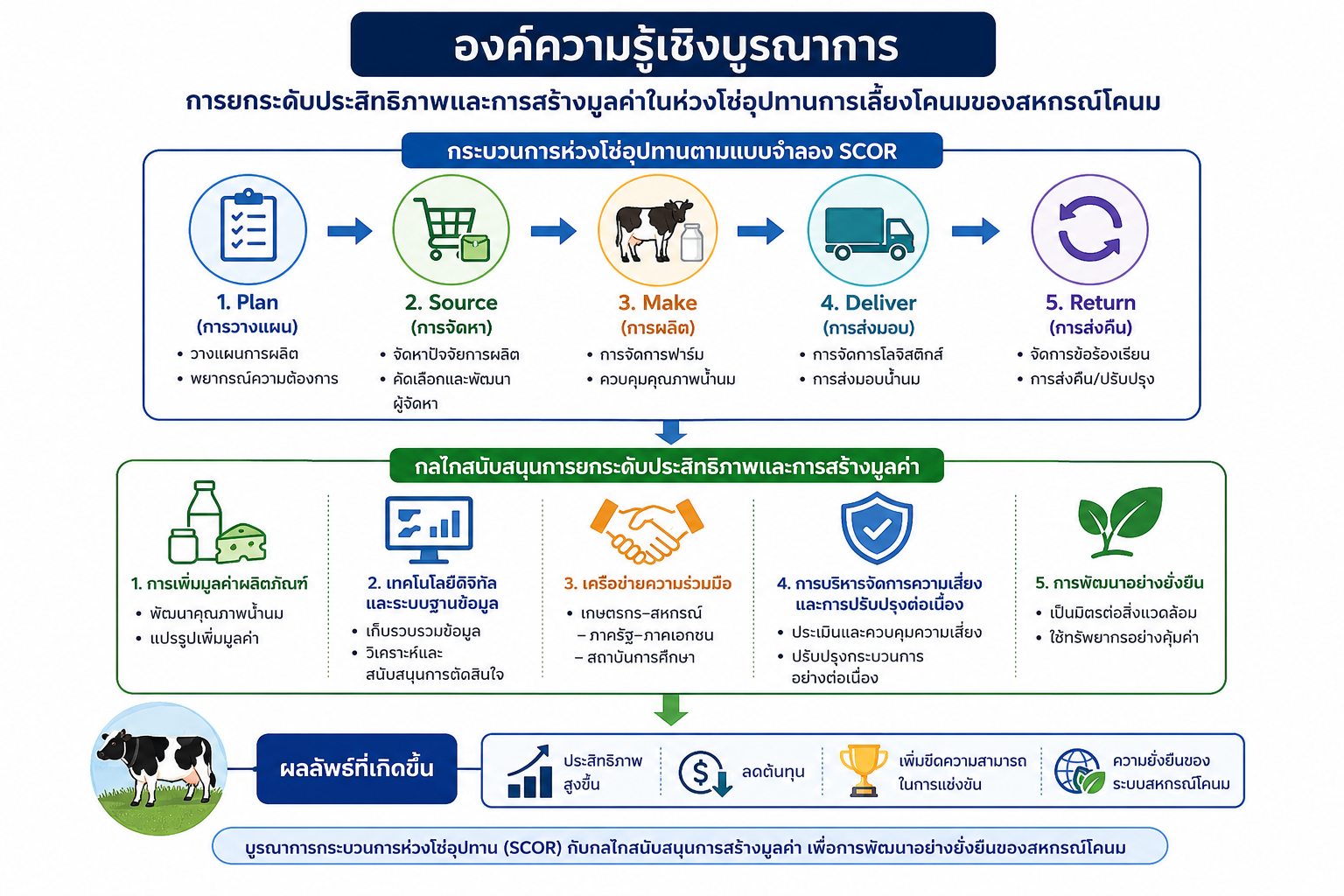
1. The overall implementation of the dairy cattle supply chain based on the SCOR model was at a high level. The Make process achieved the highest mean score, followed by Plan, Source, and Deliver, whereas Return was rated at a moderate level. These findings indicate that the supply chain is strong in production management but still faces challenges in risk management, data management, and process integration throughout the supply chain.
2. The overall guidelines for enhancing efficiency and value creation were also rated at a high level. Priority was given to increasing the value of raw milk, adopting modern technologies, strengthening collaborative networks, improving farm management, production planning, and systematic data recording. The study proposes a new body of knowledge, the Integrated SCOR–Value Creation Model, an integrated supply chain management framework that links the five core SCOR processes Plan, Source, Make, Deliver, and Return with value creation mechanisms through digital technologies, information systems, data management, participatory governance, continuous improvement, and stakeholder collaboration. The proposed model aims to enhance operational efficiency, reduce costs, improve competitiveness, and promote the long-term sustainability of dairy cooperative systems.
Article Details

This work is licensed under a Creative Commons Attribution-NonCommercial-NoDerivatives 4.0 International License.
เพื่อให้เป็นไปตามกฎหมายลิขสิทธิ์ ผู้นิพนธ์ทุกท่านต้องลงลายมือชื่อในแบบฟอร์มใบมอบลิขสิทธิ์บทความ ให้แก่วารสารฯ พร้อมกับบทความต้นฉบับที่ได้แก้ไขครั้งสุดท้าย นอกจากนี้ ผู้นิพนธ์ทุกท่านต้องยืนยันว่าบทความ ต้นฉบับที่ส่งมาตีพิมพ์นั้น ได้ส่งมาตีพิมพ์เฉพาะในวารสาร วิชาการธรรม ทรรศน์ เพียงแห่งเดียวเท่านั้น หากมีการใช้ ภาพหรือตารางของผู้นิพนธ์อื่นที่ปรากฏในสิ่งตีพิมพ์อื่นมาแล้ว ผู้นิพนธ์ต้องขออนุญาตเจ้าของลิขสิทธิ์ก่อน พร้อมทั้ง แสดงหนังสือที่ได้รับการยินยอมต่อบรรณาธิการ ก่อนที่บทความจะได้รับการตีพิมพ์References
กิตติศักดิ์ อัจฉริยะขจร และศิริชัย เอียดมุสิก. (2554). ปัจจัยที่เกี่ยวข้องกับจำนวนเซลล์โซมาติกในน้ำนมถังรวมสูงของฟาร์มโคนมรายย่อย. (วิทยาพนธ์วิทยาศาสตรมหาบัณฑิต). กรุงเทพฯ: จุฬาลงกรณ์มหาวิทยาลัย.
โชติรส นพพลกรัง, ทิพย์สุดา กุมผัน, ณัฐกร โต๊ะสิงห์, รุ่งรดิศ สมทอง, ศิริพงษ์ หอมแขก, กริชนันท์ เจริญพันธ์ และอนงค์นารถ ชัยทอง. (2566). การศึกษาการจัดการโซ่อุปทานกลุ่มวิสาหกิจชุมชนข้าวหอมมะลิ 105 บ้านยางโดยใช้ตัวแบบจำลองอ้างอิงการดำเนินงานโซ่อุปทาน. วารสารวิทยาศาสตร์และเทคโนโลยี มหาวิทยาลัยราชภัฏศรีสะเกษ, 3(1), 22-32.
ฐากูร ศิริยอด, ณัฐนันท์ ฐิติยาปราโมทย์, สุขเกษม ลางคุลเสน, ชัยฤกษ์ ตันติเตชา, นลินทิพย์ กองคำ และธนวรกฤต โอฬารธนพร. (2566). การวิเคราะห์ปัจจัยเสี่ยงเพื่อพัฒนาประสิทธิภาพของห่วงโซ่อุปทานข้าวโพดหวานสำหรับการส่งออกไปยังตลาดต่างประเทศ. วารสารเกษตรศาสตร์ธุรกิจประยุกต์, 17(27), 21-43.
ตรียาพร ตุ่มศรียา, ฑิฏิวุฒิ ศรีมานพ, บุญสาน ทระทึก, จักรกฤษณ์ แก้วประเสริฐ และศุภานัน ศรีวิราช. (2568). อิทธิพลของการประยุกต์ใช้เทคโนโลยีดิจิทัล ประสิทธิภาพห่วงโซ่อุปทาน และความสามารถด้านทรัพยากรมนุษย์ต่อขีดความสามารถทางการแข่งขันระหว่างประเทศของธุรกิจส่งออกไทย. วารสารสังคมพัฒนศาสตร์, 8(9), 297-311.
นลินี คงสุบรรณ, ศิริพร กิรติการกุล, ฑีฆา โยธาภักดี และเก นันทะเสน. (2564). ประสิทธิภาพทางเทคนิคการผลิตโคเนื้อของสมาชิกสหกรณ์เครือข่ายโคเนื้อ จำกัด. วารสารเศรษฐศาสตร์และกลยุทธ์การจัดการ, 8(1), 97-114.
ปัชฌา ตรีมงคล. (2559). การพัฒนากลยุทธ์การจัดการความรู้เชิงรุกสำหรับชุมชนผู้ผลิตวัตถุดิบในห่วงโซ่อุปทานของกิจการเพื่อสังคม. (วิทยานิพนธ์ปรัชญาดุษฎีบัณฑิต). กรุงเทพฯ: มหาวิทยาลัยศิลปากร.
ไพลิน เลิศพิมลพันธ์, รัชฎากร ภู่ห้อย, โชติชวาล ฟูกิจการญจน์ และวีดา สัตยารมณ์. (2568). การบริหารจัดการโลจิสติกส์และห่วงโซ่อุปทานการขนส่งสินค้าทางทะเลในจังหวัดชลบุรี. วารสารส่งเสริมและพัฒนาวิชาการสมัยใหม่, 3(4), 665-680.
รวีสรา อัญชุลี, ฉัตรชัย เหล่าเขตการณ์ และธนธร ชื่นยินดี. (2568). แนวทางในการปรับปรุงการจัดการโซ่อุปทานกล้วยไม้ในจังหวัดสมุทรสาคร. วารสารมนุษยศาสตร์และสังคมศาสตร์ มหาวิทยาลัยธนบุรี (ฉบับบัณฑิตศึกษา), 3(1), 25-35.
สรายุธ รัศมี. (2567). ความหลากหลายในห่วงโซ่อุปทาน: กลยุทธ์ใหม่เพื่อการผลิตและจัดหาวัตถุดิบที่ยั่งยืนในยุควิกฤต. วารสารบริหารธุรกิจราชมงคลสุวรรณภูมิ, 1(3), 34-53.
อัจฉริยะขจร และกิตติศักดิ์. (2560). การยกระดับการควบคุมคุณภาพน้ำนมดิบที่ศูนย์รวบรวมน้ำนมดิบ. UNISEARCH (Unisearch Journal), 4(1), 28-32.
Guan, W., & Rehme, J. (2012). Vertical integration in supply chains: driving forces and consequences for a manufacturer's downstream integration. Supply chain management: An international Journal, 17(2), 187-201.
Huan, S. H., Sheoran, S. K., & Wang, G. (2004). A review and analysis of supply chain operations reference (SCOR) model. Supply chain management: An international Journal, 9(1), 23-29.
Juhara, S. (2024). Optimizing supply chain management: Strategies for enhancing efficiency and reducing costs in manufacturing industries. The Journal of Academic Science, 1(1), 37-44.
Li, Y., Wu, F., Zong, W., & Li, B. (2017). Supply chain collaboration for ERP implementation: an inter-organizational knowledge-sharing perspective. International Journal of Operations & Production Management, 37(10), 1327-1347.
Madhani, P. M. (2019). Strategic supply chain management for enhancing competitive advantages: developing business value added framework. International Journal of Value Chain Management, 10(4), 316-338.
Nuprain, A., Srikarn, M., & Jundum, S. (2026). The Upland Rice Supply Chain through the Application of the Supply Chain Operations Reference (SCOR) Model: A Case Study of Kanchanadit District, Surat Thani Province. Research and Development Journal, Loei Rajabhat University, 20(74), 1-16.
Stewart, G. (1997). Supply‐chain operations reference model (SCOR): the first cross‐industry framework for integrated supply‐chain management. Logistics information management, 10(2), 62-67.
Wankmüller, C., & Reiner, G. (2020). Coordination, cooperation and collaboration in relief supply chain management. Journal of Business Economics, 90(2), 239-276.
