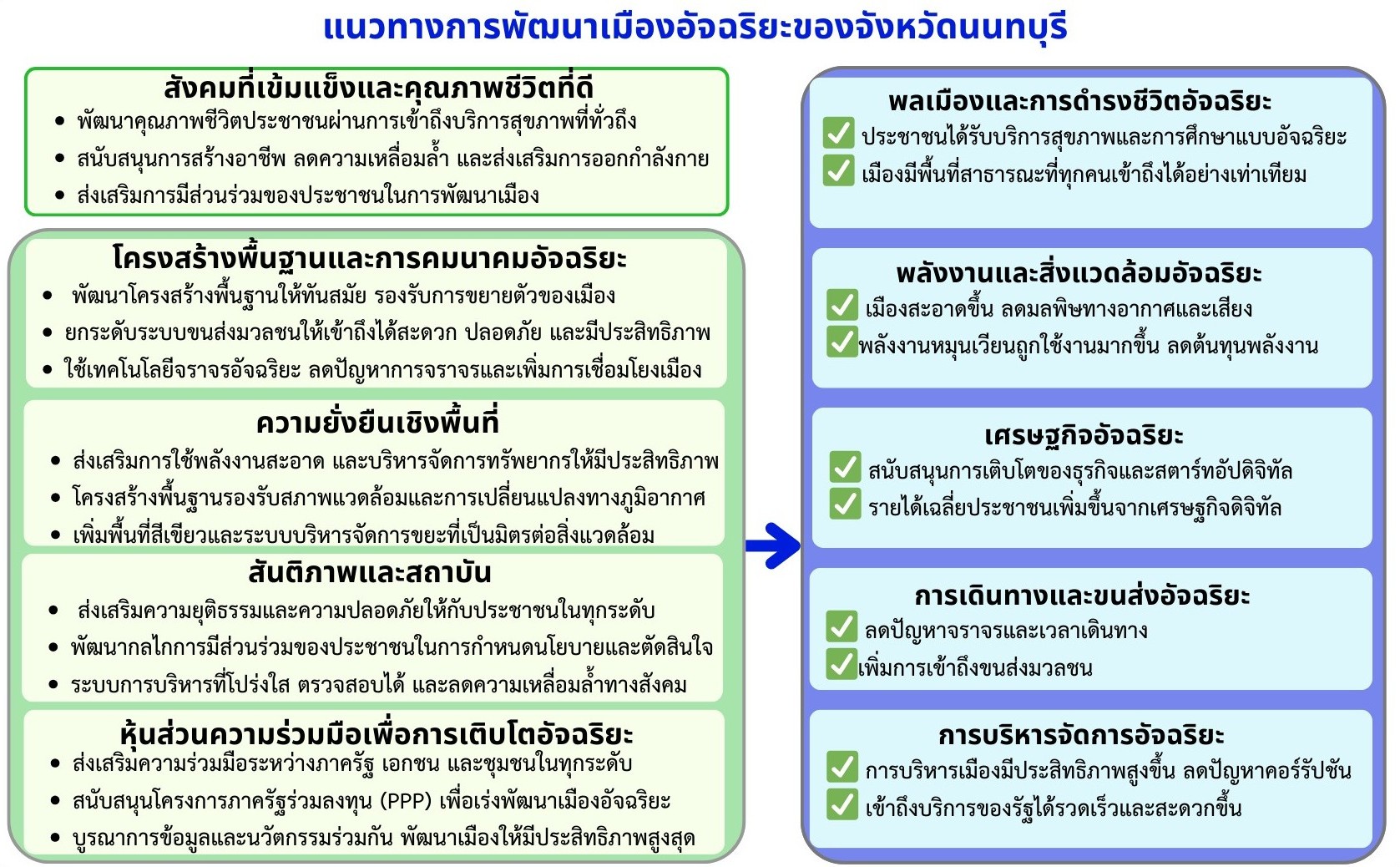
Guidelines for the Development of a Smart City in Nonthaburi Province
Article Sidebar
Main Article Content
Abstract
This study aims to; 1) analyze the level of smart city development in Nonthaburi Province, 2) examine the key factors influencing its transformation, and 3) propose guidelines for its future development. The research framework encompasses five dimensions of urban development: social, infrastructure, peace and institutions, development partnerships, and smart governance. This study employs a mixed-methods approach, combining quantitative and qualitative methodologies. A survey was conducted among 400 Nonthaburi residents, with data analyzed using descriptive statistics, correlation analysis, and multiple regression. Additionally, in-depth interviews were conducted with smart city development experts.
The results revealed that:
1. The level of smart city development in Nonthaburi was found to be high, with development partnerships scoring the highest, followed by social and smart governance dimensions. This reflects the crucial role of multi-sector collaboration in driving smart city development.
2. Factors influencing smart city development indicate that development partnerships and smart governance significantly impact all dimensions of transformation, particularly in economic innovation and smart mobility. Additionally, infrastructure development plays a crucial role in enhancing transportation networks and urban utilities.
3. Guidelines for smart city development suggest prioritizing the enhancement of smart infrastructure, fostering collaboration between public and private sectors, and integrating digital technology for efficient urban management. The findings provide valuable policy insights that can be utilized by local administrative organizations, governmental agencies responsible for infrastructure, technology, and energy, as well as private sector investors and civil society groups. This study serves as a strategic framework for advancing Nonthaburi into a highly efficient and technology-driven smart city.
Article Details

This work is licensed under a Creative Commons Attribution-NonCommercial-NoDerivatives 4.0 International License.
เพื่อให้เป็นไปตามกฎหมายลิขสิทธิ์ ผู้นิพนธ์ทุกท่านต้องลงลายมือชื่อในแบบฟอร์มใบมอบลิขสิทธิ์บทความ ให้แก่วารสารฯ พร้อมกับบทความต้นฉบับที่ได้แก้ไขครั้งสุดท้าย นอกจากนี้ ผู้นิพนธ์ทุกท่านต้องยืนยันว่าบทความ ต้นฉบับที่ส่งมาตีพิมพ์นั้น ได้ส่งมาตีพิมพ์เฉพาะในวารสาร วิชาการธรรม ทรรศน์ เพียงแห่งเดียวเท่านั้น หากมีการใช้ ภาพหรือตารางของผู้นิพนธ์อื่นที่ปรากฏในสิ่งตีพิมพ์อื่นมาแล้ว ผู้นิพนธ์ต้องขออนุญาตเจ้าของลิขสิทธิ์ก่อน พร้อมทั้ง แสดงหนังสือที่ได้รับการยินยอมต่อบรรณาธิการ ก่อนที่บทความจะได้รับการตีพิมพ์References
กระทรวงดิจิทัลเพื่อเศรษฐกิจและสังคม. (2559). แผนพัฒนาดิจิทัลเพื่อเศรษฐกิจและสังคม. กรุงเทพฯ: กระทรวงดิจิทัลเพื่อเศรษฐกิจและสังคม.
เทศบาลนครนนทบุรี. (2565). แนวทางการพัฒนาเมืองอัจฉริยะของจังหวัดนนทบุรี. เข้าถึงได้จาก https://www.nonthaburicity.go.th
Bibri, S. E., & Krogstie, J. (2017). Smart sustainable cities of the future: An extensive interdisciplinary literature review. Sustainable Cities and Society, 31, 183-212. https://doi.org/10.1016/j.scs.2017.02.016
Cohen, J. (1988). Statistical power analysis for the behavioral sciences. (2nd ed.). Routledge.
Cronbach, L. J. (1951). Coefficient alpha and the internal structure of tests. Psychometrika, 16, 297-334.
Deloitte. (2018). Supercharging the smart city-Smarter people and better governance. Retrieved from https://www2.deloitte.com
Klijn, E. H., & Koppenjan, J. (2020). Governance networks in the public sector. Routledge.
Likert, R. (1932). A technique for the measurement of attitudes. Archives of Psychology, 22(140), 1-55.
Lom, M., & Pribyl, O. (2021). Smart city model based on systems theory. International Journal of Information Management, 56(3), 102092. https://doi.org/10.1016/j.ijinfomgt.2020.102092
Meijer, A., & Bolívar, M. P. R. (2016). Governing the smart city: A review of the literature on smart urban governance. International Review of Administrative Sciences, 82(2), 392-408. https://doi.org/10.1177/0020852314564308
Mergel, I. (2020). Digital transformation in the public sector: Principles of public administration and information technology. Springer.
Pollitt, C., & Bouckaert, G. (2021). Public management reform: A comparative analysis-into the age of austerity. Oxford University Press.
UN-Habitat. (2024). World Cities Report 2024: Cities and Climate Action. Retrieved from https://unhabitat.org/world-cities-report-2024-cities-and-climate-action
Yamane, T. (1976). Statistics: An introductory analysis. New York: Harper and Row.
