A Model for Developing Transformational Leadership Based on the Dutiyapāpaṇika Sutta for Secondary School Administrators under the Office of the Basic Education Commission in Inspection Region 12
Article Sidebar
Main Article Content
Abstract
The purposes of this research were: 1) assess the needs for a adaptive leadership model for secondary school administrators, 2) develop a adaptive leadership development model based on the Dutiyapāpaṇika Sutta for these administrators, and (3) evaluate the effectiveness of the developed model. The population consisted of 10,045 secondary school administrators and teachers under the Office of the Basic Education Commission in Inspection Region 12, with a sample size of 1,358 participants. The qualitative data were collected from: (1) nine experts through focus group discussions and (2) nine specialists for model evaluation. The research instruments included questionnaires, interviews, and evaluation forms, with data analyzed using percentage, mean, standard deviation, and the PNI modified index to rank the priority of needs.
The results revealed that:
1. The study on the needs for adaptive leadership based on the Dutiyapāpaṇika Sutta for secondary school administrators under the Office of the Basic Education Commission in Inspection Region 12 identified the following priority areas in order of importance: (1) Cultural competence (PNI modified = 0.60), (2) Fostering unity (PNI modified = 0.59), (3) Knowledge management (PNI modified = 0.58), and (4) Holistic vision (PNI modified = 0.57).
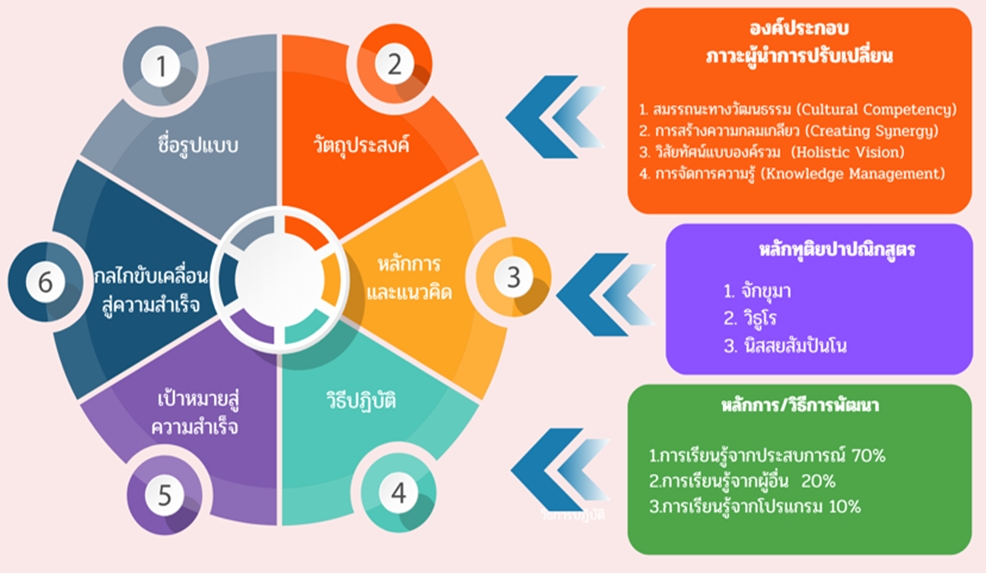
2. The development adaptive leadership development model based on the Dutiyapāpaṇika Sutta for these administrators of six key components: (1) model name, (2) objectives, (3) principles and conceptual framework, (4) implementation methods, (5) success objectives, and (6) driving mechanisms for success.
3. The evaluation of the adaptive leadership model based on the Dutiyapāpaṇika Sutta for secondary school administrators under the Office of the Basic Education Commission in Inspection Region 12 was conducted across three key aspects: appropriateness, benefits, and feasibility. The results showed that the average scores for all aspects were at the highest level.
Article Details

This work is licensed under a Creative Commons Attribution-NonCommercial-NoDerivatives 4.0 International License.
เพื่อให้เป็นไปตามกฎหมายลิขสิทธิ์ ผู้นิพนธ์ทุกท่านต้องลงลายมือชื่อในแบบฟอร์มใบมอบลิขสิทธิ์บทความ ให้แก่วารสารฯ พร้อมกับบทความต้นฉบับที่ได้แก้ไขครั้งสุดท้าย นอกจากนี้ ผู้นิพนธ์ทุกท่านต้องยืนยันว่าบทความ ต้นฉบับที่ส่งมาตีพิมพ์นั้น ได้ส่งมาตีพิมพ์เฉพาะในวารสาร วิชาการธรรม ทรรศน์ เพียงแห่งเดียวเท่านั้น หากมีการใช้ ภาพหรือตารางของผู้นิพนธ์อื่นที่ปรากฏในสิ่งตีพิมพ์อื่นมาแล้ว ผู้นิพนธ์ต้องขออนุญาตเจ้าของลิขสิทธิ์ก่อน พร้อมทั้ง แสดงหนังสือที่ได้รับการยินยอมต่อบรรณาธิการ ก่อนที่บทความจะได้รับการตีพิมพ์References
ธีรพจน์ แนบเนียน, ประเทือง ภูมิภัทราคม และอานนท์ เมธีวรฉัตร. (2565). แนวทางการพัฒนาภาวะผู้นำเชิงกลยุทธ์ตามหลักทุติยปาปณิกสูตรของผู้บริหารมหาวิทยาลัยราชภัฏ กลุ่มภาคเหนือตอนล่าง. วารสารวิจยวิชาการ, 5(2), 129-142. https://doi.org/10.14456/jra.2022.38
ศึกษาธิการภาค 12. (2567). รายงานผลการดำเนินงานตามแผนปฏิบัติราชการประจำปีงบประมาณ พ.ศ. 2565. กรุงเทพฯ: สำนักงานศึกษาธิการภาค 12.
สันติ ชัยชนะ. (2557). ตัวบ่งชี้ภาวะผู้นำการปรับเปลี่ยนสำหรับผู้บริหารสถานศึกษาขั้นพื้นฐาน. (วิทยานิพนธ์ปรัชญาดุษฎีบัณฑิต). ขอนแก่น: มหาวิทยาลัยขอนแก่น.
สำนักงานเลขาธิการสภาการศึกษา. (2560). แผนการศึกษาแห่งชาติ พ.ศ. 2560-2579. สำนักงานเลขาธิการสภาการศึกษา. เข้าถึงได้จาก https://www.onec.go.th/index.php/book/BookView/1540
Albano, C. (2005). What is Adaptive Leadership. Retrieved from http://www.selfgrowth.com/articles/calbano.html
Dubrin, A. J. (2004). Leadership Research Finding: Practice and Skills. Boston Houghton: Mifflin Company.
Glover, J., Rainwater, K., Jones, G., & Friedman, H. (2002). Adaptive leadership (Part two): Four principles for being adaptive. Organization Development Journal, 20(4), 18-38.
Hanson, M. E. (2003). Educational administration and organizational behavior. (4th ed.). Boston, MA: Allyn & Bacon.
Heifetz, R. A., Linsky, M., & Grashow, A. (2009). The practice of adaptive leadership: Tools and tactics for changing your organization and the world. Cambridge, MA: Harvard Business Press.
Jennings, C. (2013). Framework for high performance. Retrieved from http://charles-jennings.blogspot.com/2013/06/702010-framework-for-highperformance.html
Sims, B. D. (2009). Complexity, adaptive leadership, phase transitions, and new emergent order: A case study of the Northwest Texas Conference of the United Methodist Church. (Doctoral dissertation). School of Global Leadership & Entrepreneurship, Regent University, Virginia Beach, VA, United States.
Thomas, R. J. (2008). Crucibles of leadership: How to learn from experience to become a great leader. Boston, MA: Harvard Business Press.
