General management strategy based on The Fuor Brahmavihāra principles of Phrapariyattidhamma School General Education Department, Area 7
Article Sidebar
Main Article Content
Abstract
This dissertation aims to: 1) Study the needs and necessities of general administrative strategies for Pariyatti Dhamma Schools, General Education Division, Region 7; 2) Develop general administrative strategies based on the Four Divine States (Brahmavihara) for Pariyatti Dhamma Schools, General Education Division, Region 7, and 3) Evaluate general administrative strategies based on the Four Divine States (Brahmavihara) for Pariyatti Dhamma Schools, General Education Division, Region 7. The researcher employed a mixed-methods research design, integrating quantitative and qualitative methodologies. Quantitative data were collected through questionnaires distributed to a study population, including administrators and teachers of Pariyatti Dhamma Schools, General Education Division, Region 7. The sample size consisted of 175 individuals. For qualitative data, the researcher conducted formal interviews with key informants, specifically administrators from Pariyatti Dhamma Schools, General Education Division, Region 7, selected purposively, totaling 10 individuals. The research tools used were questionnaires and semi-structured interviews. Data were analyzed using frequency, percentage, mean, standard deviation, and the PINmodified index.
The research results were as follows:
1. The current state of general administration was rated at a high level overall. When considered by specific aspects, the highest-rated aspect was Aspect 3: Administration of school facilities and the environment, followed by Aspect 4: Public relations. The lowest-rated aspect was Aspect 1: Administrative operations. The desired state of general administrative practices was rated at the highest level overall. When considered by specific aspects, the highest-rated aspect was Aspect 4: Public relations, followed by Aspect 3: Administration of school facilities and the environment. The lowest-rated aspect was Aspect 2: Technology and innovation for education. Based on the PINmodified index ranking, the most critical and urgent area requiring development was Aspect 4: Public relations, followed by Aspect 1: Administrative operations, and lastly, Aspect 2: Technology and innovation for education.
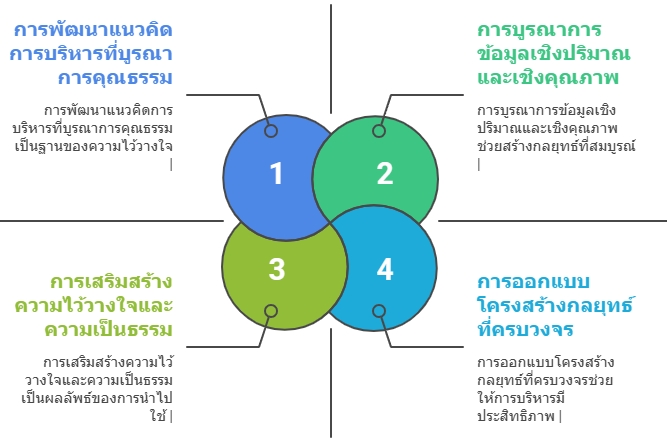
2. The development of general administrative strategies based on the Four Divine States (Brahmavihara) for Pariyatti Dhamma Schools, General Education Division, Region 7, resulted in a complete strategic model comprising one vision, four missions, four objectives, four strategic issues, and 48 strategies.
3. The evaluation of the general administrative strategies based on the Four Divine States (Brahmavihara) for Pariyatti Dhamma Schools, General Education Division, Region 7, revealed that the strategies' feasibility and appropriateness were rated at the highest level.
Article Details

This work is licensed under a Creative Commons Attribution-NonCommercial-NoDerivatives 4.0 International License.
เพื่อให้เป็นไปตามกฎหมายลิขสิทธิ์ ผู้นิพนธ์ทุกท่านต้องลงลายมือชื่อในแบบฟอร์มใบมอบลิขสิทธิ์บทความ ให้แก่วารสารฯ พร้อมกับบทความต้นฉบับที่ได้แก้ไขครั้งสุดท้าย นอกจากนี้ ผู้นิพนธ์ทุกท่านต้องยืนยันว่าบทความ ต้นฉบับที่ส่งมาตีพิมพ์นั้น ได้ส่งมาตีพิมพ์เฉพาะในวารสาร วิชาการธรรม ทรรศน์ เพียงแห่งเดียวเท่านั้น หากมีการใช้ ภาพหรือตารางของผู้นิพนธ์อื่นที่ปรากฏในสิ่งตีพิมพ์อื่นมาแล้ว ผู้นิพนธ์ต้องขออนุญาตเจ้าของลิขสิทธิ์ก่อน พร้อมทั้ง แสดงหนังสือที่ได้รับการยินยอมต่อบรรณาธิการ ก่อนที่บทความจะได้รับการตีพิมพ์References
พระพรหมคุณาภรณ์ (ป.อ. ปยุตฺโต). (2551). พรหมวิหาร 4 ทางสร้างสุขของชีวิตและสังคม. กรุงเทพฯ: มูลนิธิพุทธธรรม.
พระภัทรพงษ์ ฐิตญาโณ (ปิดตาระโพธิ์), ธีระศักดิ์ บึงมุม และสังวาล เพียยุระ. (2562). การบริหารสถานศึกษาตามหลักพรหมวิหาร 4 ในสถานศึกษาขั้นพื้นฐาน สังกัดสำนักงานเขตพื้นที่การศึกษาประถมศึกษาขอนแก่น เขต 1. วารสารมณีเชษฐาราม วัดจอมมณี, 2(1), 1-10. https://so07.tci-thaijo.org/index.php/JMCR/article/view/149/123
สมศักดิ์ ไชยเดช, พระครูศรีสุธรรมนิวิฐ และพระมหาอุดร อุตฺตโร. (2567). แนวทางการบริหารงานทั่วไปตามหลักพรหมวิหาร 4 ของผู้บริหารโรงเรียนประถมศึกษา ในอำเภอเมืองนครสวรรค์ จังหวัดนครสวรรค์. วารสารบวรสหการศึกษาและมนุษยสังคมศาสตร์, 5(1), 354-367. https://so03.tci-thaijo.org/index.php/JOB_EHS/article/view/272070
สำนักงานพระพุทธศาสนาแห่งชาติ. (2563). รายงานสถานการณ์การจัดการศึกษาโรงเรียนพระปริยัติธรรม แผนกสามัญศึกษา. กรุงเทพฯ: สำนักงานพระพุทธศาสนาแห่งชาติ.
สำนักงานเลขาธิการสภาการศึกษา. (2564). รายงานสภาวะการศึกษาไทย ปี 2563/2564: การพัฒนาคุณภาพและความเสมอภาคทางการศึกษา. กรุงเทพฯ: สำนักงานเลขาธิการสภาการศึกษา.
Bryson, J. M. (2018). Strategic planning for public and nonprofit organizations. (5th ed.). Hoboken, NJ: John Wiley & Sons.
Bush, T. (2020). Theories of educational leadership and management. (5th ed.). London: SAGE Publications.
Hoy, W. K., & Miskel, C. G. (2018). Educational administration: Theory, research, and practice. (9th ed.). New York, NY: McGraw-Hill Education.
Khan, M. A., Khan, M. A., Soomro, M. A., & Khan, A. (2020). Ethical leadership and organizational performance: The mediating role of employee engagement. Journal of Business Ethics, 166(4), 623-639. https://doi.org/10.1007/s10551-019-04163-4
Krejcie, R. V., & Morgan, D. W. (1970). Determining sample size for research activities. Educational and Psychological Measurement, 30(3), 607-610. https://doi.org/10.1177/001316447003000308
Murry. (1964). A study of the moral aspects of leadership in an urban setting. (Doctoral dissertation, University of New Orleans, New Orleans, LA, United States). ProQuest Dissertations & Theses Global. (No. 2565-A).
Northouse, P. G. (2021). Leadership: Theory and practice. (9th ed.). Thousand Oaks, CA: SAGE Publications.
Nthontho, M. A. (2018). Schools as legal persons: Implications for religion in education. South African Journal of Education, 38(1), 1-8. https://doi.org/10.15700/saje.v38ns2a1542
