The Development of Thai Tone Pronunciation Skills Using Tone Exercises with Phonics Techniques for Grade 3 Students
Article Sidebar
Main Article Content
Abstract
The purposes of this research were: 1) Assess a tone-shifting exercise set using phonics for Grade 3 students, aiming for an efficiency score of 80/80. 2) Compare tone-shifting achievement before and after using this exercise set. The target group consisted of 12 Grade 3 students with tone-shifting difficulties in Thai at Tha Khlong 1 Municipality School, selected through purposive sampling. Research tools were: 1) three phonics lesson plans over 4 hours; 2) tone-shifting exercise sets; and 3) pre- and post-tests with 10 multiple-choice questions (max score: 10).
Research results revealed:
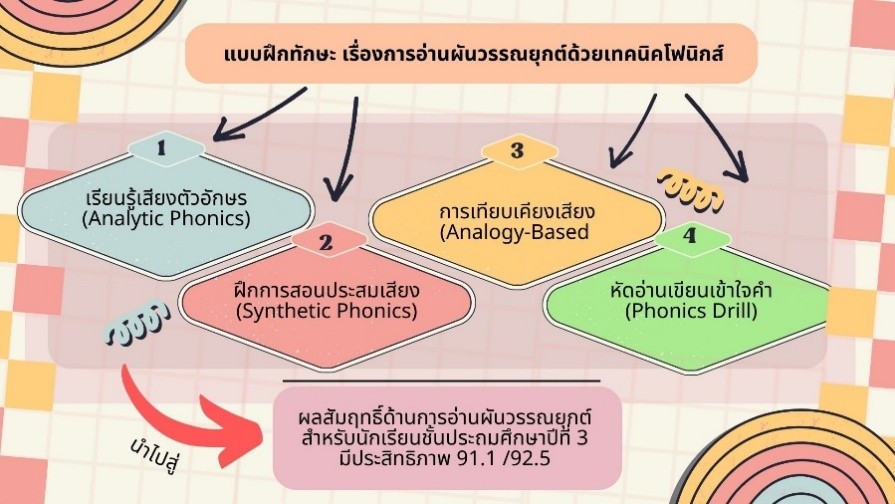
1. The results of evaluating the effectiveness of the tone-shifting exercise set using phonics techniques. For Grade 3 students, the process efficiency (E1) was 91.1, and the process efficiency (E2) was 92.5. This indicates that the learning activities on reading with tone variation using the phonics skill training kit had process efficiency and outcome efficiency (E1/E2) exceeding the specified 80/80 criterion.
2. The pre-test achievement in tone variation using the phonics skill training kit for Grade 3 students had a mean score of 6.00 and a standard deviation of 1.34. In contrast, the post-test scores after using the phonics skill training kit had a mean score of 9.25 and a standard deviation of 0.75. Comparing the learning achievement between the pre-test and post-test using a t-test for dependent samples, the post-test scores were significantly higher than the pre-test scores at a statistical significance level of .05.
Article Details

This work is licensed under a Creative Commons Attribution-NonCommercial-NoDerivatives 4.0 International License.
เพื่อให้เป็นไปตามกฎหมายลิขสิทธิ์ ผู้นิพนธ์ทุกท่านต้องลงลายมือชื่อในแบบฟอร์มใบมอบลิขสิทธิ์บทความ ให้แก่วารสารฯ พร้อมกับบทความต้นฉบับที่ได้แก้ไขครั้งสุดท้าย นอกจากนี้ ผู้นิพนธ์ทุกท่านต้องยืนยันว่าบทความ ต้นฉบับที่ส่งมาตีพิมพ์นั้น ได้ส่งมาตีพิมพ์เฉพาะในวารสาร วิชาการธรรม ทรรศน์ เพียงแห่งเดียวเท่านั้น หากมีการใช้ ภาพหรือตารางของผู้นิพนธ์อื่นที่ปรากฏในสิ่งตีพิมพ์อื่นมาแล้ว ผู้นิพนธ์ต้องขออนุญาตเจ้าของลิขสิทธิ์ก่อน พร้อมทั้ง แสดงหนังสือที่ได้รับการยินยอมต่อบรรณาธิการ ก่อนที่บทความจะได้รับการตีพิมพ์References
กระทรวงศึกษาธิการ. (2551). หลักสูตรแกนกลางการศึกษาขั้นพื้นฐาน พุทธศักราช 2551. กรุงเทพฯ: ชุมชนสหกรณ์การเกษตรแห่งประเทศไทย.
ฉวีวรรณ วัฒนานุกิจ. (2565). การพัฒนาชุดกิจกรรมการเรียนรู้ด้วยการสอนแบบโฟนิกส์เพื่อส่งเสริมการอ่านออกเสียงภาษาอังกฤษ หน่วยการเรียนรู้เรื่อง สระเสียงสั้น สำหรับนักเรียนชั้นประถมศึกษาปีที่ 1. (วิทยานิพนธ์ครุศาสตรมหาบัณฑิต). จันทบุรี: มหาวิทยาลัยราชภัฏรำไพพรรณี.
ทิฏฐา สุวรรณกิจ, มาโนช ดินลานสกูล และวิทวัฒน์ ขัตติยะมาน. (2565). การสร้างแบบฝึกการอ่านออกเสียงภาษาไทยมาตรฐานร่วมกับการสอนภาษาแบบโฟนิกส์สำหรับนักเรียนชั้นประถมศึกษาปีที่ 3 โรงเรียนตำรวจตระเวนชายแดน บ้านสำนักเอาะ อำเภอสะบ้าย้อย จังหวัดสงขลา. วารสารศึกษาศาสตร์ มหาวิทยาลัยหาดใหญ่, 20(2), 2151-2168.
นงนุช อุปลี, นพวรรณ ฉิมรอยลาภ และสิทธิกร สุมาลี. (2565). การพัฒนาทักษะการอ่านและการเขียนคำที่มีวรรณยุกต์ด้วยเกมการศึกษาของนักเรียนชั้นประถมศึกษาปีที่ 1 โรงเรียนอนุบาลนนทบุรี. กรุงเทพฯ: มหาวิทยาลัยเกษตรศาสตร์.
พรรณพิมล มีแก้วแกม (2554). รายงานผลการใช้แบบฝึกเสริมทักษะการอ่านการเขียนคำและการผันวรรณยุกต์ กลุ่มสาระการเรียนรู้ภาษาไทย ชั้นประถมศึกษาปีที่ 4. อุตรดิตถ์: โรงเรียนบ้านน้ำพี้ มิตรภาพที่ 214 สำนักงานเขตพื้นที่การศึกษาประถมศึกษาอุตรดิตถ์ เขต 1.
สถาบันทดสอบทางการศึกษาแห่งชาติ (องค์การมหาชน). (2568). รายงานข้อค้นพบการใช้ภาษาไทยของนักเรียนจากการทดสอบ O-NET ด้วยรูปแบบข้อสอบอัตนัย ชั้นประถมศึกษาปีที่ 6 ปีการศึกษา 2567. กรุงเทพฯ: สถาบันทดสอบทางการศึกษาแห่งชาติ (องค์การมหาชน).
สุจิตรา ภู่สวัสดิ์ (2561). การเปรียบเทียบผลสัมฤทธิ์ทางการเรียนวิชาภาษาไทย เรื่อง การผันวรรณยุกต์ ของนักเรียนชั้นประถมศึกษาปีที่ 4 โรงเรียนวัดดอนยอ ที่สอนด้วยการใช้แบบฝึกทักษะและการสอนแบบปกติ. (วิทยานิพนธ์ครุศาสตรมหาบัณฑิต). กรุงเทพฯ: มหาวิทยาลัยรามคำแหง.
Adams, M. J. (1990). Beginning to read: Thinking and learning about print. Cambridge, MA: MIT Press.
Bruner, J. S. (1990). Acts of meaning. Cambridge, MA: Harvard University Press.
Keller, J. M. (2010). Motivational design for learning and performance: The ARCS model approach. New York, NY: Springer.
Kolb, D. A. (1984). Experiential learning: Experience as the source of learning and development. Englewood Cliffs, NJ: Prentice Hall.
Lyon, G. R., & Chhabra, V. (2004). The science of reading research. Educational Leadership, 61(6), 16-21.
Vygotsky, L. S. (1978). Mind in society: The development of higher psychological processes. Cambridge, MA: Harvard University Press.
