Developing A Learning Organization Model Based on the Sappāya Dhamma Principles for Schools under the Primary Educational Service Area Office in Inspection Region 12
Article Sidebar
Main Article Content
Abstract
The purposes of this research were to: (1) investigate the current conditions, desirable conditions, and priority needs of learning organization development based on the principles of Sappāya-dhamma in schools under the Office of Primary Educational Service Areas in Educational Inspectorate Area 12; (2) develop a learning organization model based on the principles of Sappāya-dhamma for schools under the Office of Primary Educational Service Areas in Educational Inspectorate Area 12; and (3) evaluate the developed learning organization model. This study employed a mixed-methods research design. The research instruments included questionnaires, semi-structured interviews, a model evaluation form, and a satisfaction assessment form. The sample consisted of 18 school administrators and 320 teachers, totaling 338 participants. The quantitative data were analyzed using frequency, percentage, mean, standard deviation, and priority needs index, while qualitative data were obtained through semi-structured interviews and focus group discussions. Model evaluation and satisfaction data were analyzed using frequency, percentage, and standard deviation.
The research findings revealed that:
1. Overall, the current conditions of the learning organization based on the principles of Sappāya-dhamma were at a high level, while the desirable conditions were at the highest level. The priority needs, ranked in descending order, were: (1) team learning, (2) systems thinking, (3) mental model development, (4) shared vision building, and (5) personal mastery.
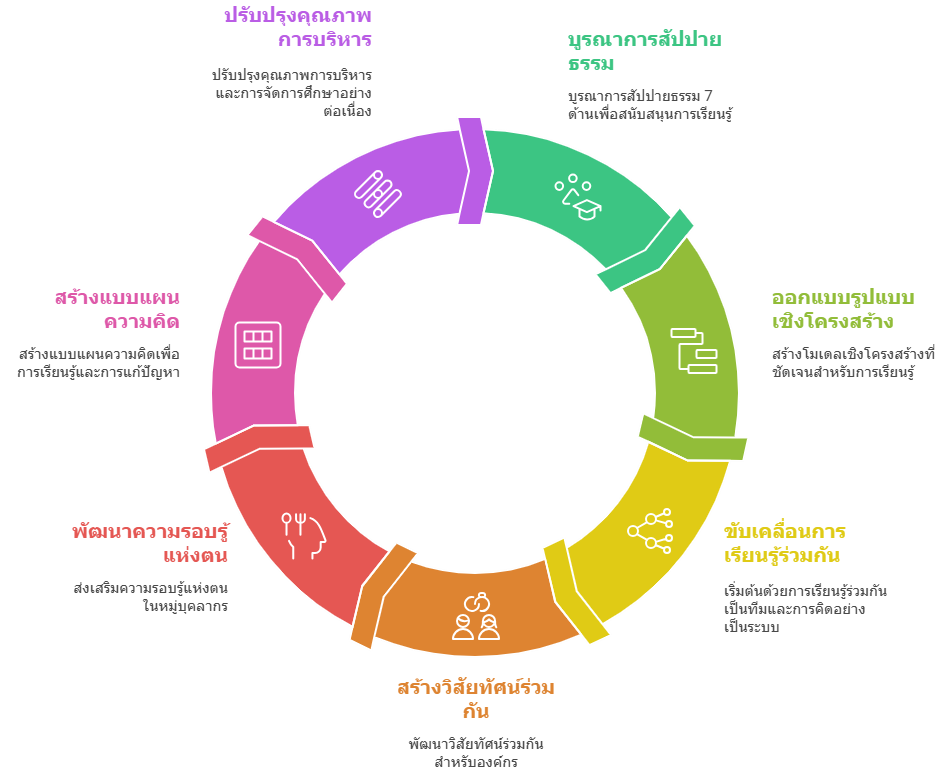
2. The developed learning organization model comprised the following components: (1) model title, (2) objectives, (3) principles and conceptual framework, and (4) content, including principles and concepts, objectives, methods and activities, integration of Sappāya-dhamma, and expected outcomes.
3. The evaluation results indicated that the learning organization model demonstrated appropriateness, feasibility, and usefulness at the highest level in all aspects.
Article Details

This work is licensed under a Creative Commons Attribution-NonCommercial-NoDerivatives 4.0 International License.
เพื่อให้เป็นไปตามกฎหมายลิขสิทธิ์ ผู้นิพนธ์ทุกท่านต้องลงลายมือชื่อในแบบฟอร์มใบมอบลิขสิทธิ์บทความ ให้แก่วารสารฯ พร้อมกับบทความต้นฉบับที่ได้แก้ไขครั้งสุดท้าย นอกจากนี้ ผู้นิพนธ์ทุกท่านต้องยืนยันว่าบทความ ต้นฉบับที่ส่งมาตีพิมพ์นั้น ได้ส่งมาตีพิมพ์เฉพาะในวารสาร วิชาการธรรม ทรรศน์ เพียงแห่งเดียวเท่านั้น หากมีการใช้ ภาพหรือตารางของผู้นิพนธ์อื่นที่ปรากฏในสิ่งตีพิมพ์อื่นมาแล้ว ผู้นิพนธ์ต้องขออนุญาตเจ้าของลิขสิทธิ์ก่อน พร้อมทั้ง แสดงหนังสือที่ได้รับการยินยอมต่อบรรณาธิการ ก่อนที่บทความจะได้รับการตีพิมพ์References
อัจจิมา รัตนาจารย์. (2564). การศึกษาคุณลักษณะที่ส่งผลในการเป็นองค์กรแห่งการเรียนรู้ สำนักงานคณะกรรมการการศึกษาขั้นพื้นฐาน. (วิทยานิพนธ์รัฐศาสตรมหาบัณฑิต). กรุงเทพฯ: มหาวิทยาลัยธรรมศาสตร์.
Krejcie, R. V., & Morgan, D. W. (1970). Determining sample size for research activities. Educational and Psychological Measurement, 30(3), 607-610. https://doi.org/10.1177/001316447003000308
Marquardt, M. J., & Reynolds, A. (1994). The global learning organization. Burr Ridge, IL: Irwin Professional Publishing.
Ubben, G. C., Hughes, L. W., & Norris, C. J. (2011). The principal: Creative leadership for excellence in schools. (7th ed.). Upper Saddle River, NJ: Pearson Education.
