Model of Innovative Leadership Development Based on Brahmavihara Principles 4 of Educational Institution Administrators Under the Jurisdiction of the Secondary Educational Service Area Office in Government Inspection Area 13
Article Sidebar
Main Article Content
Abstract
This research aimed to: 1) investigate the current situation, the desired condition, and the necessary needs for developing innovative leadership among educational institution administrators under the jurisdiction of the Secondary Educational Service Area Office in Government Inspection Area 13; 2) develop an innovative leadership development model based on the Four Brahmavihara Principles; and 3) evaluate the appropriateness of the developed model. The quantitative sample consisted of 238 school administrators, while the qualitative data were collected from 9 experts for focus group discussions and another 9 specialists for model evaluation. Research instruments included questionnaires, interviews, and evaluation forms. Data were analyzed using basic statistics such as mean, percentage, standard deviation, and the Priority Needs Index Modified (PNI modified).
The findings revealed that:
1. The current state of innovative leadership, based on the Four Brahmavihara Principles, was at a high level overall. Ranked in order from highest to lowest were team collaboration and participation, risk management, creativity, transformational vision, and the creation of an innovative organization. The desired state was rated at the highest level, indicating a significant need to enhance leadership capacity.
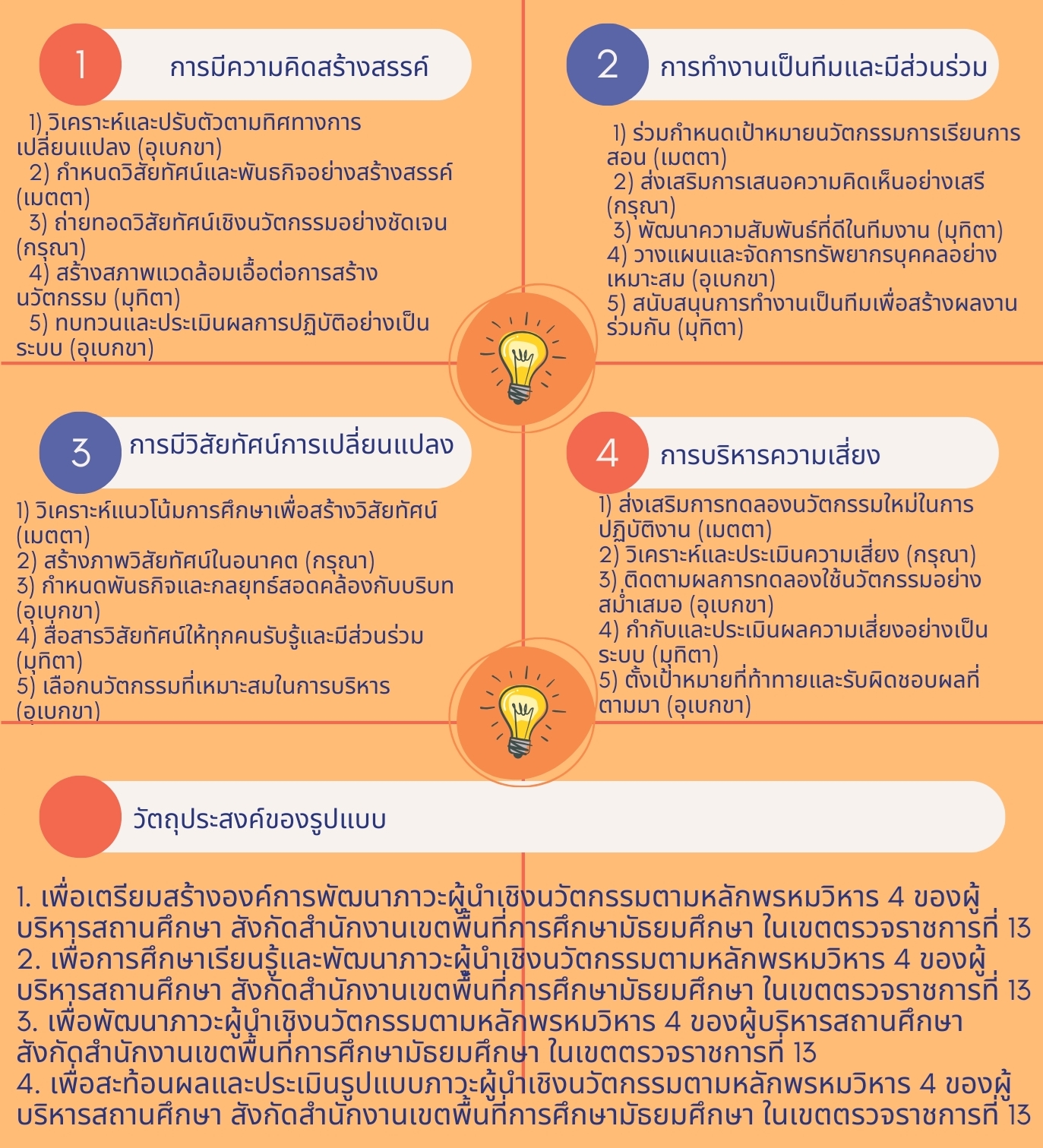
2. The developed model comprised five main components: model title, objectives, implementation methods, success goals, and driving mechanisms. The model integrates the ethical foundation of the Brahmavihara Principles with modern leadership approaches that emphasize innovation and moral integrity.
3. The evaluation of the model by experts confirmed its high levels of appropriateness, feasibility, and utility, suggesting that it is a practical and effective framework for promoting innovative leadership in the current educational context.
Article Details

This work is licensed under a Creative Commons Attribution-NonCommercial-NoDerivatives 4.0 International License.
เพื่อให้เป็นไปตามกฎหมายลิขสิทธิ์ ผู้นิพนธ์ทุกท่านต้องลงลายมือชื่อในแบบฟอร์มใบมอบลิขสิทธิ์บทความ ให้แก่วารสารฯ พร้อมกับบทความต้นฉบับที่ได้แก้ไขครั้งสุดท้าย นอกจากนี้ ผู้นิพนธ์ทุกท่านต้องยืนยันว่าบทความ ต้นฉบับที่ส่งมาตีพิมพ์นั้น ได้ส่งมาตีพิมพ์เฉพาะในวารสาร วิชาการธรรม ทรรศน์ เพียงแห่งเดียวเท่านั้น หากมีการใช้ ภาพหรือตารางของผู้นิพนธ์อื่นที่ปรากฏในสิ่งตีพิมพ์อื่นมาแล้ว ผู้นิพนธ์ต้องขออนุญาตเจ้าของลิขสิทธิ์ก่อน พร้อมทั้ง แสดงหนังสือที่ได้รับการยินยอมต่อบรรณาธิการ ก่อนที่บทความจะได้รับการตีพิมพ์References
ตรี ภูวิโคตรธนกุล, วัลลภา อารีรัตน์ และประกฤติยา ทักษิโณ. (2562). โมเดลภาวะผู้นำของผู้บริหารสถานศึกษาที่ส่งผลต่อสมรรถนะครูในการจัดการเรียนรู้ตามแนวสะเต็มศึกษา: โมเดลแข่งขันภาวะผู้นำเชิงนวัตกรรมและภาวะผู้นำเชิงวิชาการ. วารสารบริหารการศึกษามหาวิทยาลัยขอนแก่น, 15(2), 70-84. https://so02.tci-thaijo.org/index.php/EDMKKU/article/view/215463
พยัต วุฒิรงค์. (2557). การจัดการนวัตกรรม: ทรัพยากร องค์การแห่งการเรียนรู้ และนวัตกรรม. กรุงเทพฯ: จุฬาลงกรณ์มหาวิทยาลัย.
มหาวิทยาลัยสุโขทัยธรรมาธิราช. (2554). การปรึกษาเชิงจิตวิทยา. นนทบุรี: คณะศึกษาศาสตร์ มหาวิทยาลัยสุโขทัยธรรมาธิราชนนทบุรี.
สุกัญญา แช่มช้อย. (2555). แนวคิดเชิงนวัตกรรมสำหรับการบริหารสถานศึกษาในศตวรรษที่ 21. วารสารศึกษาศาสตร์ มหาวิทยาลัยนเรศวร, 4(2), 1-12.
