The Transformational Leadership Model Based on the Four Brahmavihāra Principles of Administrators in Phrapariyattidhamma Schools, General Education Division, Region 7
Article Sidebar
Main Article Content
Abstract
The purposes of this research were: 1) examine the current state, desirable state, and necessary improvements in transformational leadership of administrators in Phrapariyattidhamma Schools, General Education Division, Region 7, 2) develop a transformational leadership model based on the Four Brahmavihāra Principles, and 3) evaluate the effectiveness of the developed leadership model. The study utilized a mixed-methods approach, with a sample group comprising 305 administrators and teachers from Phrapariyattidhamma Schools, General Education Division, Region 7. Research instruments included questionnaires, semi-structured interviews, and evaluation forms, while data analysis employed percentage, mean, standard deviation, and necessary needs index (PNI).
The results revealed that:
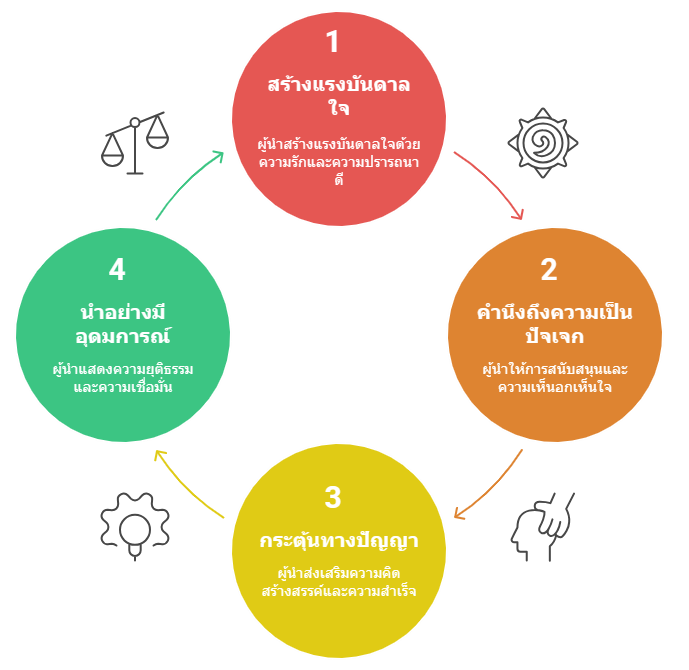
1. The current state of transformational leadership based on the Four Brahmavihāra Principles among school administrators was found to be at a high level overall. When considering specific aspects, all dimensions had high average scores. The desirable state was at the highest level overall, with most individual dimensions scoring between high to highest levels. The average necessary needs index (PNI) was calculated at 0.19, with the ranking of leadership aspects from highest to lowest as follows: (1) Idealized Influence, (2) Intellectual Stimulation, (3) Individual Consideration, and (4) Inspirational Motivation.
2. The Transformational Leadership Model based on the Four Brahmavihāra Principles consists of (1) model name, (2) model objectives, (3) principles and conceptual framework, (4) content structure integrating the Four Brahmavihāra Principles, and (5) expected outcomes.
3. The evaluation of the transformational leadership model based on the Four Brahmavihāra Principles in terms of appropriateness, feasibility, and benefits yielded high average scores across all criteria.
Article Details

This work is licensed under a Creative Commons Attribution-NonCommercial-NoDerivatives 4.0 International License.
เพื่อให้เป็นไปตามกฎหมายลิขสิทธิ์ ผู้นิพนธ์ทุกท่านต้องลงลายมือชื่อในแบบฟอร์มใบมอบลิขสิทธิ์บทความ ให้แก่วารสารฯ พร้อมกับบทความต้นฉบับที่ได้แก้ไขครั้งสุดท้าย นอกจากนี้ ผู้นิพนธ์ทุกท่านต้องยืนยันว่าบทความ ต้นฉบับที่ส่งมาตีพิมพ์นั้น ได้ส่งมาตีพิมพ์เฉพาะในวารสาร วิชาการธรรม ทรรศน์ เพียงแห่งเดียวเท่านั้น หากมีการใช้ ภาพหรือตารางของผู้นิพนธ์อื่นที่ปรากฏในสิ่งตีพิมพ์อื่นมาแล้ว ผู้นิพนธ์ต้องขออนุญาตเจ้าของลิขสิทธิ์ก่อน พร้อมทั้ง แสดงหนังสือที่ได้รับการยินยอมต่อบรรณาธิการ ก่อนที่บทความจะได้รับการตีพิมพ์References
กองพุทธศาสนศึกษา. (2557). คู่มือปฏิบัติงานโรงเรียนพระปริยัติธรรม แผนกสามัญศึกษา สำนักงานพระพุทธศาสนาแห่งชาติ. กรุงเทพฯ: สำนักงานพระพุทธศาสนาแห่งชาติ.
จารุวรรณ นูสา และสิทธิชัย สอนสุภี. (2564). องค์ประกอบภาวะผู้นำการเปลี่ยนแปลงของผู้บริหารสถานศึกษา สังกัดสำนักงานเขตพื้นที่การศึกษาประถมศึกษาหนองคาย เขต 2. ใน การประชุมวิชาการเสนอผลงานวิจัยระดับบัณฑิตศึกษาแห่งชาติ ครั้งที่ 22 (หน้า 902-911). ขอนแก่น: มหาวิทยาลัยขอนแก่น.
ปิยธิดา เย็นสบาย และจุฑารัตน์ นิรันดร. (2564). ความสัมพันธ์ระหว่างภาวะผู้นำการเปลี่ยนแปลงของผู้บริหารสถานศึกษากับการบริหารงานวิชาการในโรงเรียนเอกชน สังกัดสำนักงานศึกษาธิการจังหวัดสมุทรสาคร. Education Journal, 4(2), 37-48.
ปิยะวัฒน์ สุขเทศ, วรกฤต เถื่อนช้าง และปฏิธรรม สำเนียง. (2563). รูปแบบการพัฒนาภาวะผู้นำการเปลี่ยนแปลงที่มีประสิทธิภาพตามหลักพุทธธรรมของผู้บริหารสถานศึกษาขั้นพื้นฐาน. วารสารครุศาสตร์ปริทรรศน์ คณะครุศาสตร์ มหาวิทยาลัยมหาจุฬาลงกรณราชวิทยาลัย, 7(3), 1-14.
พระมหาสมบัติ ธนปญฺโญ (ฉลอง) และบรรจบ บรรณรุจิ. (2557). ยุทธศาสตร์เชิงพุทธสำหรับผู้บริหารโรงเรียนพระปริยัติธรรม แผนกสามัญศึกษา. วารสารครุศาสตร์ปริทรรศน์ คณะครุศาสตร์ มหาวิทยาลัยมหาจุฬาลงกรณราชวิทยาลัย, 1(2), 93-102.
รุ้งนภา จันทร์ลี. (2562). ภาวะผู้นำการเปลี่ยนแปลงของผู้บริหารสถานศึกษาที่ส่งผลต่อการเป็นองค์กรแห่งการเรียนรู้ของสถานศึกษา สังกัดสำนักงานเขตพื้นที่การศึกษาประถมศึกษาจันทบุรี เขต 2. (วิทยานิพนธ์ครุศาสตรมหาบัณฑิต). จันทบุรี: มหาวิทยาลัยราชภัฏรำไพพรรณี.
ศิริภัสสร ปิยนันทวารินทร์, สายรุ้ง บุบผาพันธ์ และสมชัย ศรีนอก. (2566). พรหมวิหาร 4 กับภาวะผู้นำในยุคสังคม 5.0. วารสารสหวิทยาการนวัตกรรมปริทรรศน์, 6(3), 294-306. https://so04.tci-thaijo.org/index.php/jidir/article/view/265647/179480
สุกรี สุระคำแหง. (2563). ความสัมพันธ์ระหว่างภาวะผู้นำการเปลี่ยนแปลงของผู้บริหารสถาน ศึกษากับความพึงพอใจในการปฏิบัติงานของครูโรงเรียนเอกชนสอนศาสนาอิสลาม สังกัดสำนักงานการศึกษาเอกชนจังหวัดสงขลา. (วิทยานิพนธ์ศึกษาศาสตรมหาบัณฑิต). สงขลา: มหาวิทยาลัยหาดใหญ่.
สุพรรณดา แสนบุญ, ทองฟู ศิริวงศ์, สมพล ทุ่งหว้า และลักษมี ทุ่งหว้า. (2565). ภาวะผู้นำการเปลี่ยนแปลงของผู้บริหารสถานศึกษาส่งผลต่อคุณภาพชีวิตการทำงานของครูและบุคลากรทางการศึกษาโรงเรียน ในสังกัดสำนักงานเขตพื้นที่การศึกษามัธยมศึกษา กรุงเทพมหานคร เขต 1 กลุ่ม 3. Journal of Modern Learning Development, 7(9), 259-272.
Krejcie, R. V., & Morgan, D. W. (1970). Determining sample size for research activities. Educational and Psychological Measurement, 30(3), 607-610. https://doi.org/10.1177/001316447003000308
