Analyzing the Existentialism of Simone de Beauvoir
Article Sidebar
Main Article Content
Abstract
The objectives of this research are: 1) To study the concept of Existentialism. 2) To study the Existentialism of Simone de Beauvoir. 3) To analyze the Existentialism of Simone de Beauvoir. It is a documentary research. The data were collected from the relevant sources: primary, secondary and related documents. The collected data were interpreted by the descriptive analysis based on the inductive method.
The results revealed that:
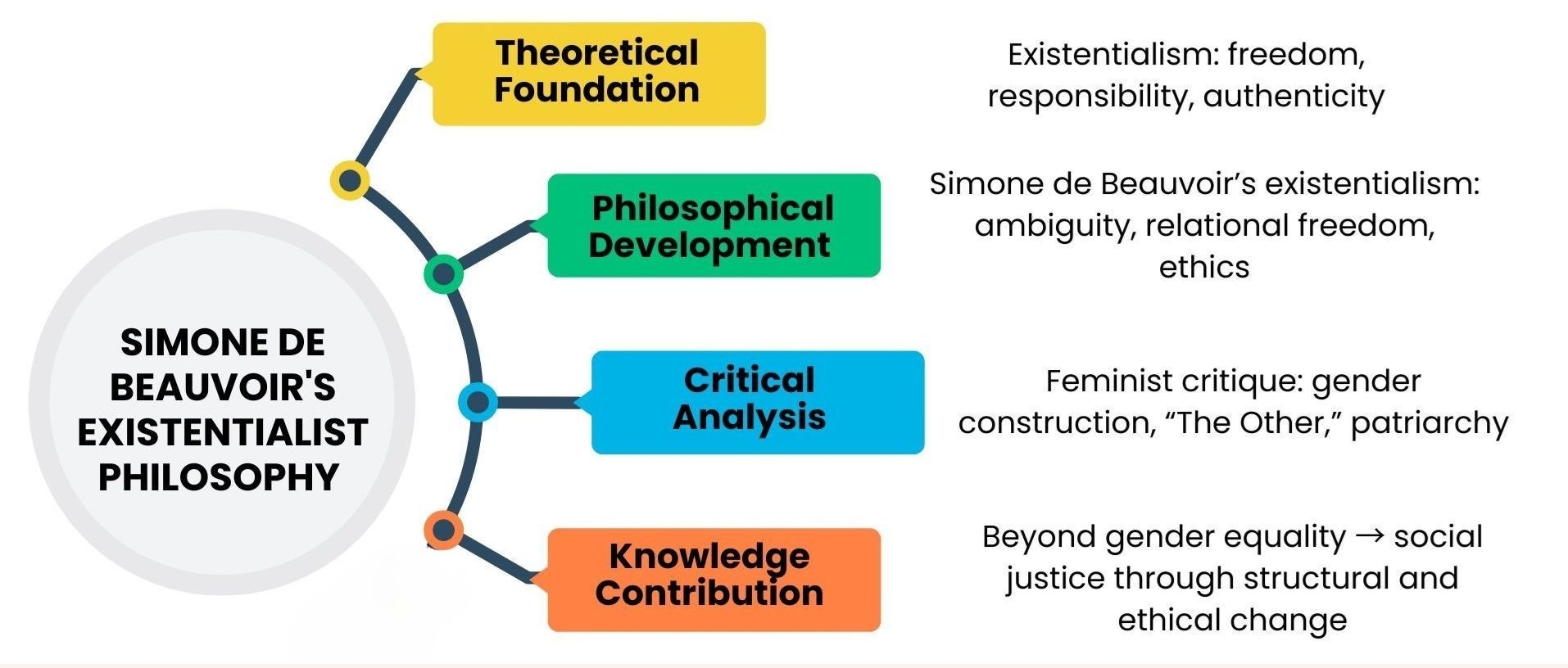
1. Existentialism serves as a vital philosophical approach that encourages individuals to confront their existence and embrace the freedom and responsibility that come with it. By engaging with existentialist ideas, individuals can cultivate a deeper understanding of themselves and their places in the world, ultimately leading to their more authentic and fulfilling lives.
2. Simone de Beauvoir’s philosophy explores ambiguity, freedom, ethics, and human relationships, emphasizing that true freedom is interconnected with the freedom of others. Her work challenges societal views on aging, advocates for gender equality, and highlights our ethical responsibility to others. By distinguishing internal and external freedom, she stresses mutual respect and shared goals for genuine connection. Her ideas remain vital to contemporary debates on social justice and collective liberation.
3. Simone de Beauvoir’s existential philosophy intertwines feminism, freedom, and ethical responsibility, challenging oppressive systems and advocating for human agency. She critiques the social construction of gender, exposing how women are relegated to The Other and calling for liberation through education, economic independence, and systemic change. Her existentialism emphasizes that freedom is not absolute but a dynamic process requiring mutual recognition and collective responsibility. By navigating human ambiguity and rejecting rigid moral absolutes, Beauvoir offers a framework for social justice, ethical engagement, and the pursuit of meaning in a world devoid of inherent purpose.
Article Details

This work is licensed under a Creative Commons Attribution-NonCommercial-NoDerivatives 4.0 International License.
เพื่อให้เป็นไปตามกฎหมายลิขสิทธิ์ ผู้นิพนธ์ทุกท่านต้องลงลายมือชื่อในแบบฟอร์มใบมอบลิขสิทธิ์บทความ ให้แก่วารสารฯ พร้อมกับบทความต้นฉบับที่ได้แก้ไขครั้งสุดท้าย นอกจากนี้ ผู้นิพนธ์ทุกท่านต้องยืนยันว่าบทความ ต้นฉบับที่ส่งมาตีพิมพ์นั้น ได้ส่งมาตีพิมพ์เฉพาะในวารสาร วิชาการธรรม ทรรศน์ เพียงแห่งเดียวเท่านั้น หากมีการใช้ ภาพหรือตารางของผู้นิพนธ์อื่นที่ปรากฏในสิ่งตีพิมพ์อื่นมาแล้ว ผู้นิพนธ์ต้องขออนุญาตเจ้าของลิขสิทธิ์ก่อน พร้อมทั้ง แสดงหนังสือที่ได้รับการยินยอมต่อบรรณาธิการ ก่อนที่บทความจะได้รับการตีพิมพ์References
Bauer, N. (2001). Simone de Beauvoir, philosophy, and feminism. New York, NY: Columbia University Press.
Beauvoir, S. de. (1976). The ethics of ambiguity (B. Frechtman, Trans.). Secaucus, NJ: Citadel Press. (Original work published 1947).
Beauvoir, S. de. (2011). The second sex (C. Borde & S. Malovany Chevallier, Trans.). New York, NY: Vintage Books. (Original work published 1949).
Card, C. (Ed.). (2003). The Cambridge companion to Simone de Beauvoir. Cambridge, UK: Cambridge University Press.
Duran, J. (2006). Eight women philosophers. Urbana and Chicago, IL: University of Illinois Press.
Kaufmann, W. (1956). Existentialism from Dostoevsky to Sartre. New York, NY: Meridian Books.
O’Brien, W., & Embree, L. (Eds.). (2001). The existential phenomenology of Simone de Beauvoir. Dordrecht, Netherlands: Springer Science + Business Media.
Sartre, J. -P. (2007). Existentialism is a humanism (C. Macomber, Trans.). New Haven, CT: Yale University Press. (Original work published 1946).
Solomon, R. C. (2005). Existentialism. (2nd ed.). New York, NY: Oxford University Press.
Tan, T. (2007). Existentialism and Samuel Beckett’s two plays: Endgame and Happy Days. (Thesis of Master of Arts). Middle East Technical University, Ankara, Turkey.
