A Development of Teacher Competencies Model in the 21st Century Under Nakhon Si Thammarat Special Education Center
Article Sidebar
Main Article Content
Abstract
The objectives of this research were: (1) to investigate the current conditions, desirable conditions, and needs concerning teacher competencies in the 21st century under the Nakhon Si Thammarat Special Education Center; (2) to develop a 21st-century teacher competency model; and (3) to validate the developed model. A multiphase mixed-methods design consisting of three phases was employed. In Phase 1, the current and desirable conditions and needs related to teacher competencies were examined among 115 school administrators and teachers under the Office of Special Education Administration, selected through purposive sampling. In Phase 2, the teacher competency model for the 21st century was constructed through connoisseurship seminars with experts. In Phase 3, the model was validated in terms of accuracy, appropriateness, feasibility, and usefulness by experts, and its practicality was evaluated by school administrators and teachers under the Office of Special Education Administration. Questionnaires and interview forms were used as research instruments. Quantitative data were analyzed using descriptive statistics, including frequency, percentage, and arithmetic mean, while qualitative data were analyzed using content analysis and summarization.
The findings revealed that:
1. The current conditions of teacher competencies in the 21st century under the Nakhon Si Thammarat Special Education Center were at a high level overall, and the desirable conditions were also rated at a high level in all aspects.
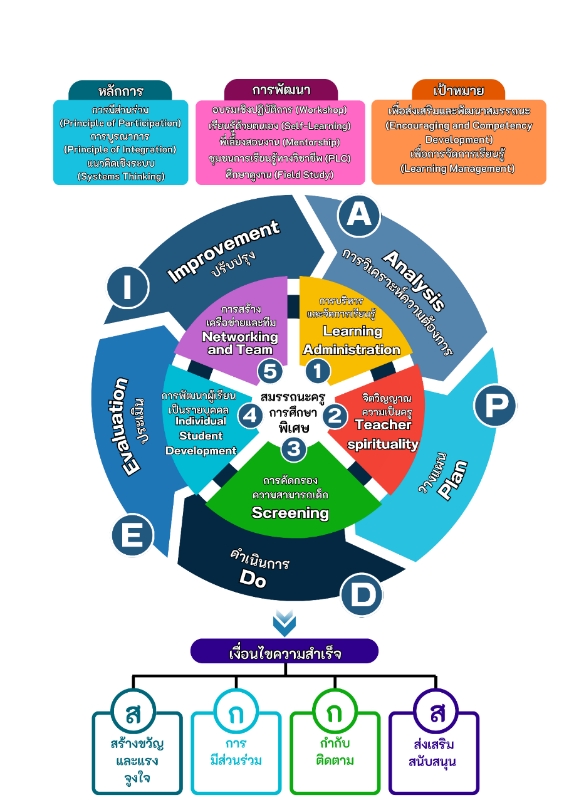
2. The developed teacher competency model comprised three components: Part 1-model name, principles, and objectives; Part 2-methods and processes for developing teacher competencies; and Part 3-model evaluation and success factors in developing teacher competencies
3. The model was confirmed to be accurate, appropriate, feasible, and useful, with all items rated at the highest level overall, indicating that it can be practically implemented.
Article Details

This work is licensed under a Creative Commons Attribution-NonCommercial-NoDerivatives 4.0 International License.
เพื่อให้เป็นไปตามกฎหมายลิขสิทธิ์ ผู้นิพนธ์ทุกท่านต้องลงลายมือชื่อในแบบฟอร์มใบมอบลิขสิทธิ์บทความ ให้แก่วารสารฯ พร้อมกับบทความต้นฉบับที่ได้แก้ไขครั้งสุดท้าย นอกจากนี้ ผู้นิพนธ์ทุกท่านต้องยืนยันว่าบทความ ต้นฉบับที่ส่งมาตีพิมพ์นั้น ได้ส่งมาตีพิมพ์เฉพาะในวารสาร วิชาการธรรม ทรรศน์ เพียงแห่งเดียวเท่านั้น หากมีการใช้ ภาพหรือตารางของผู้นิพนธ์อื่นที่ปรากฏในสิ่งตีพิมพ์อื่นมาแล้ว ผู้นิพนธ์ต้องขออนุญาตเจ้าของลิขสิทธิ์ก่อน พร้อมทั้ง แสดงหนังสือที่ได้รับการยินยอมต่อบรรณาธิการ ก่อนที่บทความจะได้รับการตีพิมพ์References
กาญจนา ฮวดศรี. (2566). รูปแบบการพัฒนาสมรรถนะครูศูนย์การศึกษาพิเศษ สังกัดสำนักบริหารงานการศึกษาพิเศษ. (วิทยานิพนธ์การศึกษาดุษฎีบัณฑิต). พิษณุโลก: มหาวิทยาลัยนเรศวร.
ทินกร บัวชู. (2564). รูปแบบการพัฒนาสมรรถนะเพื่อเพิ่มขีดความสามารถทางการแข่งขันในศตวรรษที่ 21 ของอาจารย์พยาบาลสังกัดมหาวิทยาลัยราชภัฏ. (วิทยานิพนธ์การศึกษาดุษฎีบัณฑิต). กรุงเทพฯ: มหาวิทยาลัยศรีนครินทรวิโรฒ.
ธนกฤต อั้งน้อย. (2563). การพัฒนารูปแบบการดำเนินงานระบบดูแลช่วยเหลือนักเรียนที่มีประสิทธิผลของโรงเรียนขนาดเล็ก: กรณีศึกษาโรงเรียนบ้านวังจาน. วารสารคุรุสภาวิทยาจารย์, 1(3), 31-43.
พระราชบัญญัติการจัดการศึกษาสำหรับคนพิการ พ.ศ. 2551. (5 กุมภาพันธ์ 2551). ราชกิจจานุเบกษา, เล่มที่ 125 ตอนที่ 28 ก หน้า 2-4.
พระราชบัญญัติสภาครูและบุคลากรทางการศึกษา (ฉบับที่ 8) พ.ศ. 2546. (25 พฤษภาคม 2546). ราชกิจจานุเบกษา. เล่มที่ 120 ตอนที่ 52 ก หน้า 3-4.
วรรณี เจตจำนงนุช, ปิยวรรณ วิเศษสุวรรณภูมิ, ชนิศา ตันติเฉลิม และดุสิดา ทินมาลา. (2560). มาตรฐานวิชาชีพครูการศึกษาพิเศษ. วารสารวิธีวิทยาการวิจัย, 30(2), 161-176.
สมาน อัศวภูมิ. (2550). การใช้วิจัยพัฒนารูปแบบในวิทยานิพนธ์ระดับปริญญาเอก. วารสารมหาวิทยาลัยราชภัฏอุบลราชธานี, 2(2), 76-85.
สำนักบริหารงานการศึกษาพิเศษ. (2558). แนวทางการจัดการศึกษาสำหรับผู้เรียนที่มีความต้องการจำเป็นพิเศษ. กรุงเทพฯ: กระทรวงศึกษาธิการ.
Australian College of Education. (2001). Teacher standards, quality and professionalism: Towards a nationally agreed framework. Victoria, Australia: Australian College of Education.
Eisner, E. W. (1976). Educational connoisseurship and criticism: Their form and functions in educational evaluation. Journal of Aesthetic Education, 10(3-4), 135-150. https://doi.org/10.2307/3332067
Keeves, J. P. (1988). Model and model building. In J. P. Keeves (Ed.), Educational research, methodology, and measurement: An international handbook (pp. 559-566). Oxford, UK: Pergamon Press.
McClelland, D. C. (2009). Human motivation. Cambridge, UK: Cambridge University Press.
