Validation of the Causal Model of Motivational Process Based On the Expectancy-Value Theory Affecting Innovative Thinking Competencies for Entrepreneurship in Undergraduate Students
Article Sidebar
Main Article Content
Abstract
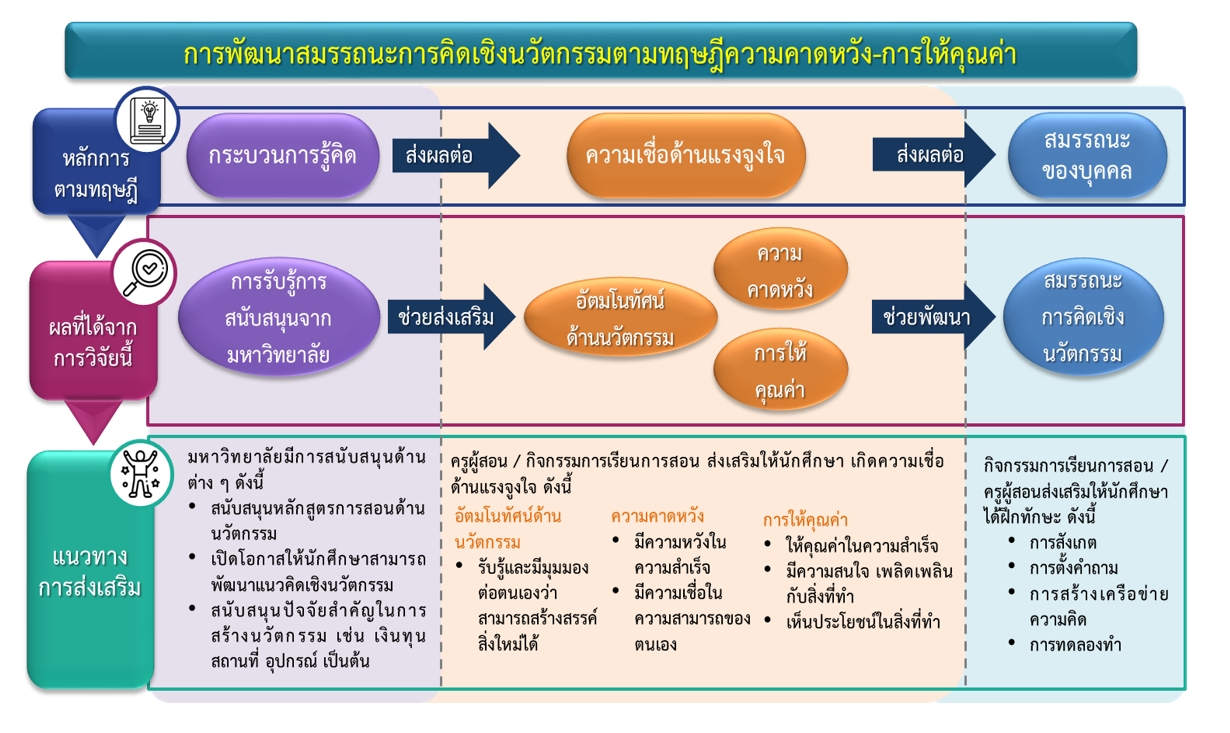
This study aimed to examine the validity of the causal relationship model, including effects of variables based on the Expectancy-Value Theory that influence innovative thinking competencies for entrepreneurship among undergraduate students. The causal variables comprised perceived university support, innovative self-concept, expectancy, and value. The sample consisted of 738 undergraduate students in Bangkok. The participants were sampled using multi-stage random sampling. Self-report questionnaires using a five-point rating scale were employed to collect data, with reliability values ranging from .94 to .96. Data were analyzed using Structural Equation Modeling.
The results revealed that: the developed model demonstrated a good fit with the empirical data (Chi-square = 87.789, df = 69, p = 0.063, Chi-square/df = 1.272, GFI = 0.983, AGFI = 0.975, RMSEA = 0.019). This indicates that the Expectancy–Value Theory appropriately explains the underlying mechanisms of innovative thinking competence. Innovative self-concept has the strongest influence on innovative thinking competencies, both directly and indirectly through expectancy and value. Perceived university support had no statistically significant direct effect on innovative thinking competencies, but it has an indirect effect through innovative self-concept, expectancy, and value. Collectively, the variables in the model explained 76% of the variance in innovative thinking competencies.
This study identifies key factors that support innovative thinking competencies, which can be beneficial for designing interventions to foster entrepreneurial innovative thinking competencies among undergraduate students. However, its cross-sectional design limits causal inference. Future studies should adopt longitudinal designs to provide stronger evidence for the causal relationships among variables.
Article Details

This work is licensed under a Creative Commons Attribution-NonCommercial-NoDerivatives 4.0 International License.
เพื่อให้เป็นไปตามกฎหมายลิขสิทธิ์ ผู้นิพนธ์ทุกท่านต้องลงลายมือชื่อในแบบฟอร์มใบมอบลิขสิทธิ์บทความ ให้แก่วารสารฯ พร้อมกับบทความต้นฉบับที่ได้แก้ไขครั้งสุดท้าย นอกจากนี้ ผู้นิพนธ์ทุกท่านต้องยืนยันว่าบทความ ต้นฉบับที่ส่งมาตีพิมพ์นั้น ได้ส่งมาตีพิมพ์เฉพาะในวารสาร วิชาการธรรม ทรรศน์ เพียงแห่งเดียวเท่านั้น หากมีการใช้ ภาพหรือตารางของผู้นิพนธ์อื่นที่ปรากฏในสิ่งตีพิมพ์อื่นมาแล้ว ผู้นิพนธ์ต้องขออนุญาตเจ้าของลิขสิทธิ์ก่อน พร้อมทั้ง แสดงหนังสือที่ได้รับการยินยอมต่อบรรณาธิการ ก่อนที่บทความจะได้รับการตีพิมพ์References
ทิบดี ทัฬหกรณ์ และธีรวัฒน์ จันทึก. (2560). การสร้างผู้ประกอบการรุ่นใหม่ในยุคไทยแลนด์ 4.0. RMUTT Global Business and Economics Review, 12(2), 107-122. https://so03.tci-thaijo.org/index.php/RMUTT-Gber/article/view/241926
สำนักงานเลขานุการของคณะกรรมการยุทธศาสตร์ชาติ. (2561). ยุทธศาสตร์ชาติ พ.ศ. 2561-2580. กรุงเทพฯ: สำนักงานคณะกรรมการพัฒนาการเศรษฐกิจและสังคมแห่งชาติ.
สำนักงานสภาพัฒนาการเศรษฐกิจและสังคมแห่งชาติ. (2565). แผนพัฒนาเศรษฐกิจและสังคมแห่งชาติ ฉบับที่สิบสาม พ.ศ. 2566-2570. กรุงเทพฯ: สำนักนายกรัฐมนตรี.
Appianing, J., & Van Eck, R. N. (2018). Development and validation of the Value-Expectancy STEM Assessment Scale for students in higher education. International Journal of STEM Education, 5(1), 1-16. https://doi.org/10.1186/s40594-018-0121-8
Chang, S. H., Wang, C. L., & Lee, J. C. (2016). Do award-winning experiences benefit students' creative self-efficacy and creativity? The moderated mediation effects of perceived school support for creativity. Learning and Individual Differences, 51, 291-298. https://doi.org/10.1016/j.lindif.2016.09.011
Chen, Y., Wei, J., Zhang, J., & Li, X. (2021). Effect Mechanism of Error Management Climate on Innovation Behavior: An Investigation from Chinese Entrepreneurs. Frontiers in psychology, 5610. https://doi.org/10.3389/fpsyg.2021.733741
Dyer, J. H., Gregersen, H. B., & Christensen, C. (2008). Entrepreneur behaviors, opportunity recognition, and the origins of innovative ventures. Strategic Entrepreneurship Journal, 2(4), 317-338. https://doi.org/10.1002/sej.59
Hair, J. F., Black, W. C., Babin, B. J., Anderson, R. E., & Tatham, R. L. (2006). Multivariate data analysis. Upper Saddle River, NJ: Pearson Prentice Hall.
International Institute for Management Development. (2024). IMD World Digital Competitiveness Ranking 2024: The digital divide: Risks and opportunities. Lausanne, Switzerland: IMD.
Karwowski, M. (2015). Development of the creative self-concept. Creativity. Theories-Research-Applications, 2(2), 165-179. https://doi.org/10.1515/ctra-2015-0019
Kolb, D. A. (1984). Experiential learning: experience as the source of learning and development. Englewood Cliffs, NJ: Prentice Hall.
Morad, S., Ragonis, N., & Barak, M. (2021). The validity and reliability of a tool for measuring educational innovative thinking competencies. Teaching and Teacher Education, 97, 103193. https://doi.org/10.1016/j.tate.2020.103193
Pukkeeree, P., Na-Nan, K., & Wongsuwan, N. (2020). Effect of attainment value and positive thinking as moderators of employee engagement and innovative work behaviour. Journal of Open Innovation: Technology, Market, and Complexity, 6(3), 69. https://doi.org/10.3390/joitmc6030069
Saeed, S., Yousafzai, S. Y., Yani-De-Soriano, M., & Muffatto, M. (2015). The role of perceived university support in the formation of students' entrepreneurial intention. Journal of small business management, 53(4), 1127-1145. https://doi.org/10.1111/jsbm.12090
Schumacker, R. E., & Lomax, R. G. (2016). A beginner’s guide to structural equation modeling. (4th ed.). New York, NY: Routledge.
Schunk, D. H., Pintrich, P. J. L., & Meece, J. L. (2008). Motivation in education: Theory, research and applications. (3rd ed.). Upper Saddle River, NJ: Pearson/Merrill.
Wang, P., & Zhu, W. (2011). Mediating role of creative identity in the influence of transformational leadership on creativity: Is there a multilevel effect?. Journal of Leadership & Organizational Studies, 18(1), 25-39. https://doi.org/10.1177/1548051810368549
West, S. G., Finch, J. F., & Curran, P. J. (1995). Structural equation models with nonnormal variables: Problems and remedies. In R. H. Hoyle (Ed.), Structural equation modeling: Concepts, issues, and applications (pp. 56-75). Thousand Oaks, CA: Sage Publications.
Wigfield, A., & Eccles, J. S. (2000). Expectancy-Value theory of achievement motivation. Contemporary Educational Psychology, 25, 68-81. https://doi.org/10.1006/ceps.1999.1015
