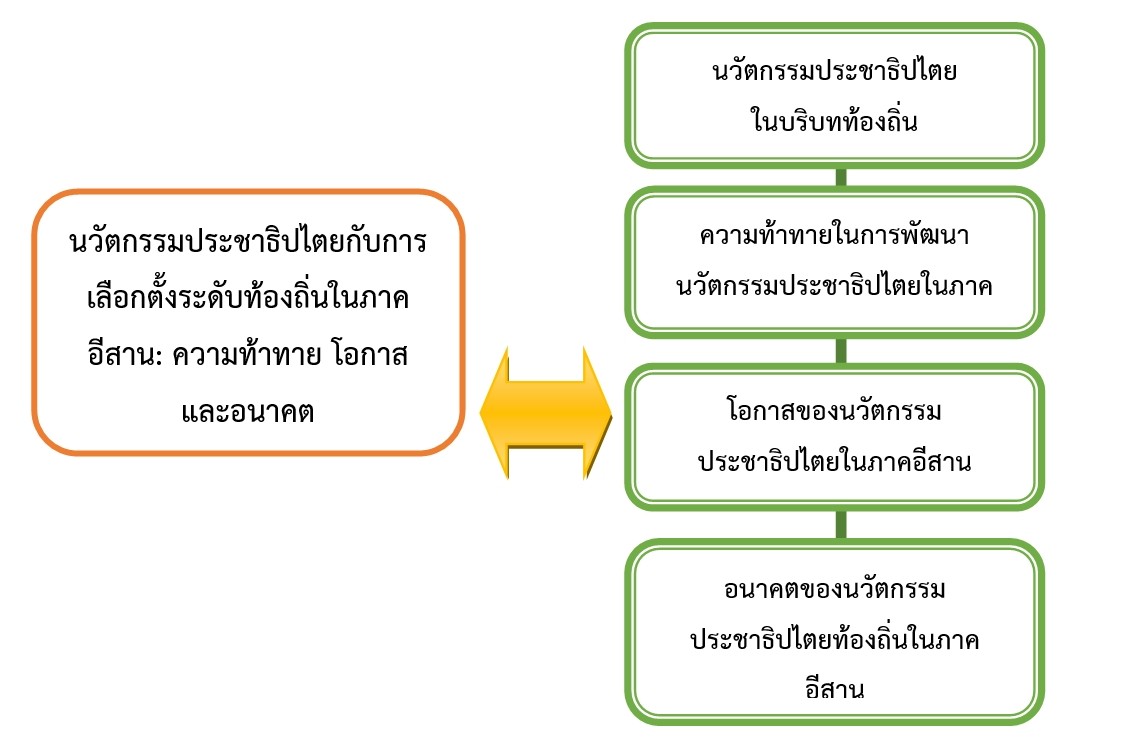
นวัตกรรมประชาธิปไตยกับการเลือกตั้งระดับท้องถิ่นในภาคอีสาน: ความท้าทาย โอกาสและอนาคต
Article Sidebar
Main Article Content
บทคัดย่อ
บทความวิชาการนี้ มีวัตถุประสงค์เพื่อศึกษาแนวทางการประยุกต์ใช้นวัตกรรมประชาธิปไตยในการส่งเสริมและพัฒนากระบวนการเลือกตั้งระดับท้องถิ่นในภาคตะวันออกเฉียงเหนือ (ภาคอีสาน) ของประเทศไทย โดยวิเคราะห์บริบททางการเมือง สังคม และวัฒนธรรมที่เป็นลักษณะเฉพาะของภูมิภาค ซึ่งมีผลต่อพลวัตและอุปสรรคของการเมืองท้องถิ่น ซึ่งบทความได้ทบทวนแนวคิดทฤษฎีเกี่ยวกับประชาธิปไตย การมีส่วนร่วมของพลเมือง นวัตกรรมประชาธิปไตยประเภทต่างๆ และสถานการณ์การเมืองท้องถิ่นในภาคอีสาน จากนั้นจึงนำเสนอตัวอย่างนวัตกรรมประชาธิปไตยที่สามารถปรับใช้ได้ เช่น เทคโนโลยีภาคพลเมือง (Civic Tech) กระบวนการปรึกษาหารือสาธารณะ และการศึกษาพลเมืองรูปแบบใหม่ ผลการศึกษาชี้ให้เห็นว่า การนำนวัตกรรมประชาธิปไตยมาใช้จะเผชิญกับความท้าทายหลายประการ อาทิ ระบบอุปถัมภ์ ความเหลื่อมล้ำทางดิจิทัล และข้อจำกัดด้านทรัพยากร แต่ก็มีโอกาสและปัจจัยสนับสนุน โดยเฉพาะความตื่นตัวของคนรุ่นใหม่และเครือข่ายภาคประชาสังคมในพื้นที่ รวมเพื่อเสนอแนวทางเชิงนโยบายต่อหน่วยงานที่เกี่ยวข้องและข้อเสนอแนะสำหรับการวิจัยในอนาคต เพื่อขับเคลื่อนการเมืองท้องถิ่น ภาคอีสานให้มีคุณภาพ โปร่งใส และตอบสนองต่อความต้องการของประชาชนอย่างแท้จริง
Article Details

อนุญาตภายใต้เงื่อนไข Creative Commons Attribution-NonCommercial-NoDerivatives 4.0 International License.
เพื่อให้เป็นไปตามกฎหมายลิขสิทธิ์ ผู้นิพนธ์ทุกท่านต้องลงลายมือชื่อในแบบฟอร์มใบมอบลิขสิทธิ์บทความ ให้แก่วารสารฯ พร้อมกับบทความต้นฉบับที่ได้แก้ไขครั้งสุดท้าย นอกจากนี้ ผู้นิพนธ์ทุกท่านต้องยืนยันว่าบทความ ต้นฉบับที่ส่งมาตีพิมพ์นั้น ได้ส่งมาตีพิมพ์เฉพาะในวารสาร วิชาการธรรม ทรรศน์ เพียงแห่งเดียวเท่านั้น หากมีการใช้ ภาพหรือตารางของผู้นิพนธ์อื่นที่ปรากฏในสิ่งตีพิมพ์อื่นมาแล้ว ผู้นิพนธ์ต้องขออนุญาตเจ้าของลิขสิทธิ์ก่อน พร้อมทั้ง แสดงหนังสือที่ได้รับการยินยอมต่อบรรณาธิการ ก่อนที่บทความจะได้รับการตีพิมพ์เอกสารอ้างอิง
พรรณราย โอสถาภิรัตน์. (2562). การเมืองภาคพลเมืองบนโลกออนไลน์: การศึกษาเครือข่ายพลเมืองอีสานกับการรณรงค์ทางสังคมและการเมือง. กรุงเทพฯ: สถาบันพระปกเกล้า.
อภิชาต สถิตนิรามัย และอนุสรณ์ อุณโณ. (2560). การเมืองคนดี: ความคิด ปฏิบัติการและอัตลักษณ์ทางการเมืองของผู้สนับสนุน “ขบวนการเปลี่ยนแปลงประเทศไทย”. (รายงานการวิจัย). กรุงเทพฯ: สำนักงานกองทุนสนับสนุนการวิจัย (สกว.).
อรรถสิทธิ์ พานแก้ว. (2560). พฤติกรรมการลงคะแนนเสียงเลือกตั้งท้องถิ่นในภาคตะวันออกเฉียงเหนือ. วารสารรัฐศาสตร์และรัฐประศาสนศาสตร์, 8(1), 45-67.
Ackerman, J. (2004). Co governance for accountability: Beyond ‘Exit’ and ‘Voice’. World Development, 32(3), 447 463.
Arghiros, D. (2001). Democracy, Development and Decentralization in Provincial Thailand. Curzon Press.
Baiocchi, G., Heller, P., & Silva, M. K. (2011). Bootstrapping democracy: Transforming local governance and civil society in Brazil. Stanford University Press.
Bjarnegård, E. (2013). Gender, Informal Institutions and Political Recruitment: Explaining Male Dominance in Parliamentary Representation. Palgrave Macmillan.
Bovaird, T., & Löffler, E. (2003). Evaluating the quality of public governance: indicators, models and methodologies. International Review of Administrative Sciences, 69(3), 313 328. https://doi.org/10.1177/0020852303693002
Callahan, S. G. (2005). Successful teaching in secondary schools: A guide for student and in service teachers. Scott, Foresman & Co.
Cornelio, J. S. (2016). Being Catholic in the contemporary Philippines: Young people reinterpreting religion. Routledge.
Farrell, D. M., Suiter, J., Harris, C., & Cunningham, K. (2020). The Effects of Mixed Membership in a Deliberative Forum: The Irish Constitutional Convention of 2012–2014. Political Studies, 68(1), 54-73. https://doi.org/10.1177/0032321719830936
Fishkin, J. S. (2009). When the People Speak: Deliberative Democracy and Public Consultation. Oxford University Press.
Glassman, M., Glassman, A., Champagne, P. J., & Zugelder, M. T. (2010). Evaluating pay for performance systems: Critical issues for implementation. Compensation & Benefits Review, 42(4), 231-238. https://doi.org/10.1177/0886368710374391
Gutmann, A., & Thompson, D. F. (2004). Why Deliberative Democracy? Princeton University Press.
Held, D. (2006). Models of Democracy. (3rd ed.). Polity Press.
Lathrop, D., & Ruma, L. (Eds.). (2010). Open government: Collaboration, transparency, and participation in practice. O'Reilly Media.
Missingham, R. (2009). Encouraging the digital economy and digital citizenship. The Australian Library Journal, 58(4), 386-399. https://doi.org/10.1080/00049670.2009.10735927
Newton, K., & Geissel, B. (Eds.). (2012). Evaluating democratic innovations: Curing the democratic malaise? Routledge.
Nishizaki, Y. (2011). Political Authority and Provincial Identity in Thailand: The Making of Banharn buri. Cornell Southeast Asia Program Publications.
Ockey, J. (2004). Making Democracy: Leadership, Class, Gender, and Political Participation in Thailand. Honolulu: University of Hawai’i Press.
Pateman, C. (1970). Participation and Democratic Theory. Cambridge University Press.
Phongpaichit, P., & Baker, C. (2009). Thaksin. (2nd ed.). Silkworm Books.
Sidel, J. T. (2014). Economic Foundations of Subnational Authoritarianism: Insights and Evidence from Qualitative and Quantitative Research. Democratization, 21(1), 161-184.
Smith, G. (2009). Democratic Innovations: Designing Institutions for Citizen Participation. Cambridge University Press.
