New Public Governance for Developing Local Products of Chang Noi Community to the Market
Article Sidebar
Main Article Content
Abstract
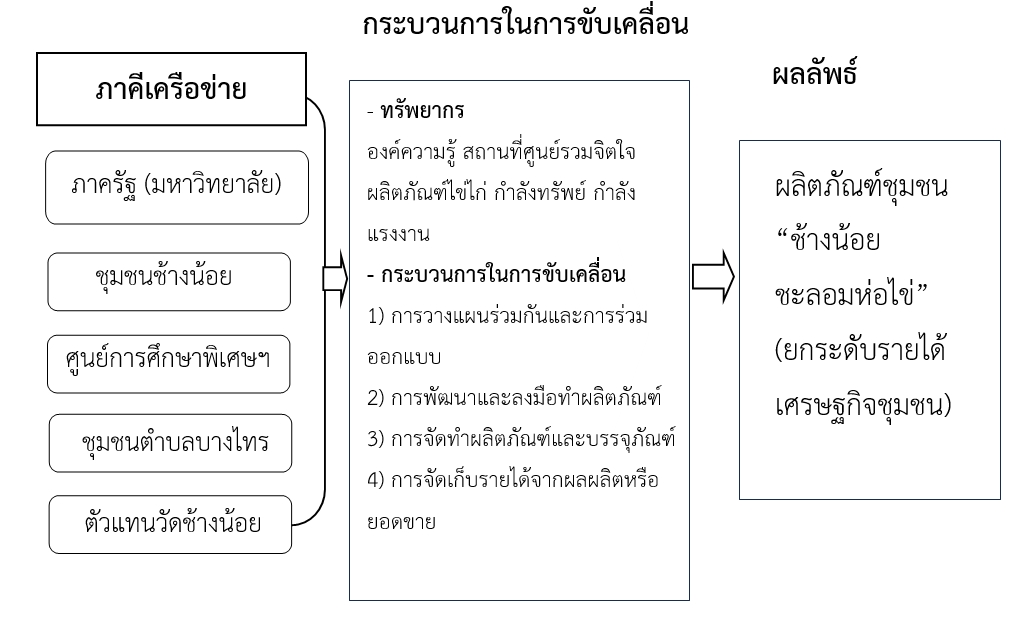
The objectives of this research were to: (1) examine the roles of stakeholders in the co-production of community products in Chang Noi Subdistrict through the New Public Governance (NPG); and (2) study the processes involved in developing community products for market distribution. The research questions focus on extracting participatory process approaches concerning the roles of stakeholders and the co-development of community products for the market. The study employed qualitative research methods through in-depth interviews and participant observation. A total of 29 key informants were purposively selected, including: (1) government representatives (university), (2) Chang Noi Subdistrict community, (3) The Special Education Center of Phra Nakhon Si Ayutthaya Province, Bang Sai District Unit, (4) representatives from Bang Sai Subdistrict community (a neighboring community), and (5) representatives from Wat Anukunchararam (Chang Noi Temple). Data were analyzed through descriptive narrative synthesis.
The results reveal that:
1. The role of stakeholders in driving community products to market began with the public sector, which initiated the product development project within the community and took on responsibilities such as coordination, implementation, and product distribution. In addition, various sectors participated by sharing knowledge and exchanging ideas, as well as providing spaces for discussion that fostered collective engagement within the community. Key stakeholder networks included representatives from the Chang Noi Subdistrict community, the neighboring Bang Sai Subdistrict community, the Special Education Center, and Wat Anukunchararam (Chang Noi Temple).
2. The process of developing community products for market distribution involved enhancing the value of local eggs by packaging them in woven bamboo baskets (Chalom) made by the community. The implementation began with a collaborative planning and design phase, which included incorporating the Chalom craft to add value to the product. This was followed by the development and production of the items, joint calculations of production costs and selling prices, and the organization of revenue collection based on the community’s product sales.
Article Details

This work is licensed under a Creative Commons Attribution-NonCommercial-NoDerivatives 4.0 International License.
เพื่อให้เป็นไปตามกฎหมายลิขสิทธิ์ ผู้นิพนธ์ทุกท่านต้องลงลายมือชื่อในแบบฟอร์มใบมอบลิขสิทธิ์บทความ ให้แก่วารสารฯ พร้อมกับบทความต้นฉบับที่ได้แก้ไขครั้งสุดท้าย นอกจากนี้ ผู้นิพนธ์ทุกท่านต้องยืนยันว่าบทความ ต้นฉบับที่ส่งมาตีพิมพ์นั้น ได้ส่งมาตีพิมพ์เฉพาะในวารสาร วิชาการธรรม ทรรศน์ เพียงแห่งเดียวเท่านั้น หากมีการใช้ ภาพหรือตารางของผู้นิพนธ์อื่นที่ปรากฏในสิ่งตีพิมพ์อื่นมาแล้ว ผู้นิพนธ์ต้องขออนุญาตเจ้าของลิขสิทธิ์ก่อน พร้อมทั้ง แสดงหนังสือที่ได้รับการยินยอมต่อบรรณาธิการ ก่อนที่บทความจะได้รับการตีพิมพ์References
ปุณณดา ทรงอิทธิสุข และวนัสนันท์ ศิริรัตนะ. (2567). การยกระดับมาตรฐานผลิตภัณฑ์เครื่องจักรสานไม้ไผ่สู่ชุมชนกลุ่มจักสานพบพระทรายงาม ตำบลพบพระ อำเภอพบพระ จังหวัดตาก. Interdisciplinary Academic and Research Journal, 4(5), 391-416. https://doi.org/10.60027/iarj.2024.267560
มหาวิทยาลัยราชภัฏวไลยอลงกรณ์ ในพระบรมราชูปถัมภ์. (2567). “พลังการรวมตัวที่ยิ่งใหญ่ หัวใจเพื่อการศึกษาและชุมชน” VRU SHOWCASE x VRU SUSTAINABILITY 2024. เข้าถึงได้จาก https://www.vru.ac.th/news7895/
สิริกาญจน์ ทวีพิธานันท์, ลักษมี งามมีศรี, เจนจิรา เงินจันทร์ และมานิตย์ สิงห์ทองชัย. (2566). การศึกษาการพัฒนาผลิตภัณฑ์และส่งเสริมการตลาดของกลุ่มวิสาหกิจชุมชนฝรั่งอินทรีย์ (บ้านตะคร้อ) เพื่อขยายตลาดไปสู่กลุ่มเป้าหมายใหม่. วารสารวิชาการการจัดการภาครัฐและเอกชน, 5(1), 173. https://doi.org/
14456/jappm.2023.12
Bovaird, T. (2007). Beyond engagement and participation: User and community coproduction of public services. Public administration review, 67(5), 846-860. https://doi.org/10.1111/j.1540-6210.2007.00773.x
Díaz-Cayeros, A., Magaloni, B., & Ruiz-Euler, A. (2014). Traditional governance, citizen engagement, and local public goods: evidence from Mexico. World development, 53, 80-93. https://doi.org/10.1016/j.worlddev.2013.01.008
Fotaki, M. (2011). Towards developing new partnerships in public services: Users as consumers, citizens and/or co‐producers in health and social care in England and Sweden. Public administration, 89(3), 933-955. https://doi.org/10.1111/j.1467-9299.2010.01879.x
Marschall, M. J. (2004). Citizen participation and the neighborhood context: A new look at the coproduction of local public goods. Political research quarterly, 57(2), 231-244. https://doi.org/ 10.1177/106591290405700205
Osborne, S. P., Radnor, Z., & Strokosch, K. (2016). Co-production and the co-creation of value in public services: a suitable case for treatment. Public management review, 18(5), 639-653. https://doi.org/10.1080/14719037.2015.1111927
Pestoff, V. (2018). Co production at the crossroads of public administration regimes. In T. Brandsen, B. Pestoff, & L. Osborne (Eds.), Co production and co creation (pp. 27-36). Routledge.
Sattrapruek, S., & Bunchusuwan, P. (2015). Good Governance for Community Enterprise Management and Development. Journal of Community Development and Life Quality, 3(3), 271-283. https://so02.tci-thaijo.org/index.php/JCDLQ/article/download/131669/99394/348992
Thai People Map and Analytics Platform. (2024). จำนวนคนจนใน ต.ช้างน้อย อ.บางไทร พระนครศรีอยุธยา. เข้าถึงได้จาก https://www.tpmap.in.th/25661/140412
Turnhout, E., Metze, T., Wyborn, C., Klenk, N., & Louder, E. (2020). The politics of co-production: participation, power, and transformation. Current Opinion in Environmental Sustainability, 42, 15-21. https://doi.org/10.1016/j.cosust.2019.11.009
