Development of Jitsuksa Model to Promote Ethical Leadership of Master’s Degree Students in Educational Administration Naresuan University
Article Sidebar
Main Article Content
Abstract
This research aimed to: (1) examine the components of ethical leadership, the essential needs, and the application of contemplative education for promoting ethical leadership; (2) develop a contemplative education model to enhance ethical leadership; (3) implement the developed model; and (4) evaluate the outcomes of the model. The study employed a research and development (R&D) methodology. The population comprised 150 first-year master's students in Educational Administration in the academic year 2023. Research instruments included questionnaires, interviews, evaluation forms, and observation records. Data were analyzed using percentage, mean, standard deviation, the Modified Priority Needs Index (PNI modified), and content analysis.
The findings revealed that:
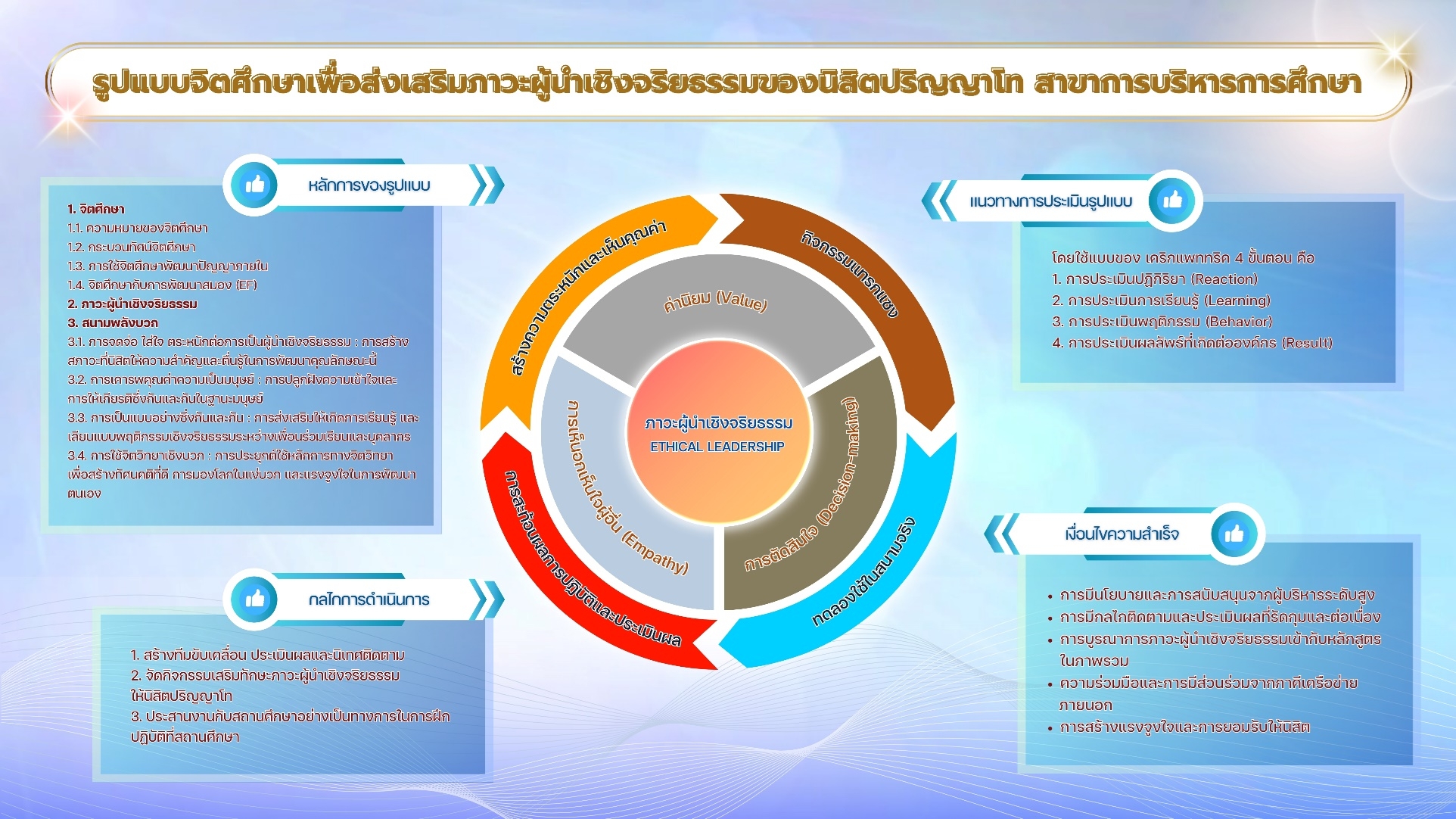
1. Ethical leadership consists of three components: values, decision-making, and empathy. The overall essential needs for developing ethical leadership showed a PNI modified value of 0.47. The application of contemplative education was categorized into two key areas: cultivating a sense of positive community and implementing contemplative practices.
2. The developed model comprised principles, objectives, operational mechanisms, methods, assessment strategies, and success conditions. The model emphasized positive psychology and contemplative practices. Expert evaluations indicated that the model was highly accurate, comprehensive, and appropriate ( = 4.76, S.D. = 0.43).
3. The implementation phase, involving master’s students in Educational Administration, showed positive reactions across all learning dimensions. Learners demonstrated increased understanding and improved contemplative practice skills. Overall behavioral outcomes were at a high level ( = 4.06, S.D. = 0.58).
4. The evaluation of the model's outcomes indicated that the overall results across all dimensions were at a high level (= 3.71, S.D. = 0.55).
Article Details

This work is licensed under a Creative Commons Attribution-NonCommercial-NoDerivatives 4.0 International License.
เพื่อให้เป็นไปตามกฎหมายลิขสิทธิ์ ผู้นิพนธ์ทุกท่านต้องลงลายมือชื่อในแบบฟอร์มใบมอบลิขสิทธิ์บทความ ให้แก่วารสารฯ พร้อมกับบทความต้นฉบับที่ได้แก้ไขครั้งสุดท้าย นอกจากนี้ ผู้นิพนธ์ทุกท่านต้องยืนยันว่าบทความ ต้นฉบับที่ส่งมาตีพิมพ์นั้น ได้ส่งมาตีพิมพ์เฉพาะในวารสาร วิชาการธรรม ทรรศน์ เพียงแห่งเดียวเท่านั้น หากมีการใช้ ภาพหรือตารางของผู้นิพนธ์อื่นที่ปรากฏในสิ่งตีพิมพ์อื่นมาแล้ว ผู้นิพนธ์ต้องขออนุญาตเจ้าของลิขสิทธิ์ก่อน พร้อมทั้ง แสดงหนังสือที่ได้รับการยินยอมต่อบรรณาธิการ ก่อนที่บทความจะได้รับการตีพิมพ์References
กมลทิพย์ ทองกำแหง. (2562). กลยุทธ์การพัฒนาภาวะผู้นำเชิงจริยธรรมสำหรับผู้บริหารโรงเรียนเอกชน. (วิทยานิพนธ์ศึกษาศาสตรมหาบัณฑิต). กรุงเทพฯ: จุฬาลงกรณ์มหาวิทยาลัย.
ณัฐริดา นิพนธ์, โสภนา สุดสมบูรณ์ และกุลชลีจงเจริญ. (2563). ความสัมพันธ์ระหว่างภาวะผู้นำเชิงจริยธรรมกับบทบาทของผู้บริหารสถานศึกษาในการพัฒนาคุณลักษณะที่พึงประสงค์ของผู้เรียนในสถานศึกษา สังกัดสำนักงานเขตพื้นที่การศึกษาประถมศึกษานครสวรรค์ เขต 1. วารสารมหาจุฬานาครทรรศน์, 7(5), 158-171.
เพ็ญศิริ สมเรือน. (2560). ภาวะผู้นำเชิงจริยธรรมของผู้บริหารสถานศึกษา สังกัดสำนักงานเขตพื้นที่การศึกษาประถมศึกษาตราด. (วิทยานิพนธ์ศึกษาศาสตรมหาบัณฑิต). ชลบุรี: บัณฑิตวิทยาลัย มหาวิทยาลัยบูรพา.
รัตนะ บัวสนธ์. (2565). การวิจัยและพัฒนานวัตกรรมการศึกษา. กรุงเทพฯ: จุฬาลงกรณ์มหาวิทยาลัย.
วิจารณ์ พานิช. (2555). วิถีสร้างการเรียนรู้เพื่อศิษย์ในศตวรรษที่ 21. กรุงเทพฯ: ตถาตาพับลิเคชั่น.
วิเชียร ไชยบัง. (2562). จิตศึกษาพัฒนาปัญญาภายใน. (พิมพ์ครั้งที่ 7). บุรีรัมย์: โรงเรียนลำปลายมาศพัฒนา.
สุทัด จันทะสินธุ์. (2560). รูปแบบภาวะผู้นำเชิงจริยธรรมแบบบูรณาการของผู้บริหารสถานศึกษา สังกัดสำนักงานคณะกรรมการการศึกษาขั้นพื้นฐาน. (ดุษฎีนิพนธ์ปรัชญาดุษฎีบัณฑิต). เชียงใหม่: มหาวิทยาลัยราชภัฏเชียงใหม่.
สุวิมล ว่องวาณิช. (2558). การวิจัยประเมินความต้องการจำเป็น. (พิมพ์ครั้งที่ 3). กรุงเทพฯ: จุฬาลงกรณ์มหาวิทยาลัย.
Brown, M. E., & Treviño, L. K. (2006). Ethical leadership: A review and future directions. The Leadership Quarterly, 17(6), 595-616. https://doi.org/10.1016/j.leaqua.2006.10.004
Burns, J. M. (1978). Leadership. New York: Harper & Row.
Grace, B. (2006). Ethical Leadership: In Pursuit of the Common Good. Seattle, WA: Center for Ethical Leadership.
Kohlberg, L. (1976). Moral stages and the idea of justice. In T. Lickona (Ed.), Moral development and behavior: Theory, research, and social issues (pp. 31-53). New York, NY: Holt, Rinehart & Winston.
Krejcie, R. V., & Morgan, D. W. (1970). Determining sample size for research activities. Educational and Psychological Measurement, 30(3), 607-610. https://doi.org/10.1177/001316447003000308
Northouse, P. G. (2003). Leadership: Theory and Practice. (3rd ed.). Thousand Oaks, CA: Sage Publications.
Starratt, R. J. (2004). Ethical Leadership. San Francisco CA: Jossey-Bass.
