The Sacred Water Bathing Ritual at Wat Hong Rattanaram Ratchaworawihan: Social Memory and Cultural Symbols
Article Sidebar
Main Article Content
Abstract
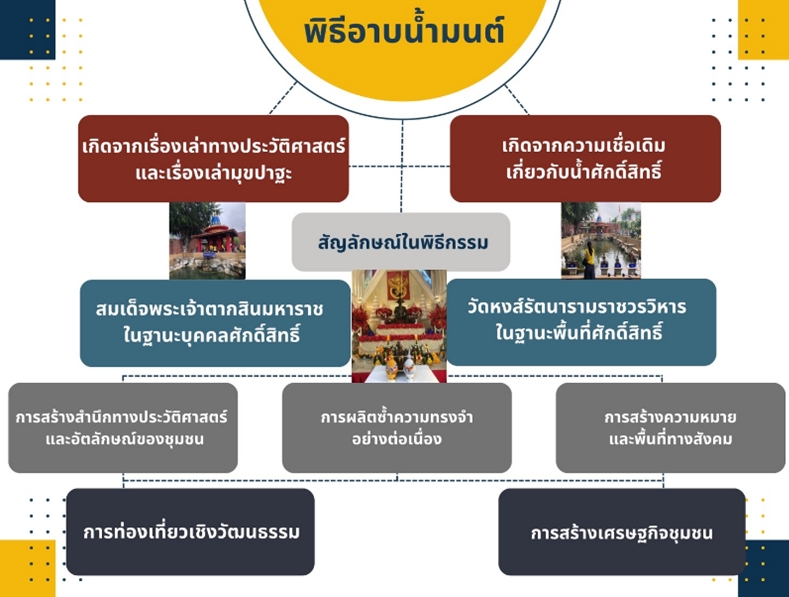
This study aims to examine the sacred water bathing ritual, analyze the symbols and meanings embedded in the ritual at Wat Hong Rattanaram Ratchaworawihan, and examine its roles in contemporary community and societal contexts. Data were collected through documentary research, electronic sources, and fieldwork, including interviews and participant observation.
The results revealed that:
1. That the ritual is grounded in social memory, drawing upon local historical narratives and enduring beliefs in the sanctity of water.
2. The symbolic meanings embedded in the sacred water bathing ritual at Wat Hong Rattanaram Ratchaworawihan encompass both material and behavioral symbols that represent supernatural power. These elements reflect the veneration of King Taksin the Great as a sacralized figure and identify symbolic markers that designate the temple as a sacred space within the ritual landscape.
3. The symbols embedded in the sacred water bathing ritual play a vital role in both community and societal contexts. They contribute to the construction of social meaning, the cultivation of historical consciousness, the articulation of communal identity, and the promotion of cultural tourism. These findings not only illuminate the dynamics of invented traditions but also contribute to broader discussions in Creative Folklore and Anthropology of religion. The findings highlight the importance of cultural capital as a foundation for designing meaningful and sustainable cultural tourism initiatives that stimulate local economies and safeguard traditional practices in contemporary contexts. The ritual thus serves as a compelling example of the seamless integration of religious, economic, and social dimensions within a dynamic cultural system.
Article Details

This work is licensed under a Creative Commons Attribution-NonCommercial-NoDerivatives 4.0 International License.
เพื่อให้เป็นไปตามกฎหมายลิขสิทธิ์ ผู้นิพนธ์ทุกท่านต้องลงลายมือชื่อในแบบฟอร์มใบมอบลิขสิทธิ์บทความ ให้แก่วารสารฯ พร้อมกับบทความต้นฉบับที่ได้แก้ไขครั้งสุดท้าย นอกจากนี้ ผู้นิพนธ์ทุกท่านต้องยืนยันว่าบทความ ต้นฉบับที่ส่งมาตีพิมพ์นั้น ได้ส่งมาตีพิมพ์เฉพาะในวารสาร วิชาการธรรม ทรรศน์ เพียงแห่งเดียวเท่านั้น หากมีการใช้ ภาพหรือตารางของผู้นิพนธ์อื่นที่ปรากฏในสิ่งตีพิมพ์อื่นมาแล้ว ผู้นิพนธ์ต้องขออนุญาตเจ้าของลิขสิทธิ์ก่อน พร้อมทั้ง แสดงหนังสือที่ได้รับการยินยอมต่อบรรณาธิการ ก่อนที่บทความจะได้รับการตีพิมพ์References
กอบชัย รัฐอุบล และปฐม หงส์สุวรรณ. (2564). ความทรงจำทางสังคมและการสร้างภาพตัวแทน ความศักดิ์สิทธิ์ในประเพณีบุญผะเหวดของชาวชุมชนวัดช้างเผือก ตำบลพานพร้าว อำเภอศรี เชียงใหม่ จังหวัดหนองคาย. วารสารสังคมศาสตร์และมานุษยวิทยาเชิงพุทธ, 6(11), 209-226. https://so04.tcithaijo.org/index.php/JSBA/article/download/248669/173007/931018
โฆษิต ไชยประสิทธิ์. (2562). น้ำศักดิ์สิทธิ์: การสร้างเครือข่ายสังคมล้านนา. วารสารข่วงผญา, 14(1), 87-109. https://so06.tci-thaijo.org/index.php/khuangpaya/article/view/235832/161965
ดินาร์ บุญธรรม. (2556). น้ำศักดิ์สิทธิ์ในวัฒนธรรมไทย. เข้าถึงได้จาก http://www.thaistudies.chula.ac.th/2018/09/29
ธวรรณเทพ มงคลศิริ, อภิวัฒน์ สุธรรมดี และอัควิทย์ เรืองรอง (2565). เรื่องเล่ากับการสร้างสรรค์พิธีกรรมบูชาที่เกี่ยวกับสมเด็จพระเจ้าตากสินมหาราช: กรณีศึกษาวัดหงส์รัตนารามราชวรวิวรวิหาร เขตบางกอกใหญ่ กรุงเทพมหานคร. วารสารมนุษยศาสตร์และสังคมศาสตร์, 17(2), 97-113. https://doi.nrct.go.th/ListDoi/listDetail/10.14456%2Flar.2022.16
ธวรรณเทพ มงคลศิริ. (2565). พลวัตของเรื่องเล่าและพิธีกรรมบูชาสมเด็จพระเจ้าตากสินมหาราชในพื้นที่ฝั่งธนบุรี จังหวัดกรุงเทพมหานคร. (วิทยานิพนธ์ศิลปศาสตรมหาบัณฑิต). กรุงเทพฯ: มหาวิทยาลัยราชภัฏบ้านสมเด็จเจ้าพระยา.
ปฐม หงส์สุวรรณ. (2560). ประเพณีประดิษฐ์ในชุมชนอีสานลุ่มน้ำโขง. ขอนแก่น: คลังนานาวิทยา.
ประเสริฐ รุนรา. (2554). พิธีสวดนพเคราะห์: พลวัตของพิธีกรรมประดิษฐ์ในสังคมไทยปัจจุบัน. (วิทยานิพนธ์อักษรศาสตรดุษฎีบัณฑิต). กรุงเทพฯ: จุฬาลงกรณ์มหาวิทยาลัย.
พิเภก เมืองหลวง. (2554). มโนทัศน์และสัญลักษณ์ในงานบุญแปดหมื่นสี่พันขันธ์ที่บ้านท่าม่วง อำเภอเสลภูมิ จังหวัดร้อยเอ็ด: การศึกษาในฐานะพิธีกรรมประดิษฐ์. (วิทยานิพนธ์อักษรศาสตรมหาบัณฑิต). กรุงเทพฯ: จุฬาลงกรณ์มหาวิทยาลัย.
ศรีนิล น้อยบุญแนว. (2554). พระราชพงศาวดารกรุงธนบุรี ฉบับหมอบรัดเลย์. กรุงเทพฯ: ศิลปวัฒนธรรม.
Assmann, J. (2011). Cultural Memory and Early Civilization: Writing, Remembrance, and Political Imagination. Cambridge: Cambridge University Press.
Bascom, W. (1965). Four functions of folklore. In A. Dundes (Ed.), The study of folklore (pp. 279-298). Englewood Cliffs, NJ: Prentice-Hall.
Halbwachs, M. (1992). On collective memory (L. A. Coser, Trans.). Chicago, IL: University of Chicago Press.
Hobsbawm, E., & Ranger, T. (Eds.). (1983). The invention of tradition. Cambridge: Cambridge University Press.
Turner, V. W. (1967). The forest of symbols: Aspects of Ndembu ritual. New York, NY: Cornell University Press.
