Intelligent Design Thinking with Generative Artificial Intelligence to Promote Digital Media Production Competencies for Pre-service Teacher
Article Sidebar
Main Article Content
Abstract
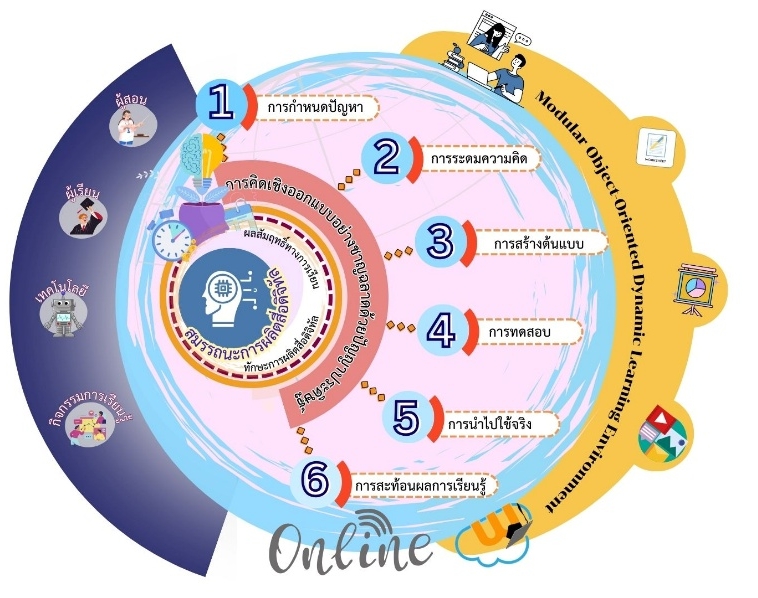
This research aimed to: (1) synthesize an intelligent design thinking process integrated with generative artificial intelligence to enhance digital media production competencies among pre-service teachers; (2) develop instructional activities based on this intelligent design thinking process; (3) develop a learning system that supports the intelligent design thinking process; and (4) assess digital media production competencies in terms of learning achievement, skills, and attitudes. The sample group consisted of 29 second-year pre-service teachers majoring in Digital Technology for Education, Faculty of Education, Chandrakasem Rajabhat University, selected through cluster sampling. Data analysis tools included mean, standard deviation, and t-test.
The results indicated thatซ the synthesized intelligent design thinking process was highly appropriate (𝑥̄ = 4.16, S.D. = 0.78). The overall learning components were also rated as highly appropriate (𝑥̄ = 4.18, S.D. = 0.77), as was the applicability of the process in real-world contexts (𝑥̄ = 4.40, S.D. = 0.82). The developed learning system was found to be highly suitable (𝑥̄ = 4.34, S.D. = 0.38), effectively supporting creative learning and enhancing digital media production skills. Post-instruction evaluation showed that students’ learning achievement scores were significantly higher than their pre-instruction scores at the .01 level of statistical significance, indicating the effectiveness of the instructional process in improving knowledge and skills. Students' digital media production performance was rated at a very high level (𝑥̄ = 4.48, S.D. = 0.72), with outputs demonstrating creativity and practical applicability. Additionally, students' attitudes toward the intelligent design thinking process integrated with generative AI were at the highest level of agreement (𝑥̄ = 4.79, S.D. = 0.10), reflecting a positive attitude and strong acceptance of the use of AI technologies in enhancing learning and competency development.
Article Details

This work is licensed under a Creative Commons Attribution-NonCommercial-NoDerivatives 4.0 International License.
เพื่อให้เป็นไปตามกฎหมายลิขสิทธิ์ ผู้นิพนธ์ทุกท่านต้องลงลายมือชื่อในแบบฟอร์มใบมอบลิขสิทธิ์บทความ ให้แก่วารสารฯ พร้อมกับบทความต้นฉบับที่ได้แก้ไขครั้งสุดท้าย นอกจากนี้ ผู้นิพนธ์ทุกท่านต้องยืนยันว่าบทความ ต้นฉบับที่ส่งมาตีพิมพ์นั้น ได้ส่งมาตีพิมพ์เฉพาะในวารสาร วิชาการธรรม ทรรศน์ เพียงแห่งเดียวเท่านั้น หากมีการใช้ ภาพหรือตารางของผู้นิพนธ์อื่นที่ปรากฏในสิ่งตีพิมพ์อื่นมาแล้ว ผู้นิพนธ์ต้องขออนุญาตเจ้าของลิขสิทธิ์ก่อน พร้อมทั้ง แสดงหนังสือที่ได้รับการยินยอมต่อบรรณาธิการ ก่อนที่บทความจะได้รับการตีพิมพ์References
เกียรติศักดิ์ สีสมุทร. (2565). การออกแบบการเรียนรู้โครงงานเป็นฐานโดยใช้การคิดเชิงออกแบบผ่านจักรวาลนฤมิตเพื่อเสริมสร้างพุทธนวัตกร. กรุงเทพฯ: มหาวิทยาลัยเทคโนโลยีพระจอมเกล้าพระนครเหนือ.
นรศักดิ์ ภูนาพลอย. (2563). การพัฒนาการเรียนการสอนออนไลน์ด้วยการคิดเชิงออกแบบเป็นฐานเพื่อสร้างผลงานสร้างสรรค์. กรุงเทพฯ: มหาวิทยาลัยเทคโนโลยีพระจอมเกล้าพระนครเหนือ.
ศักดิ์ชัย ไชยรักษ์. (2566). การเรียนรู้อารยอัจฉริยะเสมือนเพื่อพัฒนาสมรรถนะการออกแบบและการจัดการเรียนรู้สำหรับนักศึกษาครูดิจิทัล. กรุงเทพฯ: มหาวิทยาลัยเทคโนโลยีพระจอมเกล้าพระนครเหนือ.
สมบัติ ท้ายเรือคำ. (2551). วิธีการทางสถิติสำหรับการวิจัย. มหาสารคาม: ภาควิชาวัดผลและวิจัยการศึกษา คณะศึกษาศาสตร์มหาวิทยาลัยมหาสารคาม.
Aydin, M. K. (2024). Development and validation of a digital competence scale for teachers. Education and Information Technologies, 29, 1825-1845. https://doi.org/10.1007/s10639-023-11991-0
Lei, H., & Jiang, Z. (2025). Assessing the digital competence and its influencing factors among foreign language teachers in Chinese universities. Humanities and Social Sciences Communications, 12, 1435. https://doi.org/10.1057/s41599-025-05394-7
UNESCO. (2020). Education and the COVID-19 Pandemic: The Challenges and Opportunities. Paris, France: UNESCO.
Vieira, R. M. (2023). Science and mathematics teachers from the same country have different digital competence? Education Sciences, 13(8), 823. https://doi.org/10.3390/educsci13080823
Zaky, Y. A. M., & Al Mulhim, E. N. (2024). Design thinking-based approaches for enhancing creative digital learning materials among pre-service teachers. Journal of Education and Learning, 13(2), 112-123. https://doi.org/10.5539/jel.v13n2p112
