Learner’s Leadership Influence on Loyalty Behavior in University: The Mediating Role of Self-Efficacy and Affective Commitment
Article Sidebar
Main Article Content
บทคัดย่อ
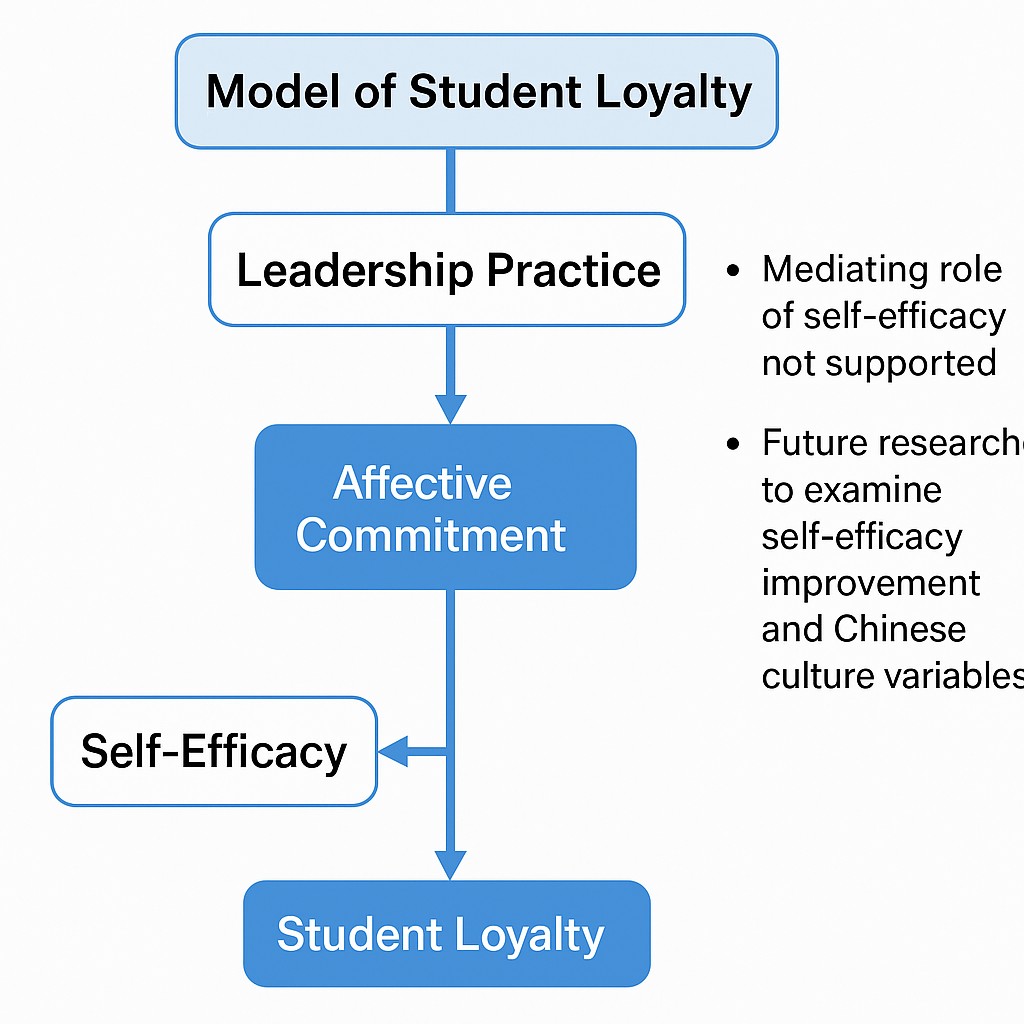
The purpose of this study is to explore the crucial role of student leadership in stimulating the affective connection of college students to their institutions in Guangxi. The results reveal a continuous chain mediation model, which originates from the context-specific practice of student leadership and leads to loyalty to the institution through self-efficacy and affective commitment. The data obtained from the questionnaires distributed to ten colleges and universities in Guangxi show that the development of college students' leadership cannot affect their loyalty to the institution through their sense of self-efficacy, it is through affective commitment that students can influence their loyalty to the institution.
Article Details

อนุญาตภายใต้เงื่อนไข Creative Commons Attribution-NonCommercial-NoDerivatives 4.0 International License.
เพื่อให้เป็นไปตามกฎหมายลิขสิทธิ์ ผู้นิพนธ์ทุกท่านต้องลงลายมือชื่อในแบบฟอร์มใบมอบลิขสิทธิ์บทความ ให้แก่วารสารฯ พร้อมกับบทความต้นฉบับที่ได้แก้ไขครั้งสุดท้าย นอกจากนี้ ผู้นิพนธ์ทุกท่านต้องยืนยันว่าบทความ ต้นฉบับที่ส่งมาตีพิมพ์นั้น ได้ส่งมาตีพิมพ์เฉพาะในวารสาร วิชาการธรรม ทรรศน์ เพียงแห่งเดียวเท่านั้น หากมีการใช้ ภาพหรือตารางของผู้นิพนธ์อื่นที่ปรากฏในสิ่งตีพิมพ์อื่นมาแล้ว ผู้นิพนธ์ต้องขออนุญาตเจ้าของลิขสิทธิ์ก่อน พร้อมทั้ง แสดงหนังสือที่ได้รับการยินยอมต่อบรรณาธิการ ก่อนที่บทความจะได้รับการตีพิมพ์เอกสารอ้างอิง
Bollen, K. A., & Stine, R. A. (1992). Bootstrapping goodness-of-fit measures in structural equation models. Sociological Methods & Research, 21(2), 205-229. https://doi.org/10.1177/0049124192021002004
Chen, Y., & Starobin, S. S. (2018). Measuring and examining general self-efficacy among community college students: A structural equation modeling approach. Community College Journal of Research and Practice, 42(3), 171-189. https://doi.org/10.1080/10668926.2017.1281178
Davidson, W. B., Beck, H. P., & Grisaffe, D. B. (2015). Increasing the institutional commitment of college students: Enhanced measurement and test of a nomological model. Journal of College Student Retention: Research, Theory & Practice, 17(2), 162-185. https://doi.org/10.1177/152102511557823
Ding, X.-Y., & Ye, Y. (2021). Enhancing college student Leadership practices through organization development interventions: A case study of Zhejiang Yuxiu University of foreign languages (ZYUFL), China. The Scholar: Human Sciences, 13(2), 405-420. http://www.assumptionjournal.au.edu/index.php/Scholar/article/view/4863
Encinas Orozco, F. C., & Cavazos Arroyo, J. (2017). Students’ loyalty in higher education: the roles of affective commitment, service co-creation and engagement. Cuadernos De Administración, 33(57), 96-110. https://doi.org/10.25100/cdea.v33i57.4464
Hair, J. F., Ringle, C. M., & Sarstedt, M. (2011). PLS-SEM: Indeed a Silver Bullet. Journal of Marketing Theory and Practice, 19(2), 139-152. https://doi.org/10.2753/MTP1069-6679190202
Ismanova, D. (2019). Students’ loyalty in higher education: The mediating effect of satisfaction, trust, commitment on student loyalty to Alma Mater. Management Science Letters, 9, 1161-1168. https://doi.org/10.5267/j.msl.2019.4.024
Krejcie, R.V., & Morgan, D. W. (1970). Determining Sample Size for Research Activities. Educational and Psychological Measurement, 30, 607-610. https://doi.org/10.1177/001316447003000308
Liu, Y., Bellibas, M. S., & Gümüs, S. (2020). The effect of instructional leadership and distributed leadership on teacher self efficacy and job satisfaction: Mediating roles of supportive school culture and teacher collaboration. Educational Management Administration & Leadership, 49(3), 430-453. https://doi.org/10.1177/1741143220910438
Pineda, A. J. M., Mohamad, A. N., Solomon, O., Birco, C. N. H., Superio, M. G., Cuenco, H. O., & Bognot, F. L. (2022). Exploring the standardized root mean square residual (SRMR) of factors influencing e-book usage among CCA students in the Philippines. Indonesian Journal of Contemporary Education, 4(2), 53-70. https://doi.org/10.33122/ijoce.v4i2.30
Pinedaa, A. J. M., Mohamadc, A. N., Solomon, O., Bircob, C. N. H., Superioe, M. G., Cuencof, H. O., & Bognot, F. L. (2022). Exploring the Standardized Root Mean Square Residual (SRMR) of Factors Influencing E-book Usage among CCA Students in the Philippines. Indonesian Journal of Contemporary Education, 4(2), 53-70. https://www.researchgate.net/publication/359415525
Posner, B. Z. (2004). A Leadership Development Instrument for Students: Updated. Journal of College Student Development, 45(4), 443-456. https://dx.doi.org/10.1353/csd.2004.0051
Schwarzer, R., & Jerusalem, M. (1995). Generalized self-efficacy scale. In J. Weinman, S. Wright, & M. Johnston (Eds.), Measures in health psychology: A user’s portfolio. Causal and control beliefs (pp. 35-37). Windsor, UK: NFER-NELSON.
Su, N., & Wang, H. -P. (2023). The Influence of Social Connectedness Stimulation on Prosocial Behavior Based on Hierarchical Linear Model-Taking Universities in Guangxi, China as an Example. International Journal of Higher Education, 12(3), 11-23. https://doi.org/10.5430/ijhe.v12n3p11
