Sacralization of the Memorial Monument for the Javanese Diaspora in Suriname on the Day of Wong Jawa
Article Sidebar
Main Article Content
Abstract
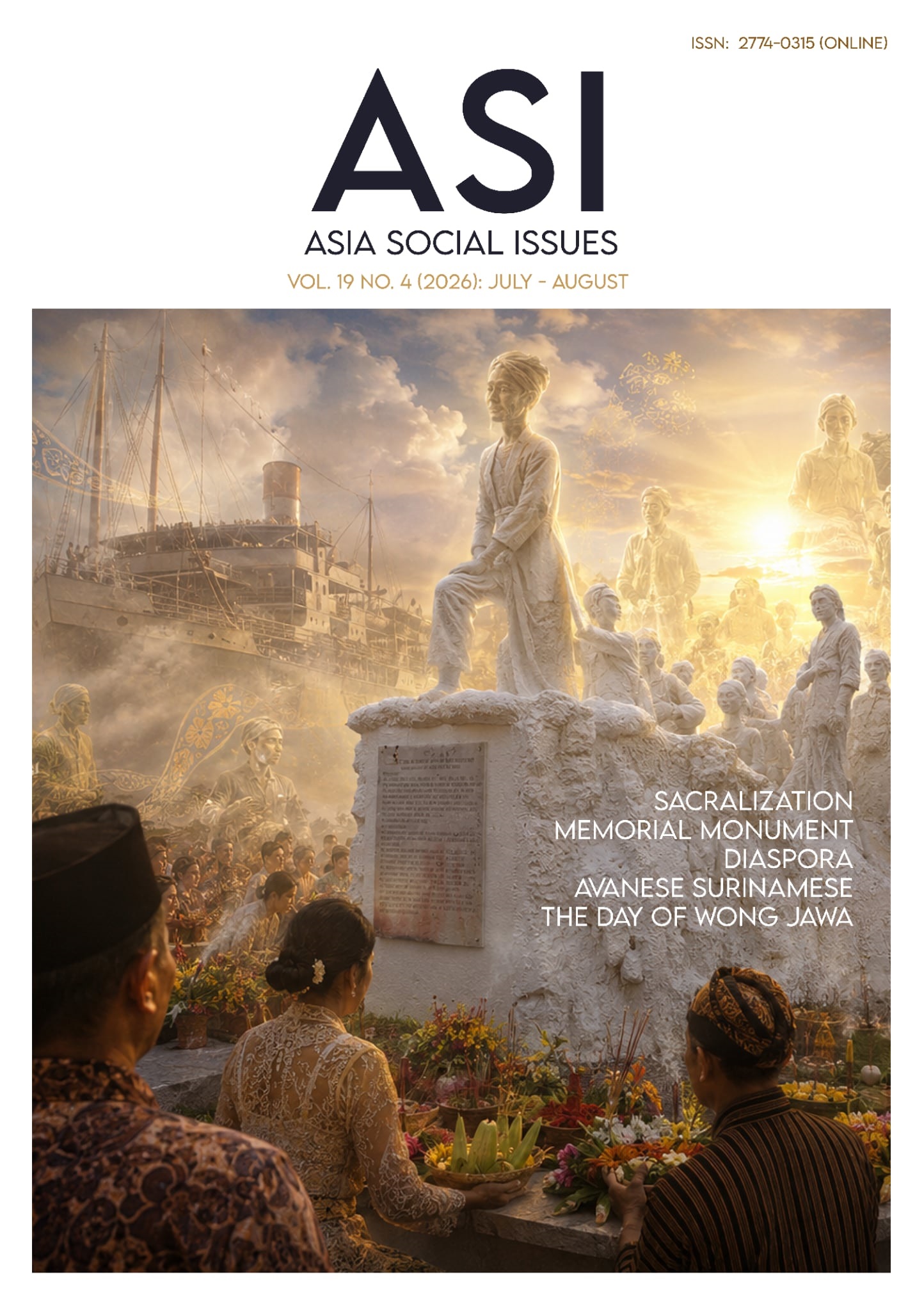
The Day of Wong Jawa is an annual commemoration of Javanese Immigration Day. It has become a national day to commemorate the first arrival of the Javanese people in Suriname. Various commemorative monuments were built to celebrate the event. This research was conducted to understand the meaning of a commemorative monument and how it becomes sacred. To understand this, the research used qualitative research methods. Data was obtained through observations and interviews with several informants. The results of this study show that the monument’s sacredness arises from its serving as a gathering place for the diaspora to remember their ancestors. The sacredness is also demonstrated by how diasporas dress and sow flowers at the monument. The monument becomes a place where the spirits of the ancestors of the Surinamese Javanese diaspora are present. This research suggests that the monument can serve as a unifying space for the diaspora while offering an opportunity to reflect on the experiences of Javanese ancestors.
Highlights
This study draws on long-term qualitative fieldwork, including observation, interviews, and visual analysis of commemorative rituals at Javanese migration monuments in Suriname. It shows how The Day of Wong Jawa (Javanese Immigration Day) sanctifies these monuments as living vessels of diasporic memory. Ritual clothing, flower offerings, and pilgrimage-like gatherings transform colonial-era structures into sacred spaces of ancestral presence and unifying arenas connecting Javanese descendants to their ancestral homeland. The article contributes a heritage- and memory-based perspective to global diaspora studies that extends beyond labor and political history.
Article Details

This work is licensed under a Creative Commons Attribution-NonCommercial-NoDerivatives 4.0 International License.
Copyright: CC BY-NC-ND 4.0
References
Allen, P. (2015). Diasporic representations of the home culture: case studies from Suriname and New Caledonia. Asian Ethnicity, 16(3), 353370.
Allen, P. (2011). Javanese cultural traditions in Suriname. RIMA: Review of Indonesian and Malaysian Affairs, 45(1/2), 199223.
Ayyathurai, G. (2021). Emigration Against Caste, Transformation of the Self, and Realization of the Casteless Society in Indian Diaspora. Essays in Philosophy, 22(1), 45-65.
Anderson’s, S. (2006). Imagined communities. Literary Criticism and Cultural Theory, 49.
Akkapram, P. (2024). The Use of Applied Theatre Activities for Rural Children’s Learning of Cultural Heritage in the ISAN Community. Asian Journal of Arts and Culture, 24(2), 1-13.
Creswell, J. W., & Poth, C. N. (2016). Qualitative inquiry and research design: Choosing among five approaches. Los Angeles, CA, United States: Sage publications.
Clark, E. H. (2020). Iron gongs and singing birds: Paths of migration and acoustic assemblages of alterity in the Former Dutch Colonial Empire. New York, United States: Columbia University.
Cohen, R. (1997). Global diasporas: An introduction. London, United Kingdom: Routledge.
Fine, E. C., & Speer, J. H. (1985). Tour guide performances as sight sacralization. Annals of tourism research, 12(1), 7395.
Hoefte, R. (1998). A passage to Suriname? The migration of modes of resistance by Asian contract laborers. International Labor and WorkingClass History, 54, 1939.
Hofte, R. M. A. L. (2008). The Javanese of Suriname; A history of colonial labour and migration has produced a unique community far from Indonesian shores. Melbourne, Australia: Inside Indonesia.
Hoefte, R. (1998). In place of slavery: A social history of British Indian and Javanese laborers in Suriname. Gainesville, FL, United States: University Press of Florida.
Hoefte, R. (2013). Suriname in the long twentieth century: Domination, contestation, globalization. New York, United States: Palgrave Macmillan
Halbwachs, M. (1992). On collective memory. Chicago, IL, United States: University of Chicago Press
Hoefte, R., & Mingoen, H. (2022). Where is home? Changing conceptions of the homeland in the SurinameseJavanese diaspora. Wacana, Journal of the Humanities of Indonesia, 23(3), 2.
Jw, C. (Creswell, J. W.) (2009). Research design: Qualitative, quantitative, and mixed methods approaches (3rd eds.). Thousand Oaks, CA, United States: SAGE Publications
Kopijn, Y. (2002). Constructions of ethnicity in the diaspora: The case of three generations of Surinamese Javanese women in the Netherlands (pp. 111-128). In Caribbean Migration: Globalized Identities. London, United Kingdom: Routledge
Khusen, M. (2005). Contending Identity in the Islamic Ritual: The Slametan among Surinamese Javanese Muslims in The Netherlands. AlJami’ah: Journal of Islamic Studies, 43(2), 283308.
Kamil, M., & Jamika, S. (2024). The role of the Javanese diaspora in Suriname in bridging the national development of Indonesia. Multidisciplinary Reviews, 7(11), 20242522024252.
Kurnia, L. (2014). “Seren Taun” Between Hegemony and Culture Industry; Reading a Sundanese Ritual of Harvest in Cigugur, West Java. Wacana, Journal of the Humanities of Indonesia, 15(2), 300313.
Leeflang, R. A. (2024). Kaseko music: a genre inspired by our ancestors. Academic Journal of Suriname, 15(1), 13.
Meel, P. (2011). Continuity through diversity: The Surinamese Javanese diaspora and the homeland anchorage. Wadabagei, 13(3), 95134.
Meel, P. (2017). Jakarta and Paramaribo calling: Return migration challenges for the Surinamese Javanese Diaspora? New West Indian Guide/Nieuwe WestIndische Gids, 91(34), 223259.
Mumfangati, T. (2007). Tradisi Ziarah Makam Leluhur Pada Masyarakat Jawa. Makna, Tradisi dan Simbol II (3), 152159.
Misztal, B. A. (2004). The sacralization of memory. European journal of social theory, 7(1), 6784.
Mujib, M. M. (2016). Fenomena tradisi ziarah lokal dalam masyarakat Jawa: Kontestasi kesalehan, identitas keagamaan dan komersial. IBDA: Jurnal Kajian Islam Dan Budaya, 14(2), 204224.
Nurani, L. M. (2015). Changing language loyalty and identity: An ethnographic inquiry of societal transformation among the Javanese people in Yogyakarta, Indonesia (Doctoral dissertation). Tempe, AZ, United States: Arizona State University
Oostindie, G. (2005). Ethnicity in the Caribbean: Essays in honor of Harry Hoetink. Amsterdam, Netherlands: Amsterdam University Press
Prasopsombat, L. (2025). Transnational Heritage and Local Integration: Exploring the Resilience of Teochew Chinese Identity in Thailand. Asian Journal of Arts and Culture, 25(3), e281344.
Pramesti, T. A., & Mukhlis, M. (2023). Semiotic Analysis at Javanese Traditional Events in West Maredan, Tualang District, Siak Regency. Asian Journal of Social and Humanities, 1(10), 618631.
Rizal, A. N. (2024). The Day of Wong Jawa, Revisiting Indonesian nationalism in Suriname. kompas.id. Retrieved from https://www.kompas.id/baca/english/2024/08/14/enthedayofwongjawamelihatulangnasionalismeindonesiadisuriname
Suparlan, P. (1995). The Javanese in Suriname: Ethnicity in an ethnically plural society. Arizona, United States: Program for Southeast Asian Studies, Arizona State University.
Tirtosudarmo, R. (2005). The Politics of Diaspora: Javanese Immigrants in Suriname and Their Relations with Indonesia. Journal of Indonesian Social Sciences and Humanities, 1, 35-58.
Van Amersfoort, H., & Van Niekerk, M. (2006). Immigration as a colonial inheritance: Postcolonial immigrants in the Netherlands, 1945-2002. Journal of ethnic and migration studies, 32(3), 323346
Vertovec, S. (1997). Three Meanings of “Diaspora,” Exemplified among South Asian Religions. Diaspora: A Journal of Transnational Studies, 6(3), 277-299.
Wilson, S. (2002). Generating Java: Youth identity, nationalism and modernity in Indonesian Java (Master’s thesis). Honolulu, HI, United States: University of Hawaiʻi at Mānoa
Wahyudi, T., Prasetya, H. B., & Ono, D. K. (2024). Knowledge of Natural Materials in Craft Arts in Suriname for Learning Indonesian Carving and Weaving Arts in the Javanese Diaspora Community. EnvironmentBehaviour Proceedings Journal, 9(SI23), 21-27.
