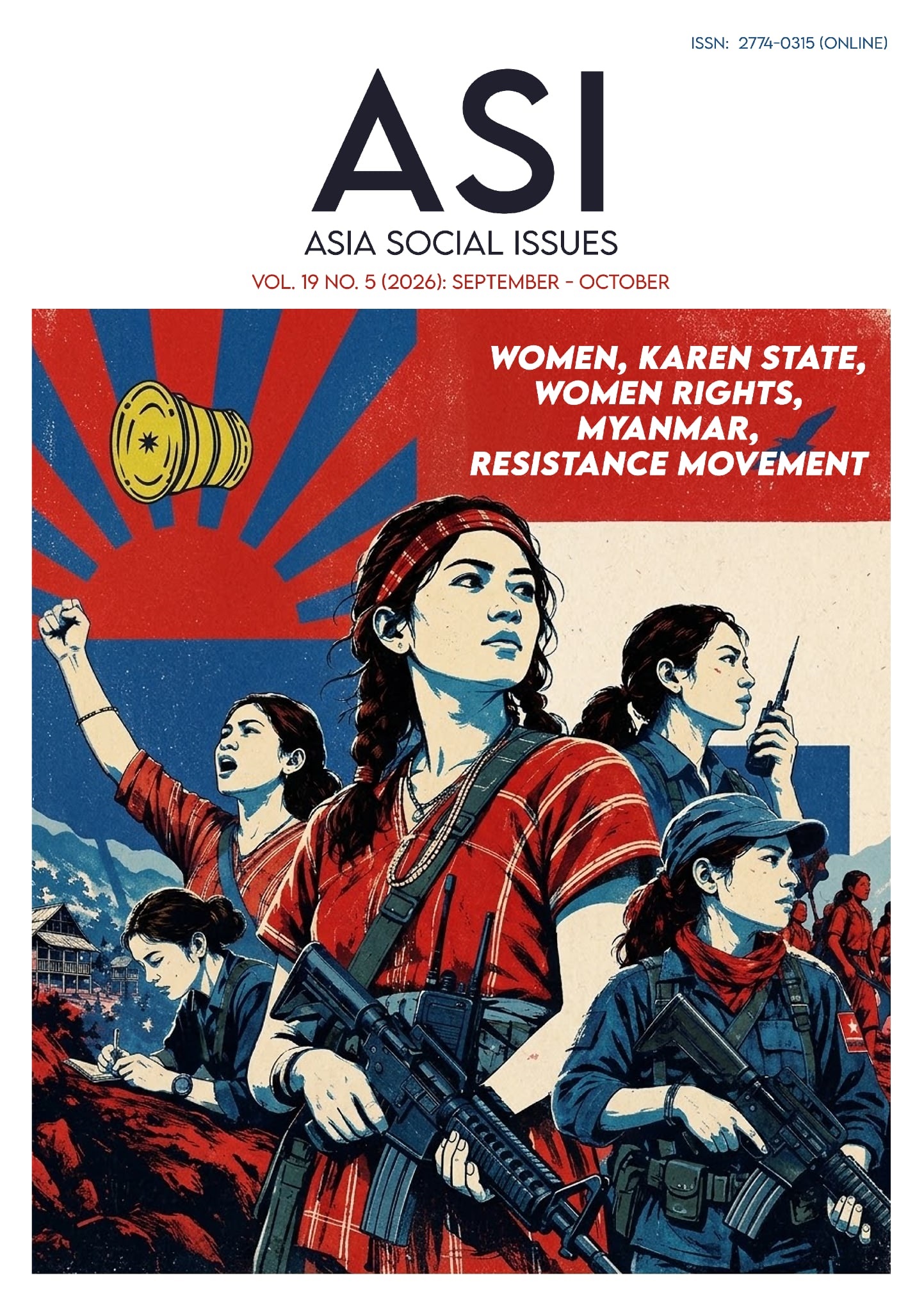
Examining the Roles of Women in the Armed Resistance Movement in Karen State, Myanmar
Article Sidebar
Main Article Content
Abstract
This study explores women’s participation in the 2021 armed resistance movement in Karen State, Myanmar—an area deeply affected by ongoing conflict. While armed struggles are often portrayed through a male-dominated lens, the extent of women’s involvement, motivations, and struggles remains underexplored. This research seeks to address that gap and highlight women’s unique experiences in conflict-affected areas to promote more inclusive and effective post-conflict solutions. Using qualitative research methods, the study draws on in-depth interviews and observations of key participants, including members of the Karen National Union, civil society members, and individuals involved in the Civil Disobedience Movement. These methods were employed to gain an understanding of women’s roles, motivations, and the socio-cultural challenges they face in the resistance movement. The findings reveal diverse and challenging roles of women—from supporters and community organizers to leaders—highlighting a remarkable shift in traditional gender norms. Women in Karen State have increasingly taken public and political responsibilities, redefining their roles from passive victims to active agents of change. The study underscores the transformative impact of women’s participation in shaping local governance and advancing gender equality within conflict and post-conflict settings.
Highlights
This study offers empirical insight into the participation of women in Karen State in Myanmar’s armed resistance movement, highlighting their roles beyond conventional support functions. It shows how women’s engagement challenges gender hierarchies, reshapes power dynamics, and contributes to renegotiating social norms. The findings also provide practical implications for gender-responsive peacebuilding and inclusive post-conflict governance.
Article Details

This work is licensed under a Creative Commons Attribution-NonCommercial-NoDerivatives 4.0 International License.
Copyright: CC BY-NC-ND 4.0
References
Bhattacharyya, R. (2023). The women of Myanmar’s spring revolution. Retrieved from https:// thediplomat.com/2023/08/the-women-of-myanmars-spring-revolution/
Byrd, M. W. (2021). Women on the front lines in Myanmar’s fights for democracy. Retrieved from https://www.airuniversity.af.edu/JIPA/Display/Article/2747495/women-on-the-front-lines-in- myanmars-fight-for-democracy/
Fishbein, E., Hkawng, J. T., & Brang, H. J. (2024). ‘Blood and sweat’: Myanmar resistance fights to overturn military coup. Retrieved from https://www.aljazeera.com/news/2024 /2/1/blood-and-sweat-myanmar-resistance-fights-to-overturn-military-coup
Kyi, S. & Thida. (2024). Conscription in Myanmar pushing young men to choose sides. Retrieved from https://fulcrum.sg/conscription-in-myanmar-pushing-young-men-to-choose-sides/
Mathieson, D. C. (2021). Myanmar’s nationwide ceasefire agreement is dead. Retrieved from https://www.irrawaddy.com/ opinion/guest-column/myanmars-nationwide-ceasefire-agreement-is-dead.html
Nyein, N. (2019). Timeline: 70 years of ethnic armed resistance movements in Myanmar. Retrieved from https://www.irrawaddy.com/specials/ timeline-70-years-ethnic-armed-resistance-movements-myanmar.html
Office of the United Nations High Commissioner for Human Rights. (n.d.). Women’s human rights and gender-related concerns in situations of conflict and instability. Retrieved from https://www. ohchr.org/en/women/womens-human-rights-and-gender-related-concerns-situations-conflict-and-instability
Thant, S. M. (2021). In the wake of the coup: How Myanmar youth arose to fight for the nation. Retrieved from https://eu.boell.org/sites/ default/files/2021-12/Myanmar%20 youth_FINAL.pdf
United Nations. (2019). UN chief urges ‘active, substantive and meaningful participation’ on International Day of Democracy. Retrieved from https://news.un.org/en/story/ 2019/09/1046372
