The Model of Buddhist Innovation for Cultivating a Positive Conciousness Among the New Generation to Resolve Political Conflicts in Democratic System of The Central North-eastern Region
Article Sidebar
Main Article Content
Abstract
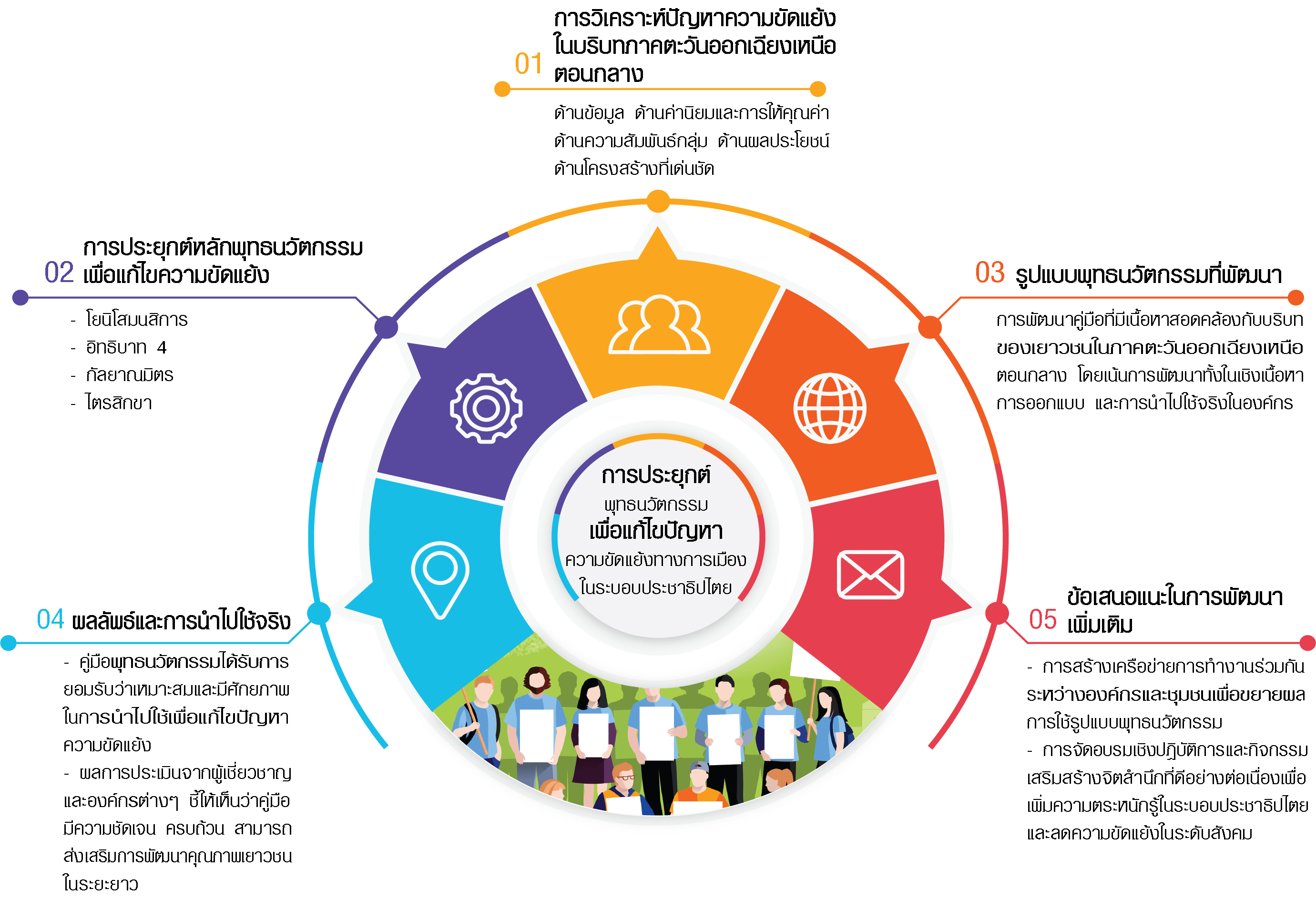
This research aims to: 1) examine the conditions of organizing processes that cultivate positive awareness among the younger generation for resolving political conflicts within the democratic system in the central northeastern region of Thailand; 2) develop a Buddhist innovation model to foster such awareness; and 3) present the outcomes of implementing this model. A mixed-methods approach was employed. The quantitative component involved a survey conducted with 400 participants, while the qualitative component involved focus group discussions and consensus-based decision-making with five experts. Data analysis included means, percentages, standard deviations, statistical tests, correlation coefficients, and descriptive analysis.
The research findings are as follows:
1. Political conflicts were identified in five major domains: informational, value-based, relational, interest-related, and structural. Each domain was characterized by specific indicators. Conflict resolution strategies were grounded in Buddhist principles—for example, Yoniso Manasikara was used to address informational conflicts, Iddhipada 4 for value-based and relational conflicts, Kalyāṇamitta for interest-related conflicts, and the Threefold Training (Trisikkhā) for structural conflicts.
2. The quantitative results demonstrated a statistically significant improvement in democratic attitudes following the implementation of the Buddhist innovation model. The average score increased from 3.25 to 3.89 (p < 0.05). Moreover, the target group showed improved understanding of Buddhist principles, greater tolerance for differing opinions, and a reduction in violent behavior—all key factors in mitigating political conflict. These findings underscore the effectiveness of Buddhist innovations in cultivating positive awareness and promoting sustainable conflict resolution in Thai society.
3. The application of the Buddhist innovation model led to the production of 100 manuals and academic dissemination through various formats.
Article Details

This work is licensed under a Creative Commons Attribution-NonCommercial-NoDerivatives 4.0 International License.
เพื่อให้เป็นไปตามกฎหมายลิขสิทธิ์ ผู้นิพนธ์ทุกท่านต้องลงลายมือชื่อในแบบฟอร์มใบมอบลิขสิทธิ์บทความ ให้แก่วารสารฯ พร้อมกับบทความต้นฉบับที่ได้แก้ไขครั้งสุดท้าย นอกจากนี้ ผู้นิพนธ์ทุกท่านต้องยืนยันว่าบทความ ต้นฉบับที่ส่งมาตีพิมพ์นั้น ได้ส่งมาตีพิมพ์เฉพาะในวารสาร วิชาการธรรม ทรรศน์ เพียงแห่งเดียวเท่านั้น หากมีการใช้ ภาพหรือตารางของผู้นิพนธ์อื่นที่ปรากฏในสิ่งตีพิมพ์อื่นมาแล้ว ผู้นิพนธ์ต้องขออนุญาตเจ้าของลิขสิทธิ์ก่อน พร้อมทั้ง แสดงหนังสือที่ได้รับการยินยอมต่อบรรณาธิการ ก่อนที่บทความจะได้รับการตีพิมพ์References
กมลาศ ภูวชนาธิพงศ์, พระมหานันทวิทย์ แก้วบุตรดี, พระภาวนาวชิรวิเทศ (มงคล มงฺคโล), มนัสนันท์ ประภัสสรพิทยา และหนึ่งธิดา สาริศรี. (2567). รูปแบบการส่งเสริมกิจกรรมเพื่อสร้างความเข้มแข็งทางจิตใจของครอบครัววิถีชีวิตใหม่ตามแนวพุทธจิตวิทยา. วารสารพุทธนวัตกรรมและการจัดการ, 7(4), 1-14. https://so06.tci-thaijo.org/index.php/bim/article/view/271790
จุรีพร กาญจนการุณ. (2552). คุณธรรมจริยธรรมและการใช้เหตุผลเชิงจริยธรรมของนักศึกษามหาวิทยาลัยเทคโนโลยีพระจอมเกล้าธนบุรี. วารสารวิชาการวิทยาลัยแสงธรรม, 1(1), 95-109. https://so05.tci-thaijo.org/index.php/PPJ/article/view/216228
ธนัท ติระพรชัย. (2567). พุทธนวัตกรรมกับการพัฒนาทุนมนุษย์. วารสารสหวิทยาการนวัตกรรมปริทรรศน์, 7(1), 310-319. https://so04.tci-thaijo.org/index.php/jidir/article/view/267643
ธีราพร ทุมมานนท์, ภัคสรกัญญ์ เชื่อมเจริญพรกุล, สุภาวดี วรรณพฤกษ์ และพรชัย พิริยะสันติ. (2567). การวิเคราะห์ความขัดแย้งทางด้านการเมืองที่มาจากความแตกต่างระหว่างช่วงวัย. วารสารการเมือง การบริหาร และกฎหมาย, 6(1), 1-15. https://ojs.lib.buu.ac.th/index.php/law/article/view/10075
สมเดช นามเกตุ, พระศิลาศักดิ์ สุเมโธ (บุญทอง) และพระณัฐพงษ์ สิริสุวณฺโณ (จันทร์โร). (2561). การปลูกจิตสำนึกทางจริยธรรมในสังคมไทย. วารสารปัญญาปณิธาน, 3(1), 13-27. https://so05.tci-thaijo.org/index.php/PPJ/article/view/216228/150231
สมศักดิ์ บุญปู่, พีรวัฒน์ ชัยสุข, พระมหาญาณวัฒน์ ฐิตวฑฺฒโน, บุญเชิด ชำนิศาสตร์, ณัชชา อมราภรณ์, วารี โศกเตี้ย และอรุณรัตน์ วิไลรัตนกุล. (2567). การพัฒนาพื้นที่นวัตกรรมการเรียนรู้วิถีพุทธ. วารสารบวรสหการศึกษาและมนุษยสังคมศาสตร์, 5(1), 117-133. https://so03.tci-thaijo.org/index.php/JOB_EHS/article/view/276126
สายหยุด มีฤกษ์, พระสมุห์โชคดี วชิรปญฺโญ, วิชชุดา ฐิติโชติรัตนา, พรทิพย์ วรรณวิโรจน์ และพระครูปลัดมารุต วรมฺงโล. (2567). การพัฒนากระบวนการและการสร้างเครือข่ายการแนะแนววิถีพุทธสำหรับบุคลากร ทางการศึกษาในสังคมไทย. วารสารพุทธจิตวิทยา, 9(3), 382-394. https://so03.tci-thaijo.org/index.php/jbp/article/view/272654
Almond, G. A., & Verba, S. (1963). The civic culture: Political attitudes and democracy in five nations. Princeton, NJ: Princeton University Press.
Marx, K. (1859). A Contribution to the Critique of Political Economy. Progress Publishers.
Simmel, G. (1955). Conflict and the Web of Group Affiliations (K. Wolff & R. Bendix, Trans.). Glencoe, IL: Free Press.
Yamane, T. (1967). Statistics: An introductory analysis. (2nd ed.). New York: Harper and Row.
