Innovative Learning Management Model Based on the Four Iddhipada Principles for Personnel in Private Schools under the Office of Khon Kaen Provincial Education
Article Sidebar
Main Article Content
Abstract
This study aimed to: (1) examine the current state, desired state, and priority needs of learning management innovators based on the Four Paths of Accomplishment (Iddhipāda 4) among personnel in private schools; (2) develop a learning management innovation model grounded in the Iddhipāda 4 principles; and (3) evaluate the proposed model. A mixed methods research design was employed, integrating quantitative and qualitative approaches. The quantitative sample consisted of 226 participants, while 20 key informants were purposively selected for the qualitative component. Research instruments were developed and validated for content validity and reliability. Quantitative data were analyzed using descriptive statistics, and qualitative data were examined through content analysis.
The findings revealed that:
1. The current state of learning management innovation based on the Iddhipāda 4 among private school personnel under the Khon Kaen Provincial Education Office was at a moderate level (x̅ = 3.34). Network building yielded the highest mean score, followed by technological knowledge, while risk management showed the lowest mean score. The desired state was at the highest level (x̅ = 4.68), with technological knowledge rated as the most important. The modified Priority Needs Index (PNI modified) indicated that network building was the most urgent need, followed by technological knowledge, leadership, and risk management, respectively.
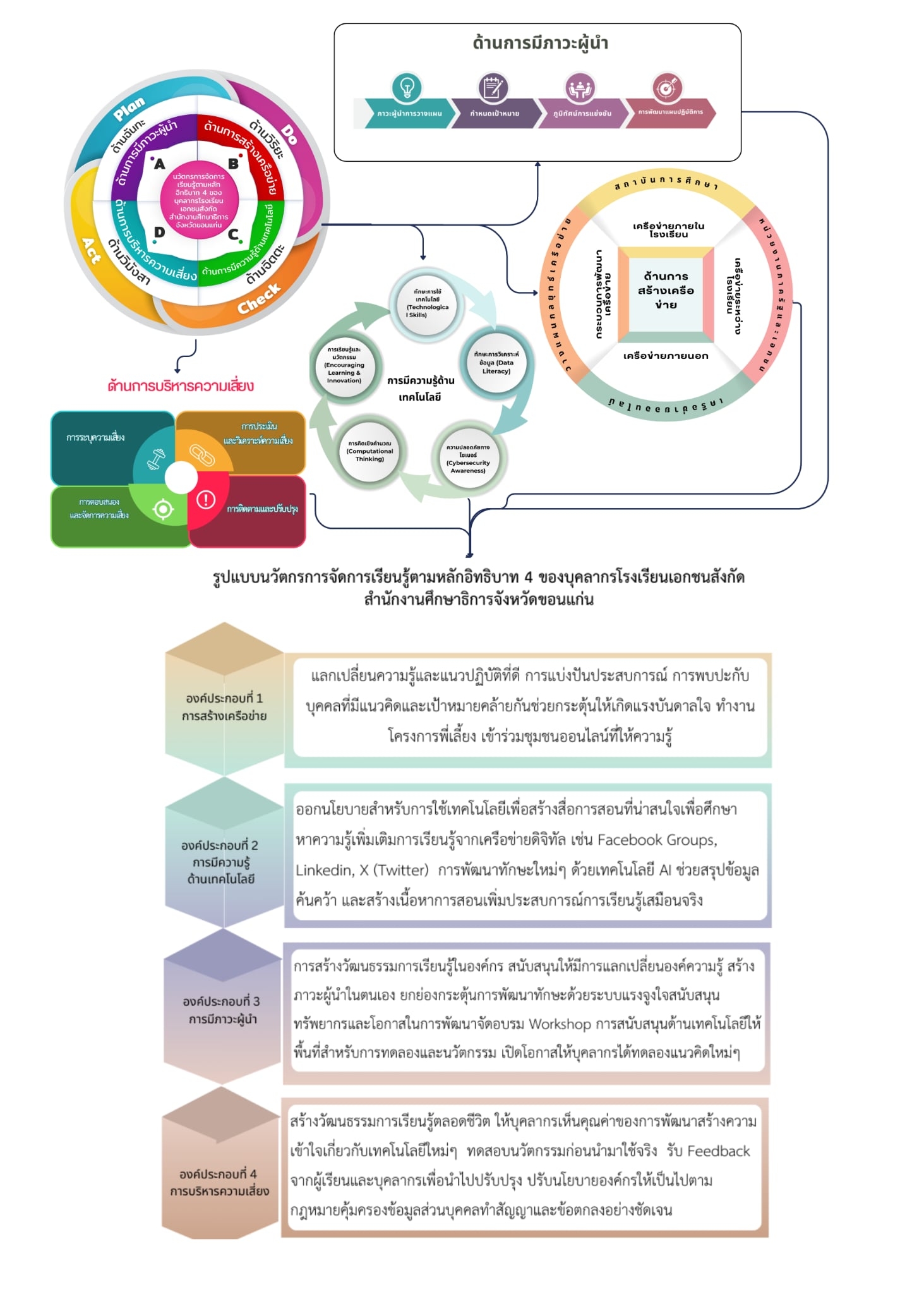
2. The developed learning management innovation model comprised four components: fostering instructional inspiration, goal setting and effective work practices, monitoring learning behaviors through technology, and systems thinking. The model integrates the Iddhipāda 4 principles Chanda (motivation and commitment), Viriya (perseverance and continuous development), Citta (attentiveness and reflective data use), and Vimamsa (reasoned inquiry and the application of technology, particularly artificial intelligence) to enhance the effectiveness of learning management.
3. The evaluation results indicated that the model was appropriate, feasible, and beneficial. It effectively enhanced network building, technological knowledge, leadership, and risk management, thereby supporting informed decision-making and improving the overall effectiveness of learning management.
Article Details

This work is licensed under a Creative Commons Attribution-NonCommercial-NoDerivatives 4.0 International License.
เพื่อให้เป็นไปตามกฎหมายลิขสิทธิ์ ผู้นิพนธ์ทุกท่านต้องลงลายมือชื่อในแบบฟอร์มใบมอบลิขสิทธิ์บทความ ให้แก่วารสารฯ พร้อมกับบทความต้นฉบับที่ได้แก้ไขครั้งสุดท้าย นอกจากนี้ ผู้นิพนธ์ทุกท่านต้องยืนยันว่าบทความ ต้นฉบับที่ส่งมาตีพิมพ์นั้น ได้ส่งมาตีพิมพ์เฉพาะในวารสาร วิชาการธรรม ทรรศน์ เพียงแห่งเดียวเท่านั้น หากมีการใช้ ภาพหรือตารางของผู้นิพนธ์อื่นที่ปรากฏในสิ่งตีพิมพ์อื่นมาแล้ว ผู้นิพนธ์ต้องขออนุญาตเจ้าของลิขสิทธิ์ก่อน พร้อมทั้ง แสดงหนังสือที่ได้รับการยินยอมต่อบรรณาธิการ ก่อนที่บทความจะได้รับการตีพิมพ์References
กระทรวงศึกษาธิการ. (2550). การสอนที่เน้นผู้เรียนเป็นศูนย์กลาง. กรุงเทพฯ: คุรุสภาลาดพร้าว.
กุลธิดา มะลิวัลย์, จุฬาพรรณภรณ์ ธนะแพทย์ และพระฮอนด้า วาทสทฺโท. (2564). ทักษะการบริหารตามหลักอิทธิบาท 4 ของผู้บริหารโรงเรียนเอกชน สังกัดสำนักงานศึกษาธิการจังหวัดหนองบัวลำภู. วารสาร มจร อุบลปริทรรศน์, 6(2), 435-448. https://so06.tci-thaijo.org/index.php/mcjou/article/view/249156
โกศล ภูศรี. (2564). กลยุทธ์การพัฒนาความเป็นนวัตกรของครูโรงเรียนมัธยมศึกษา สังกัดสำนักงานคณะกรรมการการศึกษาขั้นพื้นฐาน. (วิทยานิพนธ์การศึกษาดุษฎีบัณฑิต). มหาสารคาม: มหาวิทยาลัยมหาสารคาม.
ฐาปนา นิ่มไพศาล. (2559). องค์การและการจัดการ. กรุงเทพฯ: จุฬาลงกรณ์มหาวิทยาลัย.
ธีระ รุญเจริญ. (2559). วิถีสร้างการเรียนรู้เพื่อศิษย์ในศตวรรษที่ 21. กรุงเทพฯ: มูลนิธิสดศรีสฤษดิ์วงศ์.
บุญชม ศรีสะอาด. (2554). การวิจัยเบื้องต้น. (พิมพ์ครั้งที่ 9). กรุงเทพฯ: สุวีริยาสาส์น.
ประเวศน์ มหารัตน์สกุล. (2560). กลยุทธ์การวางแผนและการจัดการ. กรุงเทพฯ: ส. เอเชียเพรส 2989.
พระราชกฤษฎีกาว่าด้วยหลักเกณฑ์และวิธีการบริหารกิจการบ้านเมืองที่ดี พ.ศ. 2546 และที่แก้ไขเพิ่มเติม (ฉบับที่ 2) พ.ศ. 2562. (1 พฤษภาคม 2562). ราชกิจจานุเบกษา, เล่ม 136 ตอน 57 ก หน้า 79.
สำนักงานเลขาธิการคุรุสภา. (2560). แผนการศึกษาแห่งชาติ พ.ศ. 2560-2579. กรุงเทพฯ: พริกหวานกราฟฟิค.
สำนักวิชาการและมาตรฐานการศึกษา. (2553). แนวทางการจัดการเรียนรู้ ตามหลักสูตรแกนกลางการศึกษาขั้นพื้นฐาน พุทธศักราช 2551. กรุงเทพฯ: ชุมนุมสหกรณ์การเกษตรแห่งประเทศไทย.
สิริพร อินทรธรรม, วิทร วิภาหัส และประหยัด ฤาชากูล. (2566). การศึกษาแนวทางสมรรถนะด้านการพัฒนาตนเองของครูโรงเรียนเอกชน สังกัดสำนักงานศึกษาธิการ จังหวัดสกลนคร. วารสารวิชาการวิทยาลัยสันตพล, 9(2), 63-72. https://so05.tci-thaijo.org/index.php/scaj/article/view/263938
สุวิมล ว่องวานิช. (2550). การวิจัยประเมินความต้องการจำเป็น. กรุงเทพฯ: จุฬาลงกรณ์มหาวิทยาลัย.
Joyce, B., Weil, M., & Calhoun, E. (2015). Models of teaching. (9th ed.). Boston, MA: Pearson Education.
Krejcie, R. V., & Morgan, D. W. (1970). Determining sample size for research activities. Educational and Psychological Measurement, 30(3), 607-610. https://doi.org/10.1177/001316447003000308
