The Development of Learning on Public Spaces at Temples and Communities around Kaen Nakhon Lake, Khon Kaen
Article Sidebar
Main Article Content
Abstract
The objectives of this research were to 1) study the learning of history, arts and culture in public areas around Bueng Kaen Nakhon, Khon Kaen Province, 2) develop activities for learning history, arts and culture around Bueng Kaen Nakhon, and 3) evaluate the learning activities organized by temples and communities around Bueng Kaen Nakhon. This was an action research. The research was divided into 3 phases: Phase 1 studied the principles, concepts, and theories of developing learning, history, and arts and culture in public areas around Bueng Kaen Nakhon, Khon Kaen Province, through in-depth interviews with 22 key informants. Phase 2 developed learning of temples and communities in public areas by organizing activities with a target group of 110 people. Phase 3 evaluated the learning activities organized from a sample of 100 people. Data analysis used descriptive content analysis.
The results of the research found that:
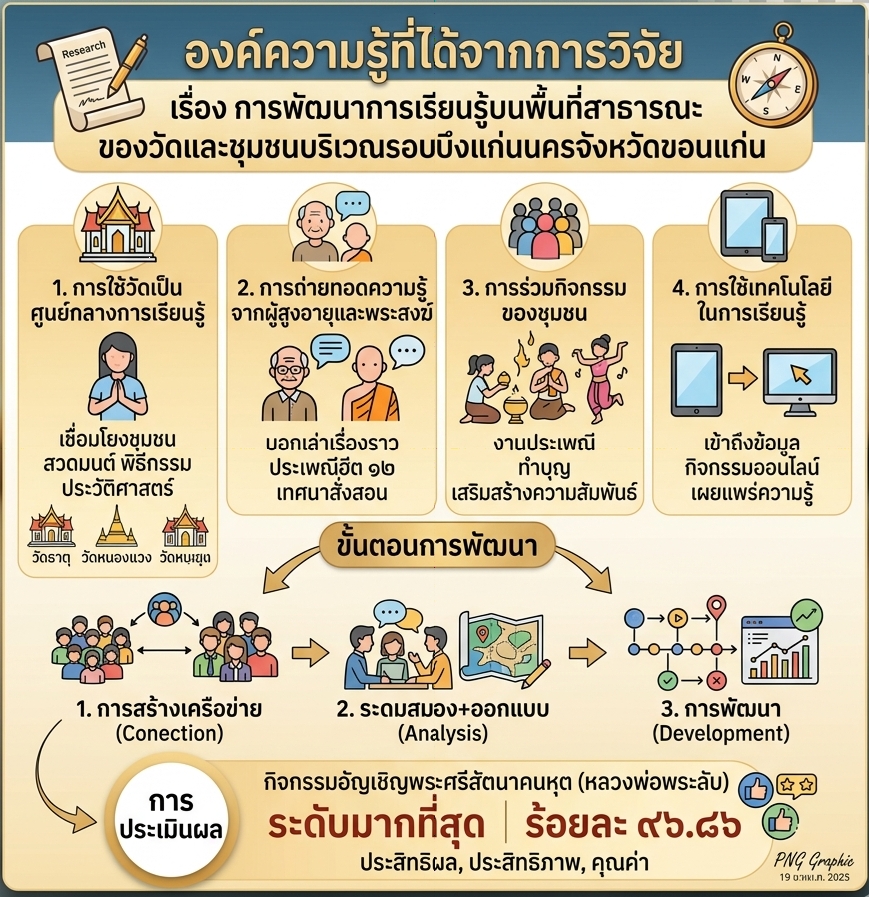
1. Learning history and arts and culture in public areas around Bueng Kaen Nakhon is learning from stories and teachings by community scholars, community learning resources, from temples where monks provide knowledge through sermons, religious activities, merit-making traditions, and from organizing activities within the community.
2. The development of learning activities on history and arts and culture around Bueng Kaen Nakhon has 3 steps: Step 1: Networking, Step 2: Brainstorming and Design, Step 3: Development. All 3 steps cover the development of learning in public areas of temples and communities around Bueng Kaen Nakhon, Khon Kaen Province.
3. Evaluation of the efficiency, effectiveness and value of learning activities of temples and communities in public areas under: The activity of inviting Phra Sri Satta Nakhanahut (Luang Pho Phra Lab) in general is at the highest level, accounting for 96.86 percent, with an average of 4.84. When considering each aspect, it was found that all items have the highest level of efficiency, with the efficiency aspect having the highest percentage, equal to 97.20, followed by the efficiency aspect and the value aspect, with the percentages equal to 96.80 and 96.60, respectively.
Article Details

This work is licensed under a Creative Commons Attribution-NonCommercial-NoDerivatives 4.0 International License.
เพื่อให้เป็นไปตามกฎหมายลิขสิทธิ์ ผู้นิพนธ์ทุกท่านต้องลงลายมือชื่อในแบบฟอร์มใบมอบลิขสิทธิ์บทความ ให้แก่วารสารฯ พร้อมกับบทความต้นฉบับที่ได้แก้ไขครั้งสุดท้าย นอกจากนี้ ผู้นิพนธ์ทุกท่านต้องยืนยันว่าบทความ ต้นฉบับที่ส่งมาตีพิมพ์นั้น ได้ส่งมาตีพิมพ์เฉพาะในวารสาร วิชาการธรรม ทรรศน์ เพียงแห่งเดียวเท่านั้น หากมีการใช้ ภาพหรือตารางของผู้นิพนธ์อื่นที่ปรากฏในสิ่งตีพิมพ์อื่นมาแล้ว ผู้นิพนธ์ต้องขออนุญาตเจ้าของลิขสิทธิ์ก่อน พร้อมทั้ง แสดงหนังสือที่ได้รับการยินยอมต่อบรรณาธิการ ก่อนที่บทความจะได้รับการตีพิมพ์References
นันทนิษฎ์ สมคิด และพระสุธีรัตนบัณฑิต. (2562). แนวทางการพัฒนาชุมชนสร้างสรรค์ในเขตพื้นที่จังหวัดจันทบุรี. วารสารมหาจุฬาวิชาการ, 6(ฉบับพิเศษ), 318-333.
พีรดร แก้วลาย และทิพย์สุดา จันทร์แจ่มหล้า. (2561). สภาพแวดล้อมเพื่อการเรียนรู้สาธารณะรูปแบบใหม่: การเปลี่ยนกระบวนทัศน์ของการเรียนรู้และผลกระทบที่มีต่อรายละเอียดโครงการ ที่ว่าง และสถาปัตยกรรมศูนย์ความรู้ร่วมสมัย. Journal of Architectural/Planning Research and Studies, 15(2), 135-152. https://so02.tci-thaijo.org/index.php/jars/article/view/167939/120949
พีรยา บุญประสงค์. (2562). อัตลักษณ์ของถิ่นที่ในกระบวนการเปลี่ยนแปลงการใช้สอยของอาคารเก่าในเขตเมืองเก่า. Journal of Architectural/Planning Research and Studies, 16(2), 31-48. https://doi.org/10.56261/jars.v16i2.175256
วิทยา ทองดี, สุรพล พรมกุล, สุธิพงษ์ สวัสดิ์ทา, สมควร นามสีฐาน และพันทิวา ทับภูมี. (2564). รูปแบบการพัฒนาชุมชนสร้างสรรค์ด้วยกระบวนการทางเทคโนโลยี สิ่งแวดล้อม สุขภาวะ ศิลปะ และการออกแบบเมืองขอนแก่น. วารสารบัณฑิตศึกษามหาจุฬาขอนแก่น, 8(3), 259-276.
สำนักงานเลขาธิการคุรุสภา. (2560). แผนการศึกษาแห่งชาติ พ.ศ. 2560-2579. กรุงเทพฯ: พริกหวานกราฟฟิค.
Office of Knowledge Management and Development. (2017). The 20-year strategic integration of museum and learning center plan (2019-2039). Bangkok: Office of Knowledge Management and Development.
