A Model of Human Behavioral Development According to Theravāda Buddhist Principles
Article Sidebar
Main Article Content
Abstract
This research aimed to: 1) study the concepts and theories related to human behavioral development; 2) examine the principles in Theravāda Buddhism related to human behavioral development; 3) develop a model for human behavioral development based on Theravāda Buddhist principles; and 4) present a model for human behavioral development according to Theravāda Buddhism. This study employed documentary research together with in-depth interviews. Data were collected from the Tipiṭaka, academic documents, and related research studies. The collected data were analyzed using content analysis and synthesized through a Buddhist philosophical approach.
The results of the research revealed that:
1. The concept of human behavioral development based on Bloom’s educational theory is divided into three domains: cognitive, affective, and psychomotor. This framework can be systematically applied to the development of human behavior.
2. The Theravāda Buddhist principles related to human behavioral development include Bhāvanā 4, Vibhajjavāda 7, Sappurisadhamma 7, and Ovādapātimokkha 3. These principles aim to develop human beings holistically in terms of wisdom, mental qualities, and behavioral conduct.
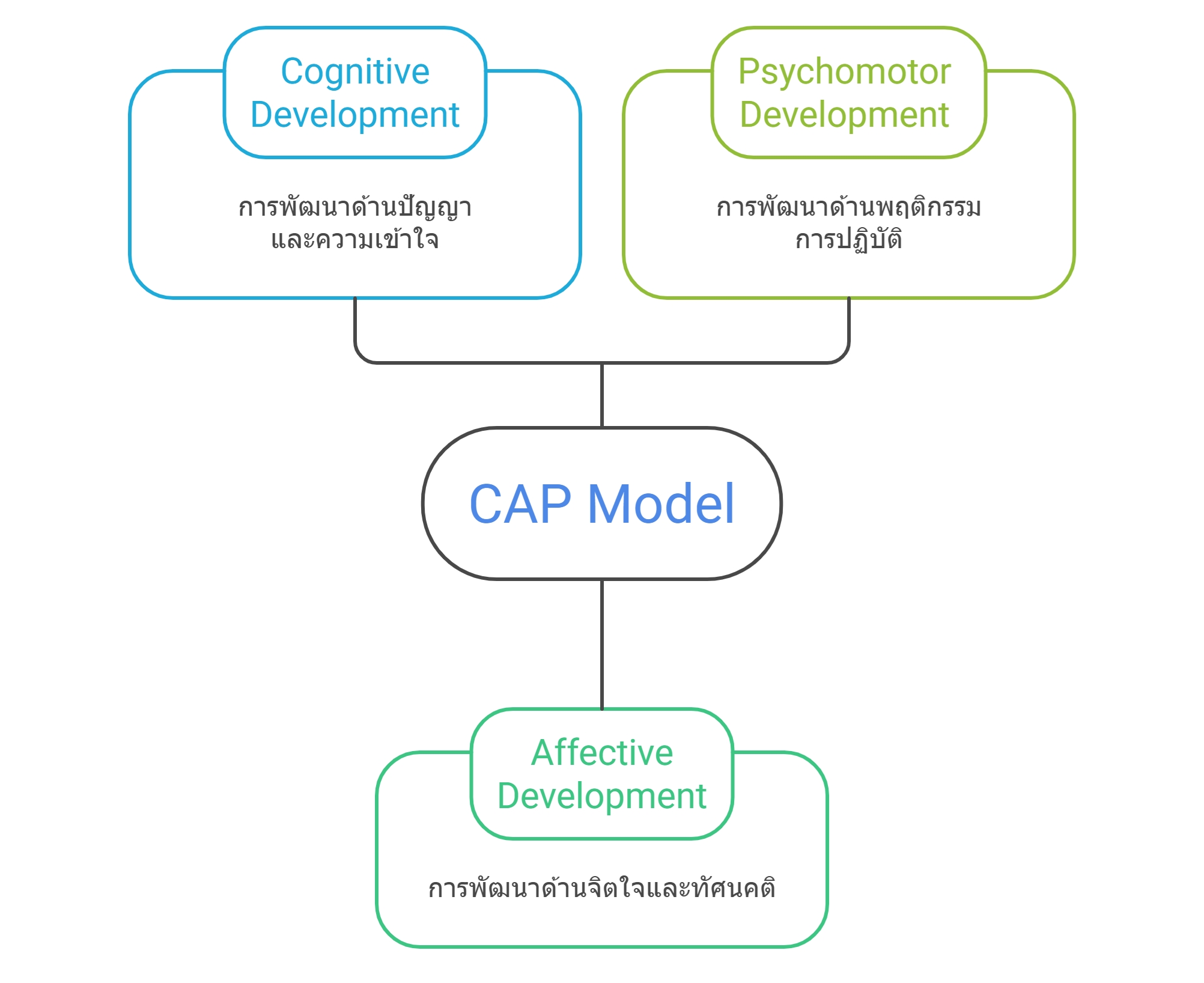
3. The development of a human behavioral development model based on Theravāda Buddhism can integrate Bloom’s learning theory with Buddhist principles by linking the cognitive domain with Bhāvanā 4, the affective domain with Vibhajjavāda 7, and the psychomotor domain with Sappurisadhamma 7 and Ovādapātimokkha 3.
4. The new body of knowledge derived from this research is an integrated model of human behavioral development based on Theravāda Buddhist principles called the CAP Model, which consists of three key processes: Cognitive Development, Affective Development, and Psychomotor Development. This model aims to promote balanced human development in terms of wisdom, mental cultivation, and practical conduct in accordance with Buddhist principles.
Article Details

This work is licensed under a Creative Commons Attribution-NonCommercial-NoDerivatives 4.0 International License.
เพื่อให้เป็นไปตามกฎหมายลิขสิทธิ์ ผู้นิพนธ์ทุกท่านต้องลงลายมือชื่อในแบบฟอร์มใบมอบลิขสิทธิ์บทความ ให้แก่วารสารฯ พร้อมกับบทความต้นฉบับที่ได้แก้ไขครั้งสุดท้าย นอกจากนี้ ผู้นิพนธ์ทุกท่านต้องยืนยันว่าบทความ ต้นฉบับที่ส่งมาตีพิมพ์นั้น ได้ส่งมาตีพิมพ์เฉพาะในวารสาร วิชาการธรรม ทรรศน์ เพียงแห่งเดียวเท่านั้น หากมีการใช้ ภาพหรือตารางของผู้นิพนธ์อื่นที่ปรากฏในสิ่งตีพิมพ์อื่นมาแล้ว ผู้นิพนธ์ต้องขออนุญาตเจ้าของลิขสิทธิ์ก่อน พร้อมทั้ง แสดงหนังสือที่ได้รับการยินยอมต่อบรรณาธิการ ก่อนที่บทความจะได้รับการตีพิมพ์References
ชํานาญ วงศ์รัศมีเดือน, สุวิญ รักสัตย์, ธวัช หอมทวนลม และพระเมธาวินัยรส. (2561). การจัดการพฤติกรรมมนุษย์ตามแนวจริตในพระพุทธศาสนาเถรวาท. วารสารสันติศึกษาปริทรรศน์ มจร, 7(3), 766-778. https://so03.tci-thaijo.org/index.php/journal-peace/article/view/144815
พระครูภาวนาโพธิคุณ (สมชาย กนฺตสีโล), พระวิมาน คมฺภีรปญฺโญ, พระมหาณัฐกิตติ อนารโท และพระสมบัตร ฐิตญาโณ. (2562). การพัฒนาพฤติกรรมเชิงจริยธรรมของเยาวชนท่ามกลางความเปลี่ยนแปลงทางเทคโนโลยี: กรณีศึกษาเยาวชนไทยในจังหวัดขอนแก่น. วารสารบัณฑิตศึกษามหาจุฬาขอนแก่น, 6(4), 701-715. https://so02.tci-thaijo.org/index.php/jg-mcukk/article/view/228953
พระพรหมคุณาภรณ์ (ป.อ. ปยุตฺโต). (2556). ตามทางพุทธกิจ. (พิมพ์ครั้งที่ 8). กรุงเทพฯ: ผลิธัมม์.
พระมหาอรรถพงษ์ สิริโสภโณ และพระครูภาวนาโพธิคุณ. (2563). การพัฒนาพฤติกรรมมนุษย์ตามแนวพุทธจริยศาสตร์ในตำบลท่าสองคอน อำเภอเมือง จังหวัดมหาสารคาม. วารสารบัณฑิตศึกษามหาจุฬาขอนแก่น, 8(2), 274-285. https://so02.tci-thaijo.org/index.php/jg-mcukk/article/view/248641
มหาจุฬาลงกรณราชวิทยาลัย. (2539). พระไตรปิฎกภาษาไทย ฉบับมหาจุฬาลงกรณราชวิทยาลัย ชุด 45 เล่ม. กรุงเทพฯ: มหาจุฬาลงกรณราชวิทยาลัย.
Bloom, B. S. (Ed.). (1956). Taxonomy of educational objectives: The classification of educational goals. Handbook I: Cognitive domain. New York, NY: David McKay.
Freud, S. (1961). The ego and the id. New York, NY: W. W. Norton & Company.
Pavlov, I. P. (1927). Conditioned reflexes: An investigation of the physiological activity of the cerebral cortex. London, UK: Oxford University Press.
Skinner, B. F. (1974). About behaviorism. New York, NY: Alfred A. Knopf.
