Structural Equation Model Leadership of School Administrators Affecting high-Performance Organization of Secondary Educational Service Area in The Northeastern Region
Article Sidebar
Main Article Content
Abstract
This research aimed to: 1) develop a causal relationship model of school administrators’ leadership affecting the high-performance organization of schools; 2) examine the consistency of the developed model with empirical data; and 3) propose guidelines for developing school administrators’ leadership affecting the high-performance organization of schools under the Secondary Educational Service Area Offices in Northeastern Thailand. The study employed a mixed methods research design and was conducted in three phases. Phase 1 involved developing the hypothetical model through a review of relevant literature and research and interviews with five experts. Phase 2 examined the model using empirical data from 638 school administrators and teachers selected through proportionate stratified random sampling. The research instrument was a five-point rating-scale questionnaire with an overall reliability coefficient of .97. Data were analyzed using descriptive statistics, Pearson’s correlation coefficient, confirmatory factor analysis, and structural equation modeling. Phase 3 involved synthesizing development guidelines from the structural model results and interviews with five experts.
The findings showed that:
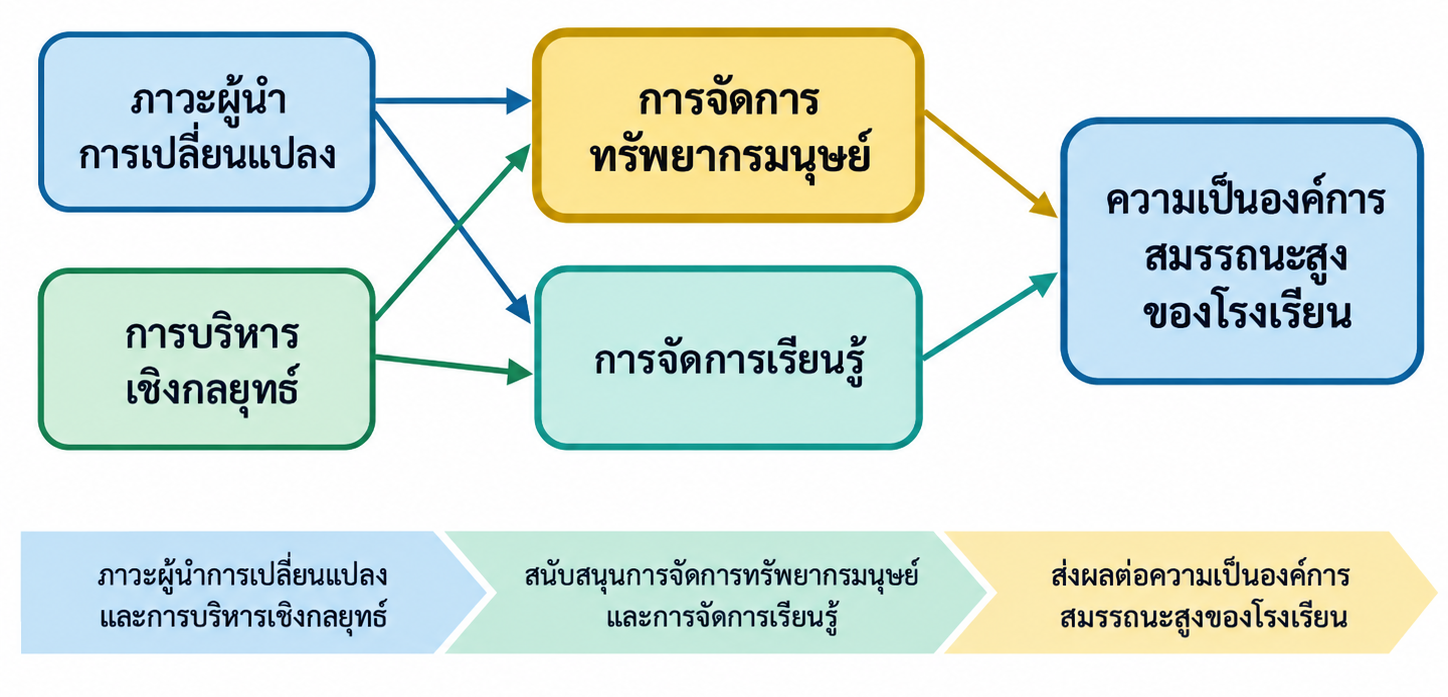
1. The model consisted of four causal variables: transformational leadership, strategic management, human resource management, and learning management, all of which were related to school high-performance organization.
2. The model was consistent with the empirical data, with χ² = 123.17, df = 106, p = .12177, GFI = .983, AGFI = .959, and RMSEA = .016. The model explained 78 percent of the variance in high-performance organization. Human resource management had the strongest direct effect on high-performance organization (β = .93, p < .01), followed by learning management (β = .22, p < .01).
3. The development guidelines emphasized strengthening administrators’ vision and ability to motivate personnel, setting clear strategic goals, systematically developing human resources, and using information to support planning and assessment in learning management.
Article Details

This work is licensed under a Creative Commons Attribution-NonCommercial-NoDerivatives 4.0 International License.
เพื่อให้เป็นไปตามกฎหมายลิขสิทธิ์ ผู้นิพนธ์ทุกท่านต้องลงลายมือชื่อในแบบฟอร์มใบมอบลิขสิทธิ์บทความ ให้แก่วารสารฯ พร้อมกับบทความต้นฉบับที่ได้แก้ไขครั้งสุดท้าย นอกจากนี้ ผู้นิพนธ์ทุกท่านต้องยืนยันว่าบทความ ต้นฉบับที่ส่งมาตีพิมพ์นั้น ได้ส่งมาตีพิมพ์เฉพาะในวารสาร วิชาการธรรม ทรรศน์ เพียงแห่งเดียวเท่านั้น หากมีการใช้ ภาพหรือตารางของผู้นิพนธ์อื่นที่ปรากฏในสิ่งตีพิมพ์อื่นมาแล้ว ผู้นิพนธ์ต้องขออนุญาตเจ้าของลิขสิทธิ์ก่อน พร้อมทั้ง แสดงหนังสือที่ได้รับการยินยอมต่อบรรณาธิการ ก่อนที่บทความจะได้รับการตีพิมพ์References
จันทิมา พรหมเกษ. (2559). ผลกระทบของการปฏิบัติการด้านการบริหารทรัพยากรมนุษย์และความผูกพันต่อองค์กรที่มีต่อการเพิ่มผลผลิตและความสามารถในการ ทำกำไรของธุรกิจกระเป๋าและเครื่องหนังในประเทศ. วารสารศรีนครินทรวิ โรฒวิจัยและพัฒนา (สาขามนุษยศาสตร์และสังคมศาสตร์), 8(16), 30-43. https://ejournals.swu.ac.th/index.php/swurd/article/view/8364/7386
จิตติภา ขาวอ่อน. (2557). ความพึงพอใจในการปฏิบัติงานของข้าราชการสำนักงานปลัดกระทรวง กระทรวงศึกษาธิการ. (วิทยานิพนธ์ครุศาสตรมหาบัณฑิต). เพชรบูรณ์: มหาวิทยาลัยราชภัฏเพชรบูรณ์.
ณัชญานุช สุดชาดี. (2561). ภาวะผู้นำเชิงนวัตกรรมของผู้บริหารสถานศึกษาที่ส่งผลต่อความเป็นองค์การสมรรถนะสูงของสถานศึกษา สังกัดสำนักงานเขตพื้นที่การศึกษาประถมศึกษาอุดรธานี. อุดรธานี: มหาวิทยาลัยราชภัฏอุดรธานี.
บัณฑิต ศรีสงคราม และไพฑูรย์ พวงยอด. (2566). สภาพปัจจุบัน ปัญหา การจัดการเรียนรู้ในสถานการณ์การแพร่ระบาดของเชื้อไวรัสโคโรนา 2019 (COVID-19) ของโรงเรียนในสังกัดสำนักงานเขตพื้นที่การศึกษามัธยมศึกษา เขต 21 จังหวัดบึงกาฬ. วารสาร มจร อุบลปริทรรศน์, 8(2), 1767-1778. https://so06.tci-thaijo.org/index.php/mcjou/article/view/269888/181091
ภารดี อนันต์นาวี. (2551). สภาพและปัญหาการบริหารจัดการที่ดีของสถานศึกษาขั้นพื้นฐานภาคตะวันออก. ชลบุรี: มหาวิทยาลัยบูรพา
วชิราพร บุนนท์. (2565). การพัฒนาตัวบ่งชี้การบริหารเชิงกลยุทธ์ของผู้บริหารสถานศึกษา สังกัดสำนักงานเขตพื้นที่การศึกษามัธยมศึกษาหนองคาย. (วิทยานิพนธ์ครุศาสตรมหาบัณฑิต). สกลนคร: มหาวิทยาลัยราชภัฏสกลนคร.
วิจารณ์ พานิช. (2555). วิถีสร้างการเรียนรู้เพื่อศิษย์ในศตวรรษที่ 21. กรุงเทพฯ: มูลนิธิสดศรีสฤษดิ์วงศ์.
วิไลลักษณ์ โภคาพานิชย์. (2562). โมเดลความสัมพันธ์เชิงสาเหตุปัจจัยที่ส่งผลต่อประสิทธิผลการบริหารจัดการศึกษาของโรงเรียนมัธยมศึกษาในภาคตะวันออกเฉียงเหนือ. (วิทยานิพนธ์ครุศาสตรดุษฎีบัณฑิต). สกลนคร: มหาวิทยาลัยราชภัฏสกลนคร.
สง่า จันทร์วิเศษ, สมกิต บุญยะโพธิ์ และสุรินทร์ สำลี. (2568). แนวทางการพัฒนาภาวะผู้นำการเปลี่ยนแปลงของผู้บริหารสถานศึกษาสังกัดสำนักงานเขตพื้นที่การศึกษามัธยมศึกษา เขต 9. วารสารส่งเสริมและพัฒนาวิชาการสมัยใหม่, 3(4), 321-337. https://so12.tcithaijo.org/index.php/MADPIADP/article/download/3084/2811/29484
สำนักงานคณะกรรมการการศึกษาขั้นพื้นฐาน. (2566). แผนปฏิบัติราชการระยะ 5 ปี (พ.ศ. 2566-2570) ของสำนักงานคณะกรรมการการศึกษาขั้นพื้นฐาน. กรุงเทพฯ: กระทรวงศึกษาธิการ.
สำนักแผนและประกันคุณภาพการศึกษา. (2558). คู่มือประกันคุณภาพการศึกษา 2558. กรุงเทพฯ: สำนักงานคณะกรรมการการอุดมศึกษา.
สุเทพ พงษ์ศรีวัฒน์. (2561). ภาวะความเป็นผู้นำ. กรุงเทพฯ: เอ็กซเปอร์เน็ท.
อัมพร พินสา. (2563). การพัฒนารูปแบบการจัดการศึกษาโดยใช้ท้องถิ่นเป็นฐานของสถานศึกษาในสังกัดสำนักงานเขตพื้นที่การศึกษาประถมศึกษาภาคตะวันออกเฉียงเหนือ. (วิทยานิพนธ์ปรัชญาดุษฎีบัณฑิต). อุดรธานี: มหาวิทยาลัยราชภัฏอุดรธานี.
De Waal, A. (2007). The Characteristics of High-Performance Organization. Business Strategy Series, 8, 179-185.
Litwin, G. H., & Stringer, R. A., Jr. (1968). Motivation and organizational climate. Boston, MA: Division of Research, Harvard Business School.
Mowday, R., Steers, R. M., & Porter, L. (1979). The measurement of organizational commitment. Journal of Vocational Behavior, 1(4), 224-247.
Partnership for 21st Century Skills. (2009). Framework for 21st century learning. Washington, DC: Author.
