Participatory Management for Restructuring Feed Corn Production to Reduce Burning and Enhance Efficiency in Mae Chaem District, Chiang Mai Province
Article Sidebar
Main Article Content
Abstract
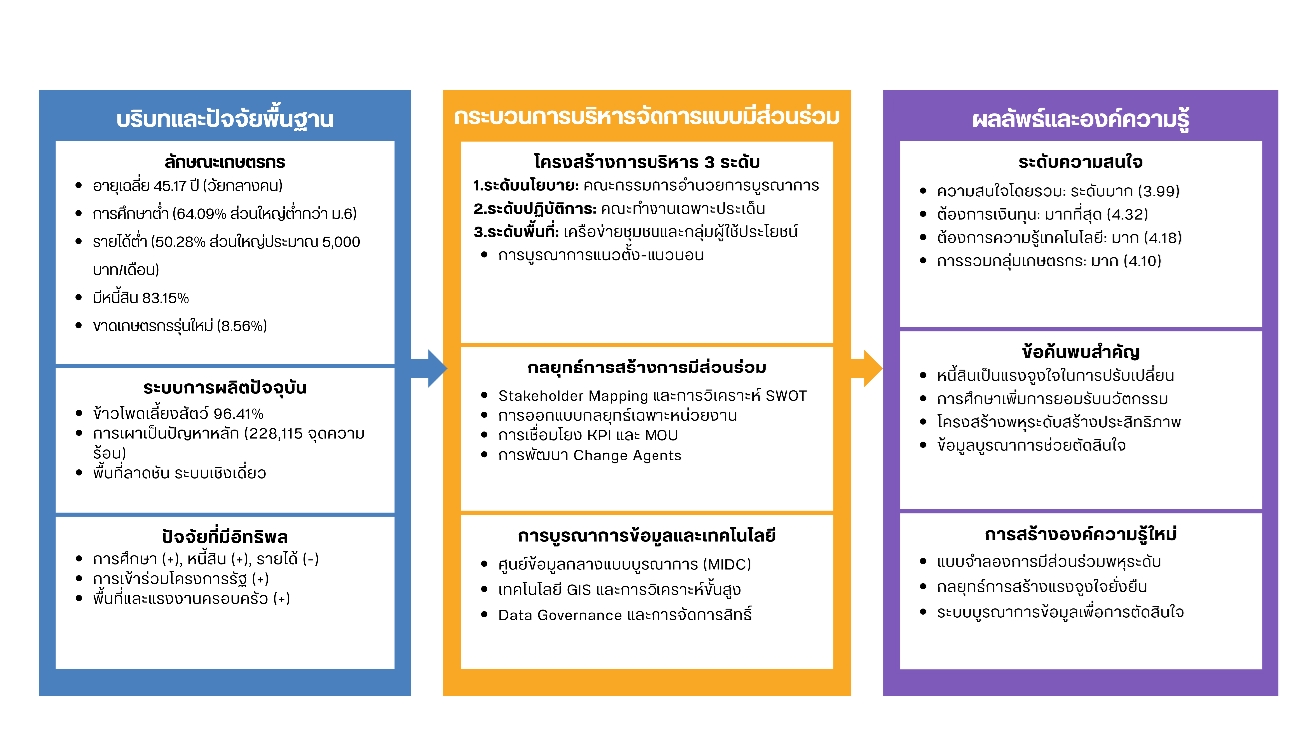
The objectives of this study were: 1) to analyze the restructuring of corn production for animal feed to reduce burning practices and increase efficiency in Mae Chaem District, Chiang Mai Province, and 2) to examine participatory management approaches toward restructuring corn production for animal feed to reduce burning and enhance efficiency in Mae Chaem District, Chiang Mai Province. The research employed a mixed-methods design, primarily collecting quantitative data supplemented by qualitative data. A total of 462 informants participated in the study, comprising: 1) 362 farmer samples, 2) 30 policymakers and 30 community leaders, 3) 10 farmer leaders, 4) 10 entrepreneurs, 5) 10 academics and experts, and 6) 10 civil society representatives. Research instruments included questionnaires, in-depth interviews, focus group discussions, and observations. Data were analyzed using descriptive statistics, content analysis, and inferential statistics.
The findings revealed that:
1. Regarding the restructuring of corn production for animal feed to reduce burning and increase efficiency, farmers demonstrated a high level of interest in production restructuring (mean = 3.99), with government financial support identified as their primary need (mean = 4.32). Factors influencing their interest included educational level, number of family members assisting in agricultural activities, and debt burden. The analysis indicated that farmers with higher debt levels, higher educational attainment, larger cultivation areas, and prior participation in government programs showed greater propensity toward corn production restructuring. Conversely, farmers with higher income levels or those experiencing market-related challenges exhibited lower interest.
2. The participatory management approach for restructuring agricultural production to reduce burning and enhance efficiency consisted of a three-tier management structure: policy level, operational level, and area level. The strategy for fostering participation involved stakeholder mapping, alignment with organizational performance indicators, and the development of an integrated central data hub to support decision-making processes.
Article Details

This work is licensed under a Creative Commons Attribution-NonCommercial-NoDerivatives 4.0 International License.
เพื่อให้เป็นไปตามกฎหมายลิขสิทธิ์ ผู้นิพนธ์ทุกท่านต้องลงลายมือชื่อในแบบฟอร์มใบมอบลิขสิทธิ์บทความ ให้แก่วารสารฯ พร้อมกับบทความต้นฉบับที่ได้แก้ไขครั้งสุดท้าย นอกจากนี้ ผู้นิพนธ์ทุกท่านต้องยืนยันว่าบทความ ต้นฉบับที่ส่งมาตีพิมพ์นั้น ได้ส่งมาตีพิมพ์เฉพาะในวารสาร วิชาการธรรม ทรรศน์ เพียงแห่งเดียวเท่านั้น หากมีการใช้ ภาพหรือตารางของผู้นิพนธ์อื่นที่ปรากฏในสิ่งตีพิมพ์อื่นมาแล้ว ผู้นิพนธ์ต้องขออนุญาตเจ้าของลิขสิทธิ์ก่อน พร้อมทั้ง แสดงหนังสือที่ได้รับการยินยอมต่อบรรณาธิการ ก่อนที่บทความจะได้รับการตีพิมพ์References
กวิน มุสิกา, สุชนนี เมธิโยธิน และบรรพต วิรุณราช. (2562). แนวทางการบริหารหนี้สินเกษตรกรไทย. วารสารสันติศึกษาปริทรรศน์ มจร, 7(1), 111-125. https://so03.tci-thaijo.org/index.php/journal-peace/article/view/137839
ชาญชัย คำจำปา และภักดี โพธิ์สิงห์. (2564). นวัตกรรมด้านการเกษตรเพื่อประโยชน์สาธารณะ. วารสารการบริหารการปกครองและนวัตกรรมท้องถิ่น, 5(3), 131-142. https://so03.tci-thaijo.org/index.php/JLGISRRU/article/view/253625
ณมน ธนินธญางกูร และวัลลักษณ์ เที่ยงดาห์. (2568). การเสริมสร้างความเข้มแข็งของเศรษฐกิจฐานรากเพื่อการพัฒนาอย่างยั่งยืน. วารสารมหาวิทยาลัยราชภัฏร้อยเอ็ด, 9(1), 124-133. https://so03.tci-thaijo.org/index.php/reru/article/view/284912/188460
ธีรพงศ์ บริรักษ์. (2562). ถอดบทเรียนวิกฤต PM 2.5. วารสารวิชาการมหาวิทยาลัยอีสเทิร์นเอเชีย, 13(3), 44-58.
https://he01.tci-thaijo.org/index.php/EAUHJSci/article/view/231508
นิพนธ์ พัวพงศกร, สุทธิภัทร ราชคม และกำพล ปั้นตะกั่ว. (2567). ปัญหาฝุ่น PM 2.5: แนวทางป้องกัน-ลดเผาในที่โล่ง และร่าง พ.ร.บ.งบฯ 67. กรุงเทพฯ: สถาบันวิจัยเพื่อการพัฒนาประเทศไทย (ทีดีอาร์ไอ).
พิพัทธเวศ วันนาร. (2565). การค้าเสรี: ความท้าทายหรือโอกาสสำหรับภาคอุตสาหกรรมการเกษตร. Journal of Modern Learning Development, 7(7), 263-280.
วรารัตน์ บุญเรืองจักร, สัญญา เคณาภูมิ และเสาวลักษณ์ โกศลกิตติอัมพร. (2559). การบูรณาการเทคโนโลยีสารสนเทศเพื่อการบริหารจัดการรัฐกิจ. วารสารวิชาการธรรมทรรศน์, 16(2), 203-220.https://so06.tci-thaijo.org/index.php/dhammathas/article/view/78819/63110
วิวัฒน์ ไมเกิ้นสาร และมนฤดี มูลคำ. (2557). การเปลี่ยนแปลงในภาคเกษตรในบริบทของอนาคตโลก. ปัญญาพิวัฒน์สาร, 5(ฉบับพิเศษ), 244-255. https://so05.tci-thaijo.org/index.php/pimjournal/article/view/20113
ศรติ ภูมิโพธ. (2556). การค้าเสรี: เครือข่ายการบริหารเพื่อผู้มีส่วนได้ส่วนเสีย: กรอบแนวคิดเชิงพลวัตระบบ. วารสารร่มพฤกษ์ มหาวิทยาลัยเกริก, 13(2), 1-18. https://so05.tci-thaijo.org/index.php/romphruekj/article/view/62151
แสงดาว กองใจ, สมคิด แก้วทิพย์, เฉลิมชัย ปัญญาดี และบงกชมาศ เอกเอี่ยม. (2565). การยึดมั่นผูกพันในงานและหนุนเสริมขับเคลื่อนหุ้นส่วนทางสังคม เพื่อป้องกันและแก้ไขปัญหาฝุ่นควันจังหวัดเชียงใหม่. วารสารวิชาการธรรมทรรศน์, 22(3), 387-397. https://so02.tci-thaijo.org/index.php/JBS/article/view/254371
สุภางค์ จันทวานิช. (2557). วิธีการวิจัยเชิงคุณภาพ. (พิมพ์ครั้งที่ 21). กรุงเทพฯ: จุฬาลงกรณ์มหาวิทยาลัย.
สำนักงานพัฒนาเทคโนโลยีอวกาศและภูมิสารสนเทศ. (2567). รายงานสรุปสถานการณ์ไฟป่าและหมอกควันด้วยเทคโนโลยีอวกาศและภูมิสารสนเทศปี 2567. กรุงเทพฯ: สำนักประยุกต์และบริหารภูมิสารสนเทศ.
สำนักงานจังหวัดเชียงใหม่. (2568). รายงานการประชุมหัวหน้าส่วนราชการประจำจังหวัดเชียงใหม่และการประชุมคณะกรมการจังหวัดเชียงใหม่. เชียงใหม่: กลุ่มงานอำนวยการจังหวัดเชียงใหม่.
สำนักงานเกษตรและสหกรณ์จังหวัดเชียงใหม่. (2567). ข้อมูลพื้นฐานของจังหวัดเชียงใหม่. เข้าถึงได้จาก https://www.opsmoac.go.th/chiangmai-dwl-files-461291791090
Ajzen, I. (1991). The Theory of Planned Behavior. Organizational Behavior & Human Decision Processes, 50(2), 179-211. https://www.researchgate.net/publication/272790646_The_Theory_of_Planned_Behavior
Hooghe, L., & Marks, G. (2001). Multi-Level Governance and European Integration. New York: Lanham, Boulder, Oxford: Rowman & Littlefield Publishers, Inc.
Muhammad Isa Abdurrahman, Sukalpaa Chaki, Gaurav Saini. (2020). Stubble burning: Effects on health & environment, regulations and management practices. Retrieved from https://www.sciencedirect.com/science/article/pii/S2666765720300119
Rogers, E. M. (2003). Diffusion of innovations. (5rd ed.). A Division of Macmillan Publishing. New York, NY: Free Press.
Reed, M. S. (2008). Stakeholder participation for environmental management: A literature review. Biological Conservation, 141(10), 2417-2431. https://www.sciencedirect.com/science/article/abs/pii/S0006320708002693
