The Development Of A Model For Enhancing Students’ Career Skills Through Activity-based Learning In Schools Under Surat Thani Primary Education Service Area Office 3
Article Sidebar
Main Article Content
Abstract
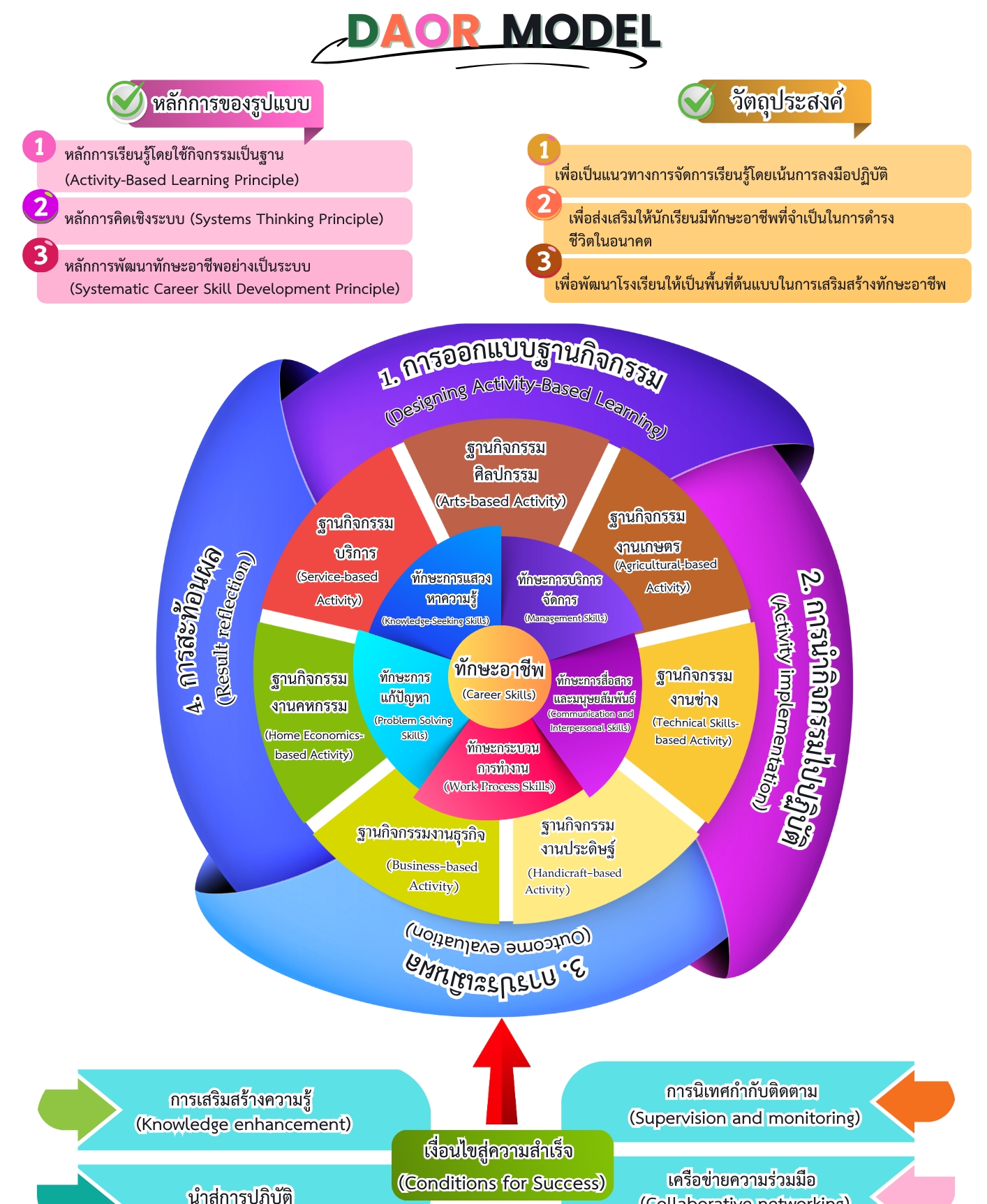
This research aimed to: (1) examine the current conditions and desired conditions for enhancing students’ career skills through activity-based learning in educational institutions; (2) develop a model for enhancing students’ career skills using activity-based approaches; and (3) evaluate the appropriateness and feasibility of the developed model. This study employed a research and development (R&D) design using a mixed-methods approach, conducted in three phases. Phase 1 involved investigating the current and desired conditions from 306 teachers using a questionnaire, and analyzing the data with the Modified Priority Needs Index (PNI modified). Phase 2 focused on model development through an expert seminar involving 9 experts, with data analyzed using content analysis. Phase 3 involved validating the model through a focus group discussion with 9 practitioners.
The research findings revealed that:
1. The desired needs for organizing activity bases and career skills were at a high level. The most needed activity bases included arts, service, and home economics, while the key career skills were working skills, communication skills, and management skills.
2. The developed model was a systematic framework integrating five components: principles, objectives, career skill components, implementation processes, and success conditions. The process emphasized activity design, hands-on practice, reflection, and continuous evaluation to systematically develop students’ career skills.
3. The validation results confirmed that the model was appropriate, feasible, and applicable for practical implementation in educational institutions.
Article Details

This work is licensed under a Creative Commons Attribution-NonCommercial-NoDerivatives 4.0 International License.
เพื่อให้เป็นไปตามกฎหมายลิขสิทธิ์ ผู้นิพนธ์ทุกท่านต้องลงลายมือชื่อในแบบฟอร์มใบมอบลิขสิทธิ์บทความ ให้แก่วารสารฯ พร้อมกับบทความต้นฉบับที่ได้แก้ไขครั้งสุดท้าย นอกจากนี้ ผู้นิพนธ์ทุกท่านต้องยืนยันว่าบทความ ต้นฉบับที่ส่งมาตีพิมพ์นั้น ได้ส่งมาตีพิมพ์เฉพาะในวารสาร วิชาการธรรม ทรรศน์ เพียงแห่งเดียวเท่านั้น หากมีการใช้ ภาพหรือตารางของผู้นิพนธ์อื่นที่ปรากฏในสิ่งตีพิมพ์อื่นมาแล้ว ผู้นิพนธ์ต้องขออนุญาตเจ้าของลิขสิทธิ์ก่อน พร้อมทั้ง แสดงหนังสือที่ได้รับการยินยอมต่อบรรณาธิการ ก่อนที่บทความจะได้รับการตีพิมพ์References
กระทรวงศึกษาธิการ. (2565). นโยบายและจุดเน้นของกระทรวงศึกษาธิการ ปีงบประมาณ พ.ศ. 2565. กรุงเทพฯ: กระทรวงศึกษาธิการ.
กาญจนา จันทร์ขาว. (2562). การจัดกิจกรรมการเรียนรู้เพื่อเสริมสร้างทักษะอาชีพโดยใช้ฐานกิจกรรม. วารสารศึกษาศาสตร์, 18(3), 112-125.
จารุวรรณ พงษ์จันทร์. (2563). การจัดกิจกรรมฝึกทักษะการบริหารงานของนักเรียนระดับประถมศึกษา. (วิทยานิพนธ์ครุศาสตรมหาบัณฑิต). บุรีรัมย์: มหาวิทยาลัยราชภัฏบุรีรัมย์.
ธีราพร คงทอง. (2565). การใช้สถานการณ์จำลองเพื่อพัฒนาทักษะการคิดและการแก้ปัญหา. วารสารครุศาสตร์, 15(2), 45-56.
พรทิพย์ วิริยะพันธุ์. (2565). การสะท้อนผลเพื่อพัฒนากระบวนการเรียนรู้ในการจัดกิจกรรมอาชีพ. วารสารวิชาการครูไทย, 13(4), 45-54.
พัชรินทร์ ยอดเมือง. (2562). การพัฒนาทักษะการทำงานในศตวรรษที่ 21 ของนักเรียนระดับมัธยมศึกษา. วารสารวิจัยและพัฒนาการศึกษา, 9(3), 77-85.
พิมลรัตน์ ทองดี. (2560). รูปแบบการเรียนรู้เพื่อเสริมสร้างสมรรถนะอาชีพของนักเรียนในโรงเรียนขยายโอกาสทางการศึกษา. วารสารศึกษาศาสตร์ มหาวิทยาลัยศิลปากร, 18(2), 113-128.
ราชกิจจานุเบกษา. (2565). แผนการศึกษาแห่งชาติ พ.ศ. 2560-2579 (ฉบับปรับปรุง พ.ศ. 2565). กรุงเทพฯ: สำนักเลขาธิการคณะรัฐมนตรี.
วรรณา หงส์วราภรณ์. (2561). การพัฒนาทักษะการสื่อสารในชั้นเรียนเพื่อเสริมสร้างมนุษยสัมพันธ์. วารสารศึกษาศาสตร์, 12(1), 23-35.
สำนักงานเขตพื้นที่การศึกษาประถมศึกษาสุราษฎร์ธานี เขต 3. (2565). แผนปฏิบัติการประจำปีงบประมาณ พ.ศ. 2566. สุราษฎร์ธานี: กลุ่มนโยบายและแผน.
_______. (2566). รายงานการสังเคราะห์รายงานผลการประเมินของสถานศึกษา ประจำปีการศึกษา 2565. สุราษฎร์ธานี: กลุ่มนิเทศ ติดตามและประเมินผลการจัดการศึกษา.
สำนักงานคณะกรรมการการศึกษาขั้นพื้นฐาน. (2561). ยุทธศาสตร์ชาติ พ.ศ. 2561-2580. กรุงเทพฯ: สำนักงานคณะกรรมการพัฒนาการเศรษฐกิจและสังคมแห่งชาติ.
สุภาวดี สุขสุคนธ์. (2564). ผลของการเรียนรู้แบบโครงงานที่มีต่อการแสวงหาความรู้ของนักเรียน. วารสารวิชาการครุศาสตร์, 18(4), 61-70.
Dick, W., & Carey, L. (1996). The systematic design of instruction. (4th ed.). New York, NY: HarperCollins College Publishers.
Joyce, B., Weil, M., & Calhoun, E. (2000). Models of teaching. (6th ed.). Boston, MA: Allyn & Bacon.
Piaget, J. (1973). To understand is to invent: The future of education. New York, NY: Grossman Publishers.
Prince, M. (2004). Does active learning work? A review of the research. Journal of Engineering Education, 93(3), 223-231.
Taba, H. (1962). Curriculum development: Theory and practice. New York, NY: Harcourt, Brace & World.
Vygotsky, L. S. (1978). Mind in society: The development of higher psychological processes. Cambridge, MA: Harvard University Press.
