A Political Model for Civil Society and Participatory Local Development Based on Aparihāniyadhamma in Roi Et Province
Article Sidebar
Main Article Content
Abstract
This research aimed to: 1) study the model of civil society politics and participation in local community development based on the integrated Aparihaniyadhamma principles in Roi Et Province; 2) develop a model of civil society politics and participation in local community development based on the integrated Aparihaniyadhamma principles in Roi Et Province; and 3) propose a model of civil society politics and participation in local community development based on the integrated Aparihaniyadhamma principles in Roi Et Province. The sample group consisted of 169 representatives from government agencies, the private sector, and the public sector, as well as 9 experts/monks who participated in focus group discussions. The research instruments included focus group discussion guidelines and questionnaires. The Index of Item-Objective Congruence (IOC) ranged from 0.67 to 1.00, the discrimination values ranged from 0.445 to 0.852, and the overall reliability coefficient was 0.982. The statistics used for data analysis included percentage, mean, standard deviation, Pearson’s correlation coefficient, multiple regression analysis, and descriptive analysis.
The results revealed that:
1. Civil society politics and participation in local community development based on the integrated principle of Aparihaniyadhamma were at a high level. The relationship between civil society politics and participation in local community development was positively correlated (r = .648, p-value = .000).
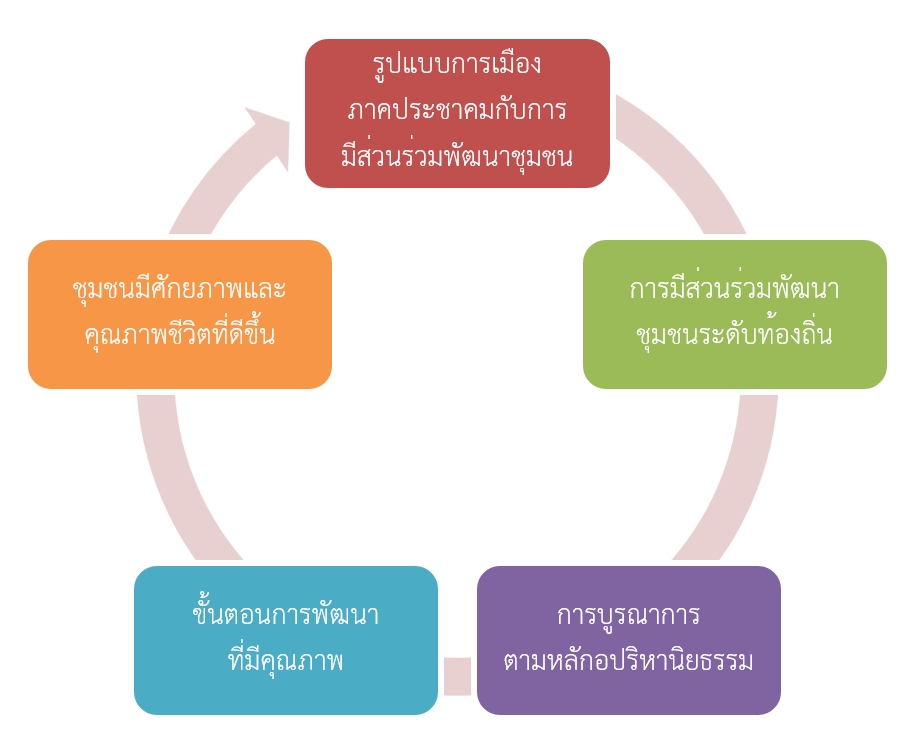
2. The developed civil society political model consists of three main components: 1) Input-participation in community development based on Aparihaniyadhamma,
emphasizing Dhamma as the principle of prosperity; 2) Process-steps for developing quality individuals and society; and 3) Output-improved quality of life, stability, and well-being of the people.
3. The proposed civil society political model leads to a systematic development process, including collaborative planning, knowledge sharing, participation from all
sectors, and the establishment of cooperative networks.
Article Details

This work is licensed under a Creative Commons Attribution-NonCommercial-NoDerivatives 4.0 International License.
เพื่อให้เป็นไปตามกฎหมายลิขสิทธิ์ ผู้นิพนธ์ทุกท่านต้องลงลายมือชื่อในแบบฟอร์มใบมอบลิขสิทธิ์บทความ ให้แก่วารสารฯ พร้อมกับบทความต้นฉบับที่ได้แก้ไขครั้งสุดท้าย นอกจากนี้ ผู้นิพนธ์ทุกท่านต้องยืนยันว่าบทความ ต้นฉบับที่ส่งมาตีพิมพ์นั้น ได้ส่งมาตีพิมพ์เฉพาะในวารสาร วิชาการธรรม ทรรศน์ เพียงแห่งเดียวเท่านั้น หากมีการใช้ ภาพหรือตารางของผู้นิพนธ์อื่นที่ปรากฏในสิ่งตีพิมพ์อื่นมาแล้ว ผู้นิพนธ์ต้องขออนุญาตเจ้าของลิขสิทธิ์ก่อน พร้อมทั้ง แสดงหนังสือที่ได้รับการยินยอมต่อบรรณาธิการ ก่อนที่บทความจะได้รับการตีพิมพ์References
กิติพัธ คำสุข, ธัชชนันท์ อิศรเดช และสุมาลี บุญเรือง. (2567). การประยุกต์หลักพุทธธรรมเพื่อส่งเสริมการมีส่วนร่วมทางการเมือง ของประชาชนในตำบลบุโพธิ์ อำเภอลำปลายมาศ จังหวัดบุรีรัมย์. วารสารพุทธนวัตกรรมและการจัดการ, 7(3), 14-28.
โกวิทย์ พวงงาม. (2553). การปกครองท้องถิ่นไทย: หลักการและมิติใหม่ในอนาคต. กรุงเทพฯ: วิญญูชน.
บุญชม ศรีสะอาด. (2554). การวิจัยเบื้องต้น. (พิมพ์ครังที่ 8). กรุงเทพฯ: สุวีริยาสาส์น.
ประเวศ วะสี. (2542). ประชาสังคมกับการพัฒนาประเทศ. กรุงเทพฯ: หมอชาวบ้าน.
พรชัย ตระกูลวรานนท์. (2552). ทุนทางสังคมและประชาสังคม: จากทฤษฎีสู่วิธีวิทยา. กรุงเทพฯ: สถาบันสัญญา ธรรมศักดิ์ เพื่อประชาธิปไตย.
พระมหาสุรสิทธิ์ ไชยสังกา, ธนกฤต โพธิ์เงิน และวิทยา สุจริตธนารักษ์. (2567). การประยุกต์ใช้หลักอปริหานิยธรรม 7 ที่ส่งผลต่อการมีส่วนร่วมทางการเมืองของประชาชนในจังหวัดมหาสารคาม. วารสารมณีเชษฐาราม วัดจอมมณี, 7(3), 53-82.
ลฏาภา นวลอินทร์ และวิจิตรา ศรีสอน. (2566). รูปแบบการเมืองภาคพลเมืองของประชาชนบนพื้นฐานประชาธิปไตย. วารสารการบริหารนิติบุคคลและนวัตกรรมท้องถิ่น, 9(8), 1676-1684.
สำนักงานประชาสัมพันธ์จังหวัดร้อยเอ็ด. (2565). ศูนย์รวมข่าวประชาสัมพันธ์. เข้าถึงได้จาก https://roiet.prd.go.th/th/page/item/index/id/12
สำนักงานเลขาธิการสภาผู้แทนราษฎร. (2560). รัฐธรรมนูญแห่งราชอาณาจักรไทย พุทธศักราช 2560. กรุงเทพฯ: สำนักการพิมพ์.
อุทิศ ทาหอม. (2564). การพัฒนาชุมชนท้องถิ่นบนฐานวัฒนธรรมเพื่อลดความเหลื่อมล้ำทางสังคม. วารสารวิจัยและพัฒนา มหาวิทยาลัยราชภัฏบุรีรัมย์, 16(2), 55-73.
