The Leader of Monks and Health Management of the Monk in Phichit Province
Article Sidebar
Published:
Sep 30, 2026
Keywords:
Buddhist clergy;, administration; , health and well-being of monks
Main Article Content
Abstract
This research aimed to 1) study the problems of health management for monks in Phichit Province, 2) study the factors affecting the effectiveness of health management for monks, and 3) study guidelines for developing health management according to the Monks' Health Charter by senior monks in Phichit Province. A mixed methods research approach was used. Quantitative research collected data from a sample of 252 monks using questionnaires. Data was analyzed using descriptive statistics, including frequency, percentage, mean, standard deviation, and stepwise multiple regression analysis. Qualitative research used in-depth interviews with 8 key informants and analyzed the data using content analysis.
The research findings revealed that:
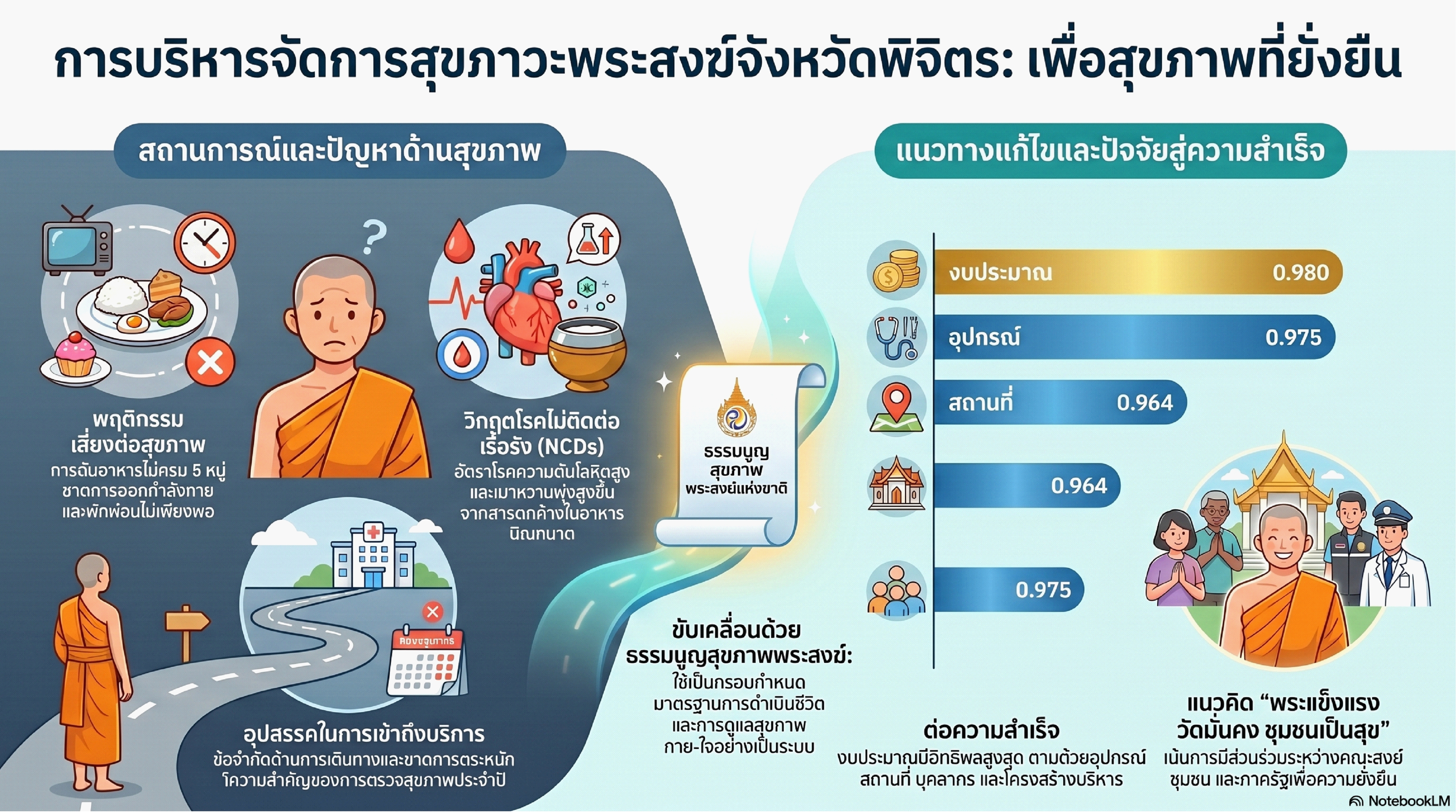
1. Problems in health management for monks in Phichit Province are evident in several areas, including physical health care, inadequate consumption of food (lacking the five food groups), irregular exercise, insufficient rest, stress management, risky behaviors, insufficient consumption of clean water, relationship building, allocation of rest time, and infrequent health check-ups and medical consultations.
2. Factors affecting the effectiveness of health management for monks were found to be related to four aspects of health management: physical exercise, nutrition, health responsibility, and hygiene. The factors can collectively explain the effectiveness at a very high level (Adjusted R² = 0.996) with statistical significance. Budgetary factors have the greatest influence, followed by equipment, facilities, personnel, and organizational structure.
3. Regarding development guidelines, the Health Charter for Monks was found to be an important framework for setting standards of living and caring for the physical and mental health of monks. It promotes the participation of the monastic community, the community, and the government in supporting health services, coupled with the development of the mind, the practice of Dharma, and the systematic prevention of health problems, in order to ensure the good and sustainable well-being of monks.
Article Details
How to Cite
Phrakhru Wibunsitthikan (Samrit Apaso), Taomitr , S. ., & Bodeerat, C. . (2026). The Leader of Monks and Health Management of the Monk in Phichit Province. Dhammathas Academic Journal, 26(3), 357–368. Retrieved from https://so06.tci-thaijo.org/index.php/dhammathas/article/view/290756
Section
บทความวิจัย (Research Article)

This work is licensed under a Creative Commons Attribution-NonCommercial-NoDerivatives 4.0 International License.
เพื่อให้เป็นไปตามกฎหมายลิขสิทธิ์ ผู้นิพนธ์ทุกท่านต้องลงลายมือชื่อในแบบฟอร์มใบมอบลิขสิทธิ์บทความ ให้แก่วารสารฯ พร้อมกับบทความต้นฉบับที่ได้แก้ไขครั้งสุดท้าย นอกจากนี้ ผู้นิพนธ์ทุกท่านต้องยืนยันว่าบทความ ต้นฉบับที่ส่งมาตีพิมพ์นั้น ได้ส่งมาตีพิมพ์เฉพาะในวารสาร วิชาการธรรม ทรรศน์ เพียงแห่งเดียวเท่านั้น หากมีการใช้ ภาพหรือตารางของผู้นิพนธ์อื่นที่ปรากฏในสิ่งตีพิมพ์อื่นมาแล้ว ผู้นิพนธ์ต้องขออนุญาตเจ้าของลิขสิทธิ์ก่อน พร้อมทั้ง แสดงหนังสือที่ได้รับการยินยอมต่อบรรณาธิการ ก่อนที่บทความจะได้รับการตีพิมพ์References
ชลธิชา จิรภัคพงค์ และคณะ. (2562). สุขภาวะพระสงฆ์: การพัฒนารูปแบบสุขภาวะตามแนววิถีพุทธโดยการบูรณาการสาธารณสุขเพื่อคุณภาพชีวิตที่ดีของจังหวัดลำปาง. วารสารมหาวิทยาลัยศิลปากร, 12(6), 1229.
พระครูสังฆรักษ์สมพงษ์ จตฺตมโล. (2567). รูปแบบการจัดการสุขภาวะของพระสงฆ์ตามธรรมนูญสุขภาพพระสงฆ์แห่งชาติในจังหวัดอ่างทอง. วารสารพุทธนวัตกรรมและการจัดการ. 7(6). 212-227.
พระธรรมปริยัติโสภณ (วรวิทย์ คงฺคปญฺโญ). (2548). การคณะสงฆ์และการพระศาสนา.
(พิมพ์ครั้งที่ 3). กรุงเทพฯ : โรงพิมพ์มหาจุฬาลงกรณ์ราชวิทยาลัย.
Yamane, T. (1973). Statistics : An Introductory Analysis (2nd ed.). Harper and Row.