A Development Model for Digital-Era School Administration of School Administrators under the Secondary Educational Service Area Office Roi Et A Development Model for Digital-Era School Administration of School Administrators under the Secondary Educational Service Area Office Roi Et
Article Sidebar
Main Article Content
Abstract
Abstract
This research aimed to: (1) investigate the components, indicators, and development guidelines for digital-era school administration of school administrators; (2) construct a development model for digital-era school administration; (3) examine the effects of implementing the model; and (4) evaluate and refine the model. The study was conducted in four phases. Phase 1 identified the components, indicators, and development guidelines through interviews and questionnaires administered to nine experts, 329 school administrators and teachers, and six additional experts. Phase 2 involved constructing and validating the development model with nine experts. Phase 3 examined the implementation results with 15 school administrators. Phase 4 focused on evaluating and refining the model with the same group of 15 participants.
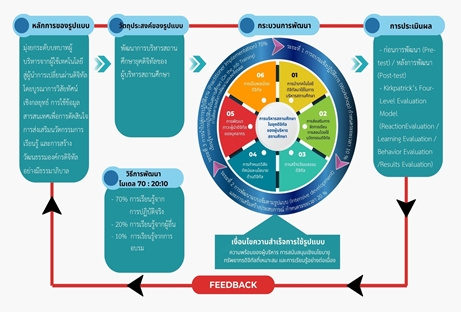
The findings revealed that: (1) digital-era school administration comprised six components, ranked by priority needs index from highest to lowest as follows: integration of digital technology in school administration; promotion of digital innovation in teaching and learning; development of digital culture; formulation of digital vision and policies; enhancement of personnel’s digital leadership; and digital citizenship. The development guidelines were based on the 70:20:10 learning model. (2) The proposed model consisted of six modules, including principles, objectives, content, development processes, measurement and evaluation, and conditions for success. The overall evaluation of the model was at the highest level. (3) Implementation results indicated that school administrators demonstrated increased knowledge and skills in digital-era school administration and exhibited more systematic, data-driven management practices, with schools progressing toward becoming digital organizations. (4) The model was appropriate, contextually relevant, and practical, with the highest level of satisfaction reported. Recommendations included clarifying operational practices within each module, developing a comprehensive implementation manual, and establishing measurable success indicators for continuous evaluation.
Article Details

This work is licensed under a Creative Commons Attribution-NonCommercial-NoDerivatives 4.0 International License.
เพื่อให้เป็นไปตามกฎหมายลิขสิทธิ์ ผู้นิพนธ์ทุกท่านต้องลงลายมือชื่อในแบบฟอร์มใบมอบลิขสิทธิ์บทความ ให้แก่วารสารฯ พร้อมกับบทความต้นฉบับที่ได้แก้ไขครั้งสุดท้าย นอกจากนี้ ผู้นิพนธ์ทุกท่านต้องยืนยันว่าบทความ ต้นฉบับที่ส่งมาตีพิมพ์นั้น ได้ส่งมาตีพิมพ์เฉพาะในวารสาร วิชาการธรรม ทรรศน์ เพียงแห่งเดียวเท่านั้น หากมีการใช้ ภาพหรือตารางของผู้นิพนธ์อื่นที่ปรากฏในสิ่งตีพิมพ์อื่นมาแล้ว ผู้นิพนธ์ต้องขออนุญาตเจ้าของลิขสิทธิ์ก่อน พร้อมทั้ง แสดงหนังสือที่ได้รับการยินยอมต่อบรรณาธิการ ก่อนที่บทความจะได้รับการตีพิมพ์References
กระทรวงศึกษาธิการ. (2564). แผนปฏิบัติการดิจิทัลเพื่อการศึกษา กระทรวงศึกษาธิการ
พ.ศ. 2563–2565. กรุงเทพฯ: ศูนย์เทคโนโลยีสารสนเทศและการสื่อสาร สำนักงาน
ปลัดกระทรวงศึกษาธิการ.
จิติมา วรรณศรี. (2564). การบริหารจัดการศึกษายุคดิจิทัล. พิษณุโลก: รัตนสุวรรณการพิมพ์
ฐานิตา ลิ่มวงศ์ และ ยุพาภรณ์ แสงฤทธิ์. (2562). ห้องเรียนกลับด้าน: การเรียนรู้แนวใหม่
สำหรับศตวรรษที่ 21 (21st Century Skills). วารสาร Mahidol R2R e-Journal,
(2), 9–17.
ธีระ รุญเจริญ. (2550). การบริหารโรงเรียนยุคปฏิรูปการศึกษา. กรุงเทพฯ: ธนาเพรส.
ปุณณิฐฐา มาเชค. (2565). การบริหารองค์กรทางการศึกษาในยุคดิจิทัล. ภาควิชาการบริหาร
การศึกษา คณะศึกษาศาสตร์ มหาวิทยาลัยบูรพา.
พระมหาพรประสงค์ ปริญฺญาวรเมธี. (2566). ภาวะผู้นำของผู้บริหารสถานศึกษาในยุคดิจิทัล
: Leadership of school administrators in the digital era. ASEAN Journal
of Religious and Cultural Research, 6(1), 19–25.
สงบ อินทรมณี. (2562). การบริหารสถานศึกษาในยุคดิจิทัล. วารสารวิชาการมหาวิทยาลัย
การจัดการและเทคโนโลยีอีสเทิร์น, 16(1), 353–360.
สมาน อัศวภูมิ. (2550). “การใช้วิจัยพัฒนารูปแบบในวิทยานิพนธ์ระดับปริญญาเอก”
ในเอกสารประกอบการสอนวิชาสัมมนาการศึกษาระดับปริญญาเอก. หน้า 50-53.
อุบลราชธานี: มหาวิทยาลัยราชภัฏอุบลราชธานี.
สุกัญญา แช่มช้อย. (2562). การบริหารสถานศึกษาในยุคดิจิทัล (พิมพ์ครั้งที่ 2). กรุงเทพฯ:
สำนักพิมพ์จุฬาลงกรณ์มหาวิทยาลัย.
สำนักงานเขตพื้นที่การศึกษามัธยมศึกษาร้อยเอ็ด. (2568). แผนปฏิบัติราชการ ประจำปี
งบประมาณ 2568. ร้อยเอ็ด; กลุ่มนโยบายและแผน สำนักงานเขตพื้นที่การศึกษา
มัธยมศึกษาร้อยเอ็ด.
สำนักงานคณะกรรมการการศึกษาขั้นพื้นฐาน. (2562). นโยบายของสำนักงานคณะกรรมการ
การศึกษาขั้นพื้นฐาน ปีงบประมาณ 2562. กรุงเทพฯ: สำนักงานคณะกรรมการ
การศึกษาขั้นพื้นฐาน.
เอกชัย กี่สุขพันธ์. (2562). การบริหารสถานศึกษายุคดิจิทัล. วารสารวิชาการมหาวิทยาลัย
การจัดการและเทคโนโลยีอีสเทิร์น, 16(1), 355-364.
Eisner, E. W. (1976). Connoisseurship and criticism: A new model for evaluating
the arts. Journal of Aesthetic Education, 10(3), 55-68.
Keeves, J. Peter. (1988). Model and Model Building, Educational Research
Methodology and Measurement: An International Handbook. Oxford:
Pergamon Press.
Steiner, E. (1988). Methodology of Theory Building. Sydney: Educology
Research Associates.
Kirkpatrick, D. L., & Kirkpatrick, J. D. (2006). Evaluating training programs:
The four levels (3rd ed.). Berrett-Koehler Publishers.
Krejcie, R. V., & Morgan, D. W. (1970). Determining sample size for research
activities. Educational and Psychological Measurement, 30(3), 607–
Lombardo, M. M., & Eichinger, R. W. (2010). The career architect development
planner (5th ed.). Minneapolis, MN: Lominger International.
