A Development Model for Participatory Academic Administration of the Phrapariyattidhamma Schools, General Education Division, Region 10, under the National Office of Buddhism
Article Sidebar
Main Article Content
Abstract
This research aimed to: (1) investigate the components, indicators, and development guidelines for participatory academic administration; (2) construct a development model for participatory academic administration; (3) examine the effects of implementing the model; and (4) evaluate and refine the development model for participatory academic administration of the Phrapariyattidhamma Schools, General Education Division, Region 10, under the National Office of Buddhism. The study was conducted in four phases. Phase 1 investigate the components, indicators, and development guidelines. Nine experts evaluated the components and indicators, six experts contributed to the development guidelines, and 186 participants served as the sample group. Research instruments included evaluation forms, interviews, and questionnaires. Phase 2 involved constructing and evaluating the development model with nine experts. Phase 3 examined the implementation of the model with 12 participants. Phase 4 focused on evaluating and refining the model based on reflections from the same 12 participants.
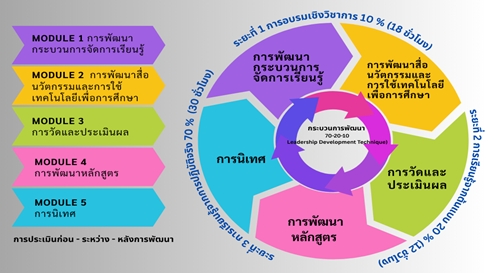
The findings revealed that: (1) the components and indicators comprised five dimensions, ranked by priority needs as follows: curriculum development, instructional process development, educational supervision, development of innovative media and educational technology, and measurement and evaluation; (2) the model consisted of principles, objectives, content, development processes, measurement and evaluation, and conditions for success. The development processes incorporated the PDCA cycle, professional learning communities (PLC), and the 70/20/10 development approach. The overall evaluation of appropriateness and feasibility was at the highest level; (3) after implementation, administrators and teachers demonstrated the highest level of knowledge and understanding of participatory academic administration; and (4) the model proved beneficial across all components and can serve as an effective framework for enhancing academic administration in Phrapariyattidhamma Schools.
Article Details

This work is licensed under a Creative Commons Attribution-NonCommercial-NoDerivatives 4.0 International License.
เพื่อให้เป็นไปตามกฎหมายลิขสิทธิ์ ผู้นิพนธ์ทุกท่านต้องลงลายมือชื่อในแบบฟอร์มใบมอบลิขสิทธิ์บทความ ให้แก่วารสารฯ พร้อมกับบทความต้นฉบับที่ได้แก้ไขครั้งสุดท้าย นอกจากนี้ ผู้นิพนธ์ทุกท่านต้องยืนยันว่าบทความ ต้นฉบับที่ส่งมาตีพิมพ์นั้น ได้ส่งมาตีพิมพ์เฉพาะในวารสาร วิชาการธรรม ทรรศน์ เพียงแห่งเดียวเท่านั้น หากมีการใช้ ภาพหรือตารางของผู้นิพนธ์อื่นที่ปรากฏในสิ่งตีพิมพ์อื่นมาแล้ว ผู้นิพนธ์ต้องขออนุญาตเจ้าของลิขสิทธิ์ก่อน พร้อมทั้ง แสดงหนังสือที่ได้รับการยินยอมต่อบรรณาธิการ ก่อนที่บทความจะได้รับการตีพิมพ์References
กระทรวงศึกษาธิการ. (2551). หลักสูตรแกนกลางการศึกษาขั้นพื้นฐาน พุทธศักราช 2551.
กรุงเทพฯ: ชุมนุมสหกรณ์การเกษตรแห่งประเทศไทย.
กมล ภู่ประเสริฐ. (2555). การบริหารงานวิชาการในสถานศึกษา. กรุงเทพฯ: เสริมสินพรีเพรส
ซิสเท็ม.
กองพุทธศาสนศึกษา. (2566). การศึกษาสงฆ์. สืบค้นเมื่อ 20 ธันวาคม 2567, จาก
https://deb.onab.go.th/th/page/item/index/id/13
ธร สุนทรายุทธ. (2561). การบริหารจัดการเชิงปฏิรูป: ทฤษฎี วิจัย และปฏิบัติทางการศึกษา.
กรุงเทพฯ: เนติกุล.
ปรียาพร วงศ์อนุตรโรจน์. (2555). การบริหารงานวิชาการ. กรุงเทพฯ: ศูนย์สื่อเสริมกรุงเทพ.
พระมหาบันทอน ทองสว่าง. (2564). รูปแบบการจัดการความรู้ของผู้บริหารโรงเรียนยุคใหม่
เพื่อพัฒนาคุณภาพการศึกษาในโรงเรียนพระปริยัติธรรมแผนกสามัญศึกษา. วารสาร
สันติศึกษาปริทรรศน์, 9(7), 3103–3116.
โรงเรียนปริยัติธรรม แผนกสามัญ ในจังหวัดกาฬสินธุ์. (2565). สารสนเทศ โรงเรียน
ปริยัติธรรมแผนกสามัญ ในจังหวัดกาฬสินธุ์ ปีการศึกษา 2565. กาฬสินธุ์ : โรงเรียน
ปริยัติธรรม แผนกสามัญ ในจังหวัดกาฬสินธุ์.
สมบัติ นามบุรี. (2562). ทฤษฎีการมีส่วนร่วมในงานรัฐประศาสนศาสตร์. วารสารวิจยวิชาการ,
(1), 183–197.
สันติ บุญภิรมย์. (2557). หลักการบริหารการศึกษา. กรุงเทพฯ: บุ๊คพอยท์.
สำนักงานพระพุทธศาสนาแห่งชาติ. (2557). คู่มือปฏิบัติงานเกี่ยวกับกฎหมาย กฎ ระเบียบ ประกาศ
และคำสั่งที่เกี่ยวกับพระปริยัติธรรม แผนกสามัญศึกษา. กรุงเทพฯ: คณะทำงานและ
คณะอนุกรรมการ.
สำนักวิชาการและมาตรฐานการศึกษา. (2553). แนวทางการจัดการเรียนรู้ตามหลักสูตรแกนกลาง
การศึกษาขั้นพื้นฐาน พุทธศักราช 2551 (พิมพ์ครั้งที่ 2). กรุงเทพฯ: โรงพิมพ์ชุมนุม
สหกรณ์การเกษตรแห่งประเทศไทย จำกัด.
Fullan, M. (2007). The new meaning of educational change (4th ed.). New York, NY:
Teachers College Press.
Hord, S. (1997). Professional learning communities: What are they and why are they
important? Issues About Change, 6(1), 23–45.
Krejcie, R. V., & Morgan, D. W. (1970). Determining sample size for research
activities. Educational and Psychological Measurement, 30(3), 607–
Lombardo, M. M., & Eichinger, R. W. (2010). The career architect development
planner (5th ed.). Minneapolis, MN: Lominger International.
