A Causal Relationship Model of Factors Affecting the Effectiveness of Academic Administration in Schools under the Primary Educational Service Area Offices in Roi Et Province
Article Sidebar
Main Article Content
Abstract
This research aimed to: 1) investigate the components of factors affecting the effectiveness of academic administration in schools; 2) examine the consistency of the causal relationship model with empirical data; and 3) evaluate the appropriateness of the causal relationship model of factors affecting the effectiveness of academic administration in schools under the Primary Educational Service Area Offices in Roi Et Province. A mixed-methods research design was employed. Qualitative data were obtained from relevant documents, research studies, and interviews with experts to identify the components and indicators of the model. Quantitative data were collected from a sample of 520 participants, consisting of 52 school administrators and 468 teachers. The sample was proportionally allocated across 20 districts and selected using simple random sampling. The research instruments included an interview form, a questionnaire, and a model evaluation form. The questionnaire had item-objective congruence indices ranging from 0.80 to 1.00, discrimination indices ranging from 0.35 to 0.88, and an overall reliability coefficient of 0.89. Data were analyzed using descriptive statistics, exploratory factor analysis, confirmatory factor analysis, and structural equation modeling.
The findings revealed that:
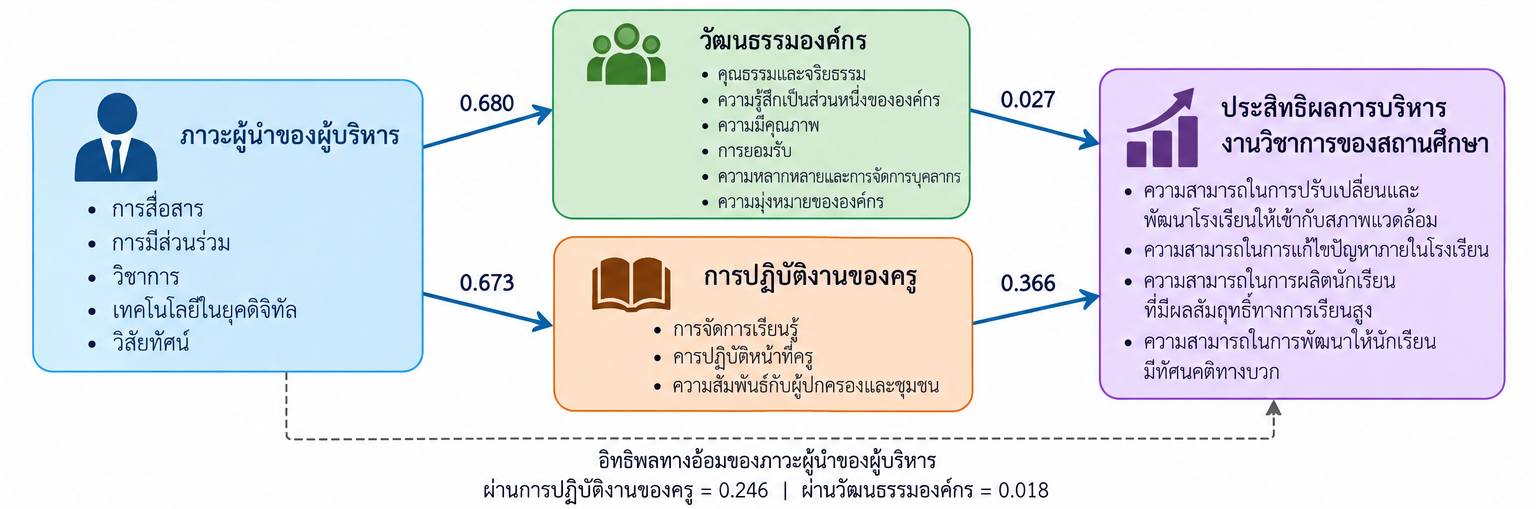
1. The factors related to the effectiveness of academic administration consisted of four main components, 18 subcomponents, and 95 indicators, namely administrators’ leadership, organizational culture, teachers’ performance, and the effectiveness of academic administration.
2. The causal relationship model demonstrated an acceptable fit with the empirical data (χ² = 33.071, df = 21, χ²/df = 1.575, p = .045, CFI = .971, TLI = .925, RMSEA = .033, and SRMR = .079). Administrators’ leadership had path coefficients of 0.680 and 0.673 on organizational culture and teachers’ performance, respectively. Teachers’ performance had a path coefficient of 0.366 on the effectiveness of academic administration, whereas organizational culture had a path coefficient of 0.027.
3. The overall evaluation of the model was at the highest level, indicating that the model was appropriate for use as a framework for enhancing academic administration in schools within the context of the study.
Article Details

This work is licensed under a Creative Commons Attribution-NonCommercial-NoDerivatives 4.0 International License.
เพื่อให้เป็นไปตามกฎหมายลิขสิทธิ์ ผู้นิพนธ์ทุกท่านต้องลงลายมือชื่อในแบบฟอร์มใบมอบลิขสิทธิ์บทความ ให้แก่วารสารฯ พร้อมกับบทความต้นฉบับที่ได้แก้ไขครั้งสุดท้าย นอกจากนี้ ผู้นิพนธ์ทุกท่านต้องยืนยันว่าบทความ ต้นฉบับที่ส่งมาตีพิมพ์นั้น ได้ส่งมาตีพิมพ์เฉพาะในวารสาร วิชาการธรรม ทรรศน์ เพียงแห่งเดียวเท่านั้น หากมีการใช้ ภาพหรือตารางของผู้นิพนธ์อื่นที่ปรากฏในสิ่งตีพิมพ์อื่นมาแล้ว ผู้นิพนธ์ต้องขออนุญาตเจ้าของลิขสิทธิ์ก่อน พร้อมทั้ง แสดงหนังสือที่ได้รับการยินยอมต่อบรรณาธิการ ก่อนที่บทความจะได้รับการตีพิมพ์References
ธีระ รุญเจริญ. (2553). ความเป็นมืออาชีพในการจัดและบริหารการศึกษายุคปฏิรูปการศึกษา. (พิมพ์ครั้งที่ 6). กรุงเทพฯ: ข้าวฟ่าง.
สำนักงานคณะกรรมการการศึกษาแห่งชาติ สำนักนายกรัฐมนตรี. (2562). พระราชบัญญัติการศึกษาแห่งชาติ พ.ศ. 2542 และที่แก้ไขเพิ่มเติม. กรุงเทพฯ: สำนักนายกรัฐมนตรี.
สำนักงานคณะกรรมการการศึกษาขั้นพื้นฐาน. (2556). การกระจายอำนาจในการบริหารจัดการไปให้สถานศึกษา. กรุงเทพฯ: ชุมนุมสหกรณ์การเกษตรแห่งประเทศไทย.
สำนักงานปลัดกระทรวงศึกษาธิการ. (2559). ค่านิยมและวัฒนธรรมของส่วนราชการของสำนักงานปลัดกระทรวงศึกษาธิการ. กรุงเทพฯ: กระทรวงศึกษาธิการ.
สำนักนายกรัฐมนตรี. (2566). แผนพัฒนาเศรษฐกิจและสังคมแห่งชาติ ฉบับที่ 13 พ.ศ. 2566-2570. กรุงเทพฯ: สำนักนายกรัฐมนตรี.
สุภาพร ศรีผดุง และนันทิยาน้อยจันทร์. (2564). ความสัมพันธ์ระหว่างบทบาทผู้บริหารสถานศึกษาด้านวิชาการกับประสิทธิผลของสถานศึกษา สังกัดสำนักงานเขตพื้นที่การศึกษาประถมศึกษานนทบุรี เขต 2. วารสารมนุษยศาสตร์และสังคมศาสตร์ มหาวิทยาลัยราชพฤกษ์, 7(3), 98-112. https://so03.tci-thaijo.org/index.php/rpu/article/view/257344/171536
Bellibaş, M. Ş., Gümüş, S., & Liu, Y. (2021). Does school leadership matter for teachers’ classroom practice? The influence of instructional leadership and distributed leadership on instructional quality. School Effectiveness and School Improvement, 32(3), 387-412.
Cheng, Y. C., & Tsui, K. T. (1999). Multimodels of teacher effectiveness: Implications for research. The Journal of Educational Research, 92(3), 141-150.
Hair, J. F., Black, W. C., Babin, B. J., & Anderson, R. E. (2010). Multivariate data analysis. (7th ed.). Upper Saddle River, NJ: Pearson Prentice Hall.
Hoy, W. K., & Miskel, C. G. (2005). Educational administration: Theory, research, and practice. (7th ed.). Boston, MA: McGraw-Hill.
Li, L., Zhu, H., & Li, H. (2022). School leadership enhances secondary students’ achievement in rural China through teacher commitment and collaborative culture. Frontiers in Psychology, 13, 894688.
Mattar, D. (2012). Instructional leadership in Lebanese public schools. Educational Management Administration & Leadership, 40(4), 509-531.
Mott, P. E. (1972). The characteristics of effective organizations. New York: Harper & Row.
Schein, E. H. (2010). Organizational culture and leadership. (4th ed.). San Francisco, CA: Jossey-Bass.
Schumacker, R. E., & Lomax, R. G. (2010). A beginner’s guide to structural equation modeling. (3rd ed.). New York: Routledge.
Shen, J., Wu, H., Reeves, P., Zheng, Y., Ryan, L., & Anderson, D. (2020). The association between teacher leadership and student achievement: A meta-analysis. Educational Research Review, 31, 100357.
Tan, C. Y., Gao, L., & Shi, M. (2022). Second-order meta-analysis synthesizing the evidence on associations between school leadership and different school outcomes. Educational Management Administration & Leadership, 50(3), 469-490.
Yukl, G. A. (2006). Leadership in organizations. (6th ed.). Upper Saddle River, NJ: Pearson/Prentice Hall.
