A A Model for Proactive Leadership Development of School Administrators in Small Schools under the Office of the Basic Education Commission
Article Sidebar
Main Article Content
Abstract
This research aimed to 1) study the components of proactive leadership among small school administrators under the Office of the Basic Education Commission. 2) develop a proactive leadership development model for small school administrators under the Office of the Basic Education Commission.and 3) evaluate the developed proactive leadership development model. This study employed a mixed-methods research design. The population consisted of 102,936 administrators and teachers in small schools under OBEC, with a sample group of 384 participants. The research instruments included a questionnaire, a semi-structured interview form, and an evaluation form assessing suitability, feasibility, and utility. The data were analyzed using percentage, mean, standard deviation, and descriptive analysis.
The research findings were as follows
- The components of proactive leadership among small school administrators under OBEC consisted of five main aspects: 1) creativity and initiative, 2) goal setting, 3) self-awareness, 4) independent determination, and 5) critical judgment. These behaviors are essential for challenging resource limitations and addressing the specific contexts of small schools.
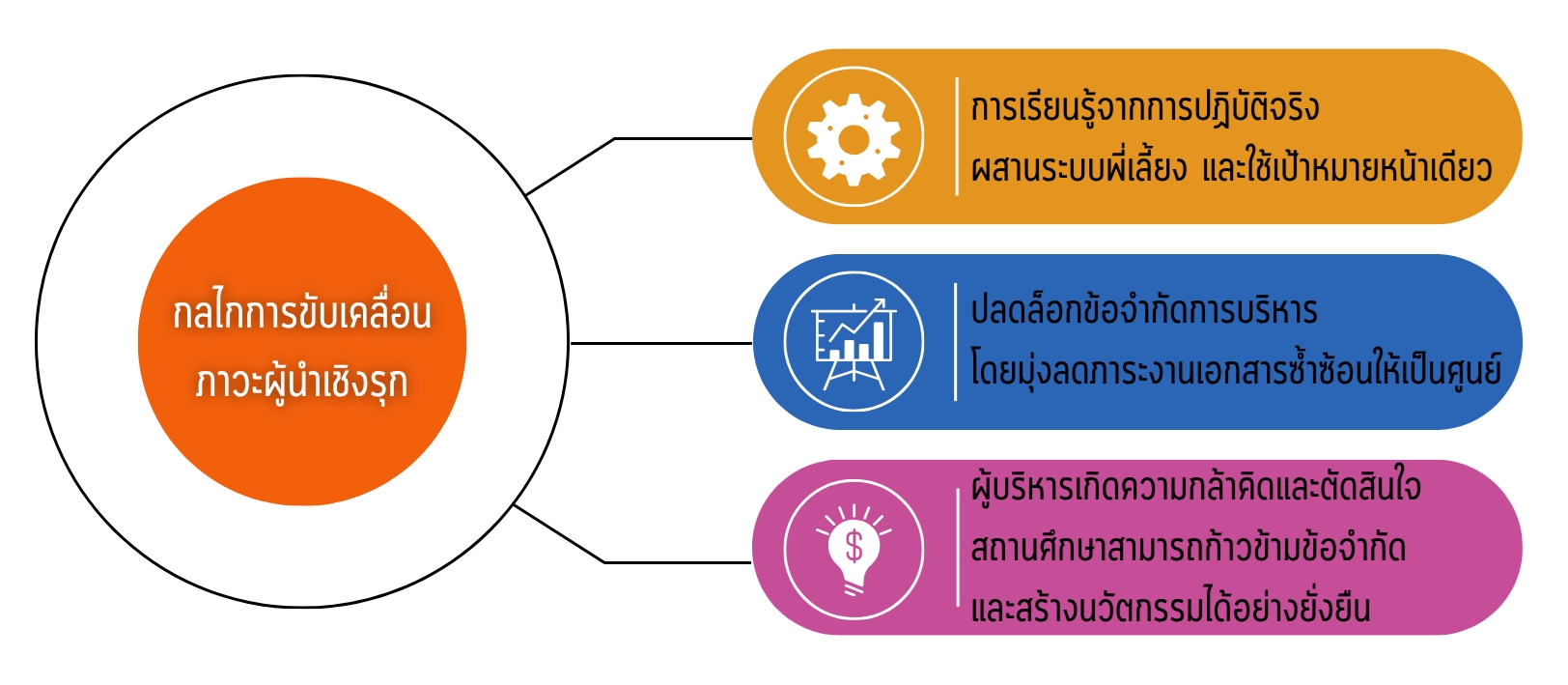
- The developed proactive leadership development model comprised seven crucial components: principles, objectives, content, development process, implementation guidelines, conditions for success, and measurement and evaluation. The development process emphasized experiential learning, with a proportion of 60% practical application and 40% theory, coupled with the use of a model manual designed to focus on practical implementation without creating redundant documentation burdens.
- The evaluation results of the model's quality by experts revealed that the overall suitability, feasibility, and utility were at the highest level (
= 4.66, S.D.= 0.47), with the utility aspect yielding the highest mean. Furthermore, the evaluation of the model manual indicated an overall quality at the highest level (
Article Details

This work is licensed under a Creative Commons Attribution-NonCommercial-NoDerivatives 4.0 International License.
เพื่อให้เป็นไปตามกฎหมายลิขสิทธิ์ ผู้นิพนธ์ทุกท่านต้องลงลายมือชื่อในแบบฟอร์มใบมอบลิขสิทธิ์บทความ ให้แก่วารสารฯ พร้อมกับบทความต้นฉบับที่ได้แก้ไขครั้งสุดท้าย นอกจากนี้ ผู้นิพนธ์ทุกท่านต้องยืนยันว่าบทความ ต้นฉบับที่ส่งมาตีพิมพ์นั้น ได้ส่งมาตีพิมพ์เฉพาะในวารสาร วิชาการธรรม ทรรศน์ เพียงแห่งเดียวเท่านั้น หากมีการใช้ ภาพหรือตารางของผู้นิพนธ์อื่นที่ปรากฏในสิ่งตีพิมพ์อื่นมาแล้ว ผู้นิพนธ์ต้องขออนุญาตเจ้าของลิขสิทธิ์ก่อน พร้อมทั้ง แสดงหนังสือที่ได้รับการยินยอมต่อบรรณาธิการ ก่อนที่บทความจะได้รับการตีพิมพ์References
บุญชม ศรีสะอาด. (2560). การวิจัยเบื้องต้น (พิมพ์ครั้งที่ 10). กรุงเทพฯ: สุวีริยาสาส์น.
พงศธร สมบูรณ์. (2564). การพัฒนาภาวะผู้นำสำหรับโรงเรียนขนาดเล็ก. กรุงเทพฯ: สำนักพิมพ์
การศึกษา.
สมเกียรติ เจริญสุข. (2562). ปัญหาและแนวทางการบริหารโรงเรียนขนาดเล็กในประเทศไทย.
นครปฐม: มหาวิทยาลัยศิลปากร.
สุนิสา แก้วประเสริฐ. (2563). ความเครียดในงานและแนวทางลดผลกระทบในโรงเรียนขนาดเล็ก.
เชียงใหม่: มหาวิทยาลัยเชียงใหม่.
Chen, H., Liang, Q., Feng, C., & Zhang, Y. (2021). Why and when do employees
become more proactive under humble leaders? The roles of psychological
need satisfaction and Chinese traditionality. Journal of Organizational
Change Management, 34(5), 1076-1095.
Covey, S. R. (2004). The 7 habits of highly effective people: Powerful lessons in
personal change. New York: Free Press.
Elsaied, M. M. (2019). Supportive leadership for innovative work behavior: The
mediating role of cognitive smartness. Journal of Management
Development, 38(6), 499-518.
Gil, A. J., Miranda, F. J., & Rodríguez, M. Á. (2023). The effect of servant leadership on
job satisfaction: The moderating role of proactive behaviour. International
Journal of Organizational Analysis.
Griffin, M. A., Neal, A., & Parker, S. K. (2007). A new model of work role performance:
Positive behavior in uncertain and interdependent contexts. Academy of
Management Journal, 50(2), 327–347.
Kilic, E., & Gök, M. S. (2022). Employee proactivity and proactive initiatives towards
creativity: Exploring the roles of job crafting and initiative climate.
International Journal of Organizational Analysis.
Kouzes, J. M., & Posner, B. Z. (2017). The leadership challenge: How to make
extraordinary things happen in organizations. San Francisco, CA: Jossey-Bass.
Krejcie, R. V., & Morgan, D. W. (1970). Determining sample size for research activities.
Educational and Psychological Measurement, 30(3), 607-610.
https://doi.org/10.1177/001316447003000308
Patcharaporn, S. (2015). Learning society and educational challenges in the 21st
century. Bangkok: Academic Publishing.
Singsorn, N. (2023). The integration of proactive leadership according to the principles
of the Sappurisa Dhamma VII for school administrators in the VUCA world
era. ASEAN Journal of Religious and Cultural Research, 6(1), 14-18.
