Administrators’ Academic Leadership Competencies, Teachers’ Instructional Leadership, and Learners’ Characteristics Influencing Academic Excellence in Primary Schools under Chonburi Primary Educational Service Area Office 2
Article Sidebar
Main Article Content
Abstract
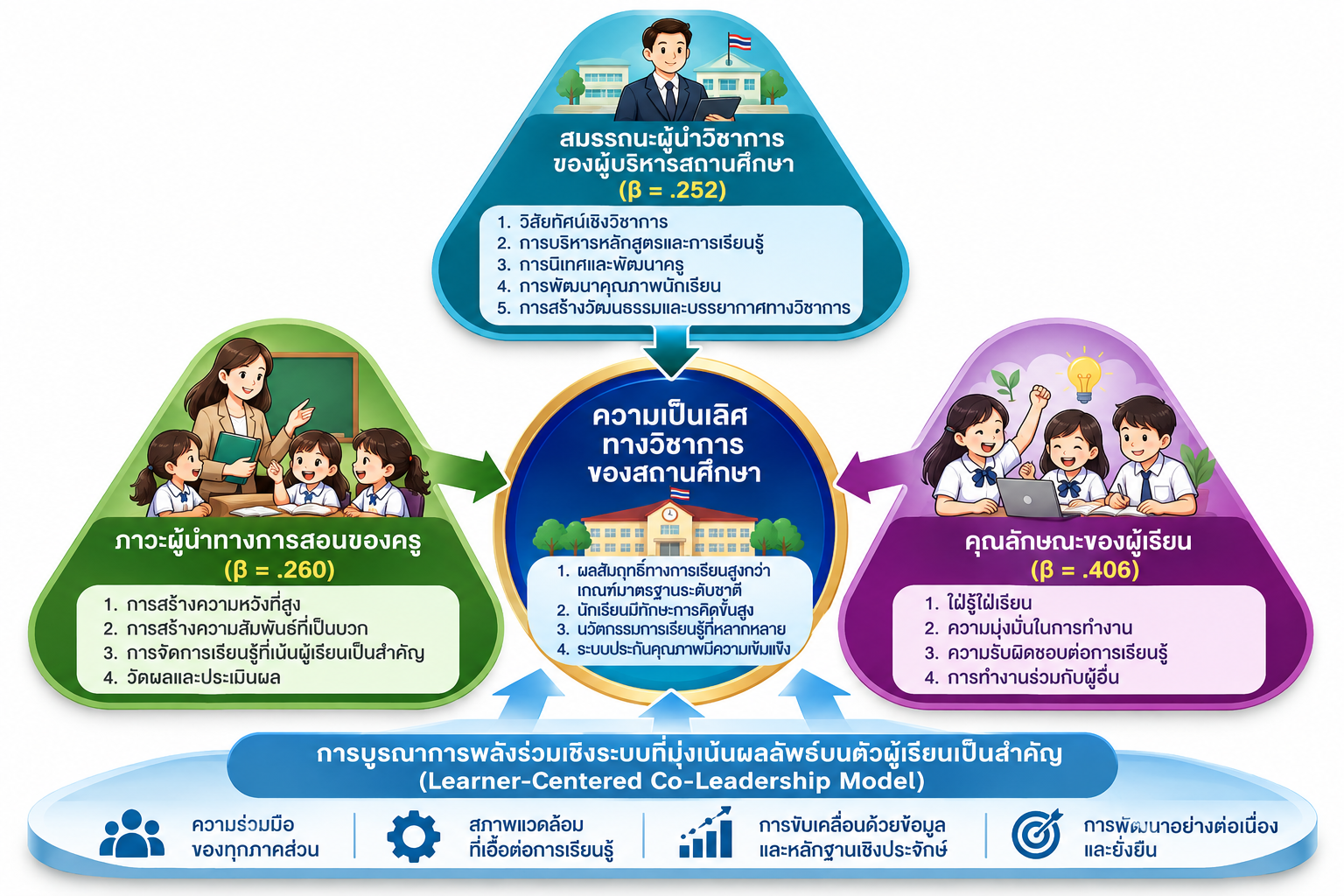
This research aimed to: (1) examine the levels of administrators’ academic leadership competencies, teachers’ instructional leadership, learners’ characteristics, and academic excellence in primary schools; (2) investigate the relationships between these variables and the academic excellence of primary schools; and (3) identify the predictor variables affecting academic excellence in primary schools under the Chonburi Primary Educational Service Area Office 2. This quantitative research involved a sample of 306 teachers in the 2025 academic year. The sample size was determined using the Krejcie and Morgan table, and the participants were selected through stratified random sampling combined with multistage sampling. The research instrument was a five-point rating-scale questionnaire. Its Item–Objective Congruence indices ranged from 0.60 to 1.00. The Cronbach’s alpha reliability coefficients for administrators’ academic leadership competencies, teachers’ instructional leadership, learners’ characteristics, and school academic excellence were 0.820, 0.760, 0.890, and 0.857, respectively, while the reliability coefficient for the entire questionnaire was 0.878. The data were analyzed using frequency, percentage, mean, standard deviation, Pearson’s correlation coefficient, and stepwise multiple regression analysis.
The findings revealed that:
1. The overall levels of administrators’ academic leadership competencies, teachers’ instructional leadership, learners’ characteristics, and school academic excellence were high.
2. All pairs of variables were significantly correlated at the .001 level.
3. Administrators’ academic leadership competencies, teachers’ instructional leadership, and learners’ characteristics jointly predicted 71.50% of the variance in school academic excellence, with statistical significance at the .001 level. Learners’ characteristics were the strongest predictor, followed by teachers’ instructional leadership and administrators’ academic leadership competencies, respectively.
Article Details

This work is licensed under a Creative Commons Attribution-NonCommercial-NoDerivatives 4.0 International License.
เพื่อให้เป็นไปตามกฎหมายลิขสิทธิ์ ผู้นิพนธ์ทุกท่านต้องลงลายมือชื่อในแบบฟอร์มใบมอบลิขสิทธิ์บทความ ให้แก่วารสารฯ พร้อมกับบทความต้นฉบับที่ได้แก้ไขครั้งสุดท้าย นอกจากนี้ ผู้นิพนธ์ทุกท่านต้องยืนยันว่าบทความ ต้นฉบับที่ส่งมาตีพิมพ์นั้น ได้ส่งมาตีพิมพ์เฉพาะในวารสาร วิชาการธรรม ทรรศน์ เพียงแห่งเดียวเท่านั้น หากมีการใช้ ภาพหรือตารางของผู้นิพนธ์อื่นที่ปรากฏในสิ่งตีพิมพ์อื่นมาแล้ว ผู้นิพนธ์ต้องขออนุญาตเจ้าของลิขสิทธิ์ก่อน พร้อมทั้ง แสดงหนังสือที่ได้รับการยินยอมต่อบรรณาธิการ ก่อนที่บทความจะได้รับการตีพิมพ์References
กาญจนา แสงสารพันธ์. (2562). แนวทางการพัฒนาสมรรถนะผู้นำวิชาการของผู้บริหารสถานศึกษายุคดิจิทัล สังกัดสำนักงานเขตพื้นที่การศึกษามัธยมศึกษา เขต 1. (สารนิพนธ์การศึกษามหาบัณฑิต). กรุงเทพฯ: มหาวิทยาลัยศรีนครินทรวิโรฒ.
พิมพ์พันธ์ เดชะคุปต์. (2564). การเรียนรู้เชิงรุกเชิงระบบด้วย Co-5STEPs: พลิกโฉมห้องเรียนและยกระดับคุณภาพผู้เรียนสู่สมรรถนะในศตวรรษที่ 21. กรุงเทพฯ: จุฬาลงกรณ์มหาวิทยาลัย.
วิจารณ์ พานิช. (2565). วิถีสร้างการเรียนรู้เพื่อศตวรรษที่ 21 สู่การพัฒนาที่ยั่งยืน. กรุงเทพฯ: มูลนิธิสดศรี-สฤษดิ์วงศ์.
สำนักงานเขตพื้นที่การศึกษาประถมศึกษาชลบุรี เขต 2. (2567). แผนพัฒนาการศึกษา พ.ศ. 2566-2570 (ฉบับปรับปรุง ปีงบประมาณ พ.ศ. 2567). ชลบุรี: สำนักงานเขตพื้นที่การศึกษาประถมศึกษาชลบุรี เขต 2.
สำนักงานคณะกรรมการการศึกษาขั้นพื้นฐาน. (2567). นโยบายและจุดเน้นของสำนักงานคณะกรรมการการศึกษาขั้นพื้นฐาน ประจำปีงบประมาณ พ.ศ. 2568-2569. กรุงเทพฯ: สำนักงานคณะกรรมการการศึกษาขั้นพื้นฐาน.
สำนักงานเลขาธิการสภาการศึกษา. (2560). แผนการศึกษาแห่งชาติ พ.ศ. 2560-2579. กรุงเทพฯ: พริกหวานกราฟฟิค.
สำนักทดสอบทางการศึกษา สำนักงานคณะกรรมการการศึกษาขั้นพื้นฐาน กระทรวงศึกษาธิการ. (2563). แนวทางการพัฒนาระบบการประกันคุณภาพการศึกษาตามกฎกระทรวงการประกันคุณภาพการศึกษา พ.ศ. 2561. กรุงเทพฯ: เอ็น.เอ. รัตนะเทรดดิ้ง.
สุเทพ พงศ์ศรีวัฒน์. (2563). ความเป็นผู้นำ: ทฤษฎีและปฏิบัติการ. (พิมพ์ครั้งที่ 4). กรุงเทพฯ: บุ๊คส์เน็ท.
อนุชา จันทรวงศ์. (2563). สมรรถนะการบริหารงานวิชาการที่ส่งผลต่อความเป็นเลิศของสถานศึกษาขั้นพื้นฐาน. วารสารการบริหารและนวัตกรรมการศึกษา, 3(3), 12-25.
Ahmadi, S. (2020). Instructional leadership practices and their teacher outcomes in primary education. Journal of Educational Studies, 18(2), 45-62.
Black, P., & Wiliam, D. (1998). Inside the black box: Raising standards through classroom assessment. Phi Delta Kappan, 80(2), 139-148.
Cronbach, L. J. (1951). Coefficient alpha and the internal structure of tests. Psychometrika, 16(3), 297-334.
Duckworth, A. L., & Seligman, M. E. P. (2005). Self-discipline outdoes IQ in predicting academic performance of adolescents. Psychological Science, 16(12), 939-944.
Hallinger, P. (2011). Leadership for learning: Lessons from 40 years of empirical research. Journal of Educational Administration, 49(2), 125-142.
Hallinger, P. (2018). Surfacing a hidden literature: A systematic review of research on educational leadership and management in Thailand. Journal of Educational Administration, 56(1), 26-41.
Hallinger, P. (2020). Science mapping the knowledge base on educational leadership and management from 1960 to 2018. Educational Management Administration & Leadership, 48(2), 209-230.
Hallinger, P., & Heck, R. H. (1996). Reassessing the principal's role in school effectiveness: A review of empirical research, 1980-1995. Educational Administration Quarterly, 32(1), 5-44.
Hallinger, P., & Heck, R. H. (1998). Exploring the principal’s contribution to school effectiveness: 1980-1995. School Effectiveness and School Improvement, 9(2), 157-191.
Hattie, J. (2012). Visible learning for teachers: Maximizing impact on learning. London: Routledge.
Krejcie, R. V., & Morgan, D. W. (1970). Determining sample size for research activities. Educational and Psychological Measurement, 30(3), 607-610. https://doi.org/10.1177/00131644700300030
Leithwood, K., Harris, A., & Hopkins, D. (2020). Seven strong claims about successful school leadership revisited. School Leadership & Management, 40(1), 5-22.
Mehnaz, S., Iqbal, M., & John, S. (2022). The mediating role of teachers' instructional leadership between school climate and academic excellence. International Journal of Educational Management, 36(3), 312-328.
Poropat, A. E. (2009). A meta-analysis of the five-factor model of personality and academic performance. Psychological Bulletin, 135(2), 322-338.
Robinson, V. M. J. (2011). Student-centered leadership. San Francisco, CA: Jossey-Bass.
Robinson, V. M. J. (2014). Reduce change fatigue by focusing on instruction. Educational Leadership, 71(8), 50-54.
Robinson, V. M. J., Lloyd, C. A., & Rowe, K. J. (2008). The impact of leadership on student outcomes: An analysis of the differential effects of leadership types. Educational Administration Quarterly, 44(5), 635-674.
Roorda, D. L., Koomen, H. M. Y., Spilt, J. L., & Oort, F. J. (2011). The influence of affective teacher–student relationships on students’ school engagement and achievement: A meta-analytic approach. Review of Educational Research, 81(4), 493-529.
Roseth, C. J., Johnson, D. W., & Johnson, R. T. (2008). Promoting early adolescents’ achievement and peer relationships: The effects of cooperative, competitive, and individualistic goal structures. Psychological Bulletin, 134(2), 223-246.
Spillane, J. P. (2015). Leadership and management: From a distributed perspective. In International Encyclopedia of the Social & Behavioral Sciences (pp. 637-641). Amsterdam, Netherlands: Elsevier.
Spillane, J. P., Halverson, R., & Diamond, J. B. (2004). Towards a theory of leadership practice: A distributed perspective. Journal of Curriculum Studies, 36(1), 3-34.
Supovitz, J. A., Sirinides, P., & May, H. (2010). How principals and peers influence teaching and learning. Educational Administration Quarterly, 46(1), 31-56.
Wenner, J. A., & Campbell, T. (2017). The theoretical and empirical basis of teacher leadership: A review of the literature. Review of Educational Research, 87(1), 134-171.
York-Barr, J., & Duke, K. (2004). What do we know about teacher leadership? Findings from two decades of scholarship. Review of Educational Research, 74(3), 255-316.
Zimmerman, B. J. (2002). Becoming a self-regulated learner: An overview. Theory Into Practice, 41(2), 64-70.
