Development of a Teacher Psychological Well-Being Assessment Tool: A Psychometric Analysis
Article Sidebar
Main Article Content
Abstract
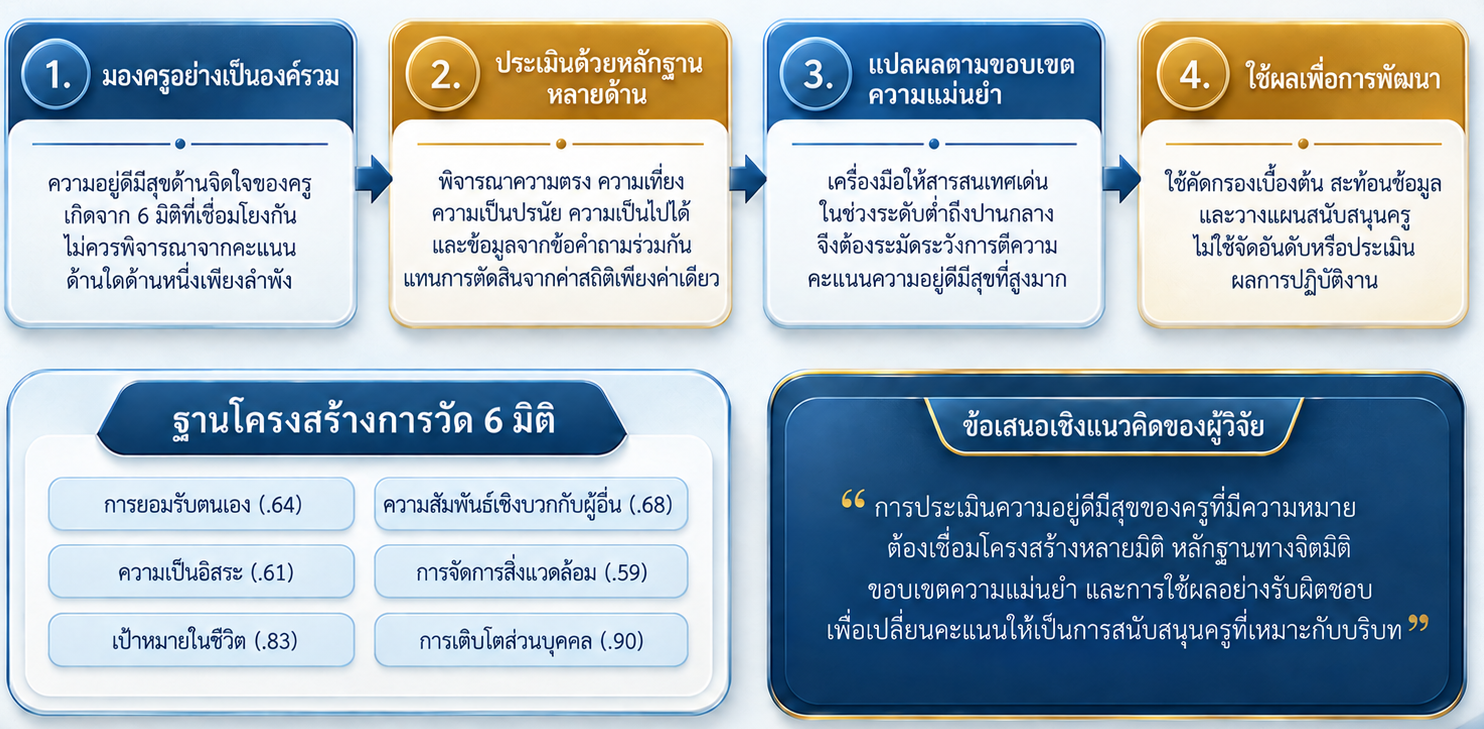
This study aimed to develop and examine the psychometric properties of an instrument for assessing teachers’ psychological well-being. The population comprised 2,002 secondary school teachers from 34 schools under the Chiang Mai Secondary Educational Service Area Office. A sample of 277 teachers was selected through multistage random sampling. The instrument consisted of 56 items covering six dimensions: self-acceptance, positive relations with others, autonomy, environmental mastery, purpose in life, and personal growth. Its quality was examined in terms of content validity, construct validity, objectivity, indicator feasibility, reliability, discrimination, and difficulty.
The findings showed that: the Item-Objective Congruence indices ranged from .50 to 1.00. Confirmatory factor analysis supported the six-factor structure, with the measurement model demonstrating a good fit to the empirical data: χ²(5) = 5.96, p = .31, CFI = 1.00, TLI = 1.00, SRMR = .02, and RMSEA = .03. The standardized factor loadings ranged from .59 to .90. The items were accompanied by clearly defined scoring and interpretation criteria, and no missing data were observed in the sample. Cronbach’s alpha was .929 for the total scale and ranged from .660 to .842 across the six dimensions. Analysis using the graded response model yielded slope parameters ranging from .64 to 2.45, while the threshold parameters were ordered consistently across the response categories. The information function reached its highest level when the latent trait ranged from -4 to 1. These findings support the use of the instrument for preliminary assessment and planning support for teachers in the study population. However, scores for teachers with very high levels of psychological well-being should be interpreted with caution.
Article Details

This work is licensed under a Creative Commons Attribution-NonCommercial-NoDerivatives 4.0 International License.
เพื่อให้เป็นไปตามกฎหมายลิขสิทธิ์ ผู้นิพนธ์ทุกท่านต้องลงลายมือชื่อในแบบฟอร์มใบมอบลิขสิทธิ์บทความ ให้แก่วารสารฯ พร้อมกับบทความต้นฉบับที่ได้แก้ไขครั้งสุดท้าย นอกจากนี้ ผู้นิพนธ์ทุกท่านต้องยืนยันว่าบทความ ต้นฉบับที่ส่งมาตีพิมพ์นั้น ได้ส่งมาตีพิมพ์เฉพาะในวารสาร วิชาการธรรม ทรรศน์ เพียงแห่งเดียวเท่านั้น หากมีการใช้ ภาพหรือตารางของผู้นิพนธ์อื่นที่ปรากฏในสิ่งตีพิมพ์อื่นมาแล้ว ผู้นิพนธ์ต้องขออนุญาตเจ้าของลิขสิทธิ์ก่อน พร้อมทั้ง แสดงหนังสือที่ได้รับการยินยอมต่อบรรณาธิการ ก่อนที่บทความจะได้รับการตีพิมพ์References
Abbott, R. A., Ploubidis, G. B., Huppert, F. A., Kuh, D., & Croudace, T. J. (2010). An evaluation of the precision of measurement of Ryff's Psychological Well-Being Scales in a population sample. Social Indicators Research, 97(3), 357-373. https://doi.org/10.1007/s11205-009-9506-x
Boateng, G. O., Neilands, T. B., Frongillo, E. A., Melgar-Quiñonez, H. R., & Young, S. L. (2018). Best practices for developing and validating scales for health, social, and behavioral research: A primer. Frontiers in Public Health, 6, 149. https://doi.org/10.3389/fpubh.2018.00149
Carroll, A., York, A., Fynes-Clinton, S., Sanders-O'Connor, E., Flynn, L., Bower, J. M., Forrest, K., & Ziaei, M. (2021). The downstream effects of teacher well-being programs: Improvements in teachers' stress, cognition and well-being benefit their students. Frontiers in Psychology, 12, 689628. https://doi.org/10.3389/fpsyg.2021.689628
DeVellis, R. F. (2017). Scale development: Theory and applications. (4th ed.). Thousand Oaks, CA: SAGE.
Dreer, B. (2023). Witnessing well-being in action: Observing teacher well-being during field experiences predicts student teacher well-being. Frontiers in Education, 8, 967905. https://doi.org/10.3389/feduc.2023.967905
Fu, Q., & Zhang, X. (2024). Promoting community resilience through disaster education: Review of community-based interventions with a focus on teacher resilience and well-being. PLOS ONE, 19(1), e0296393. https://doi.org/10.1371/journal.pone.0296393
Harding, T., Lopez, V., & Klainin-Yobas, P. (2019). Predictors of psychological well-being among higher education students. Psychology, 10(4), 578-594. https://doi.org/10.4236/psych.2019.104037
Keyes, C. L. M., Wissing, M., Potgieter, J. P., Temane, M., Kruger, A., & van Rooy, S. (2008). Evaluation of the Mental Health Continuum-Short Form (MHC–SF) in Setswana-speaking South Africans. Clinical Psychology & Psychotherapy, 15(3), 181-192. https://doi.org/10.1002/cpp.572
Rovinelli, R. J., & Hambleton, R. K. (1977). On the use of content specialists in the assessment of criterion-referenced test item validity. Dutch Journal of Educational Research, 2, 49-60.
Ryff, C. D. (1989). Happiness is everything, or is it? Explorations on the meaning of psychological well-being. Journal of Personality and Social Psychology, 57(6), 1069-1081. https://doi.org/10.1037/0022-3514.57.6.1069
Ryff, C. D., & Keyes, C. L. M. (1995). The structure of psychological well-being revisited. Journal of Personality and Social Psychology, 69(4), 719-727. https://doi.org/10.1037/0022-3514.69.4.719
Schwarzer, N.-H., Nolte, T., Fonagy, P., Griem, J., Kieschke, U., & Gingelmaier, S. (2023). The relationship between global distress, mentalizing and well-being in a German teacher sample. Current Psychology, 42(2), 1239-1248. https://doi.org/10.1007/s12144-021-01467-3
Tabachnick, B. G., & Fidell, L. S. (2013). Using multivariate statistics. (6th ed.). Boston, MA: Pearson.
Waterman, L. (2018). The impact of the technical revolution on our well-being. LSE Business Review. Retrieved from http://blogs.lse.ac.uk/businessreview/2018/03/23/the-impact-of-the-technical-revolution-on-our-well-being/
Yu, X., & Ying, T. (2024). Under the surface of teacher occupational wellness and effectiveness in higher education: A look into the mediator roles of work passion and emotion regulation via SEM analysis. BMC Psychology, 12, 166. https://doi.org/10.1186/s40359-024-01656-2
