การพัฒนาเครื่องมือประเมินความอยู่ดีมีสุขด้านจิตใจของครู: การวิเคราะห์คุณสมบัติทางจิตมิติ
Article Sidebar
Main Article Content
บทคัดย่อ
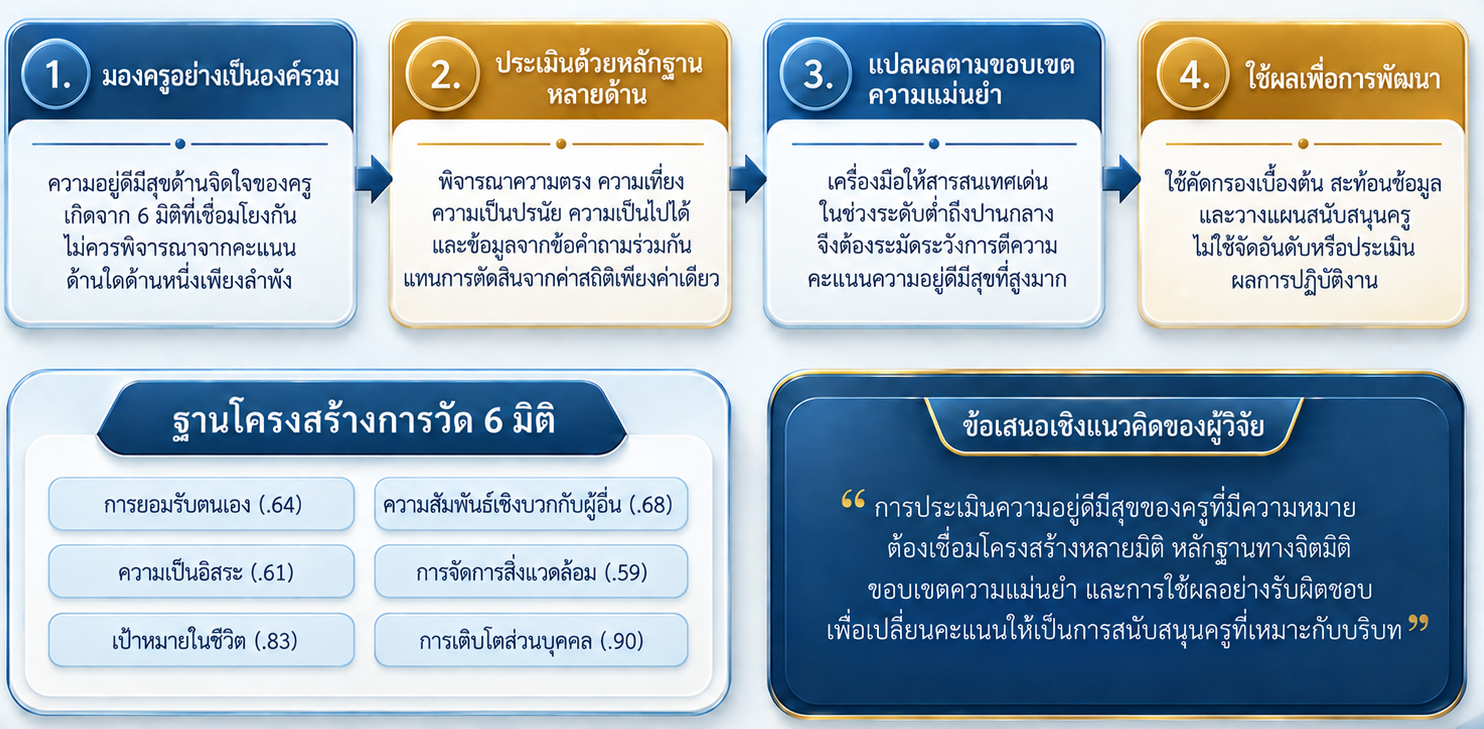
การวิจัยครั้งนี้ มีวัตถุประสงค์เพื่อพัฒนาและตรวจสอบคุณสมบัติทางจิตมิติของเครื่องมือประเมินความอยู่ดีมีสุขด้านจิตใจของครู ประชากรเป็นครูระดับมัธยมศึกษาสังกัดสำนักงานเขตพื้นที่การศึกษามัธยมศึกษาเชียงใหม่ จำนวน 2,002 คน จาก 34 โรงเรียน ตัวอย่างจำนวน 277 คน ได้มาจากการสุ่มแบบหลายขั้นตอน เครื่องมือประกอบด้วยข้อคำถาม 56 ข้อ ครอบคลุม 6 องค์ประกอบ ได้แก่ การยอมรับตนเอง ความสัมพันธ์เชิงบวกกับผู้อื่น ความเป็นอิสระ การจัดการสิ่งแวดล้อม เป้าหมายในชีวิต และการเติบโตส่วนบุคคล การตรวจสอบคุณภาพครอบคลุมความตรงเชิงเนื้อหา ความตรงเชิงโครงสร้าง ความเป็นปรนัย ความเป็นไปได้ของตัวบ่งชี้ ความเที่ยง อำนาจจำแนก และความยาก
ผลการวิจัยพบว่า ค่าดัชนีความสอดคล้องระหว่างข้อคำถามกับวัตถุประสงค์อยู่ระหว่าง .50-1.00 ผลการวิเคราะห์องค์ประกอบเชิงยืนยันสนับสนุนโครงสร้าง 6 องค์ประกอบ โดยโมเดลสอดคล้องกับข้อมูลเชิงประจักษ์ χ²(5) = 5.96, p = .31, CFI = 1.00, TLI = 1.00, SRMR = .02 และ RMSEA = .03 ค่าน้ำหนักองค์ประกอบมาตรฐานอยู่ระหว่าง .59-.90 ข้อคำถามมีเกณฑ์ให้คะแนนและแปลความหมายที่ชัดเจน และไม่พบข้อมูลสูญหายในตัวอย่าง ค่าสัมประสิทธิ์แอลฟาของครอนบาคทั้งฉบับเท่ากับ .929 ส่วนรายองค์ประกอบอยู่ระหว่าง .660-.842 การวิเคราะห์ด้วยโมเดลการตอบสนองข้อสอบแบบเกรดให้ค่าพารามิเตอร์ความชันระหว่าง .64-2.45 และค่าพารามิเตอร์เกณฑ์เรียงลำดับตามระดับการตอบ ฟังก์ชันสารสนเทศให้ข้อมูลสูงสุดเมื่อระดับคุณลักษณะแฝงอยู่ระหว่าง -4 ถึง 1 ผลดังกล่าวสนับสนุนการใช้เครื่องมือเพื่อประเมินเบื้องต้นและวางแผนสนับสนุนครูในกลุ่มประชากรที่ศึกษา โดยควรระมัดระวังการแปลผลในกลุ่มที่มีความอยู่ดีมีสุขสูงมาก
Article Details

อนุญาตภายใต้เงื่อนไข Creative Commons Attribution-NonCommercial-NoDerivatives 4.0 International License.
เพื่อให้เป็นไปตามกฎหมายลิขสิทธิ์ ผู้นิพนธ์ทุกท่านต้องลงลายมือชื่อในแบบฟอร์มใบมอบลิขสิทธิ์บทความ ให้แก่วารสารฯ พร้อมกับบทความต้นฉบับที่ได้แก้ไขครั้งสุดท้าย นอกจากนี้ ผู้นิพนธ์ทุกท่านต้องยืนยันว่าบทความ ต้นฉบับที่ส่งมาตีพิมพ์นั้น ได้ส่งมาตีพิมพ์เฉพาะในวารสาร วิชาการธรรม ทรรศน์ เพียงแห่งเดียวเท่านั้น หากมีการใช้ ภาพหรือตารางของผู้นิพนธ์อื่นที่ปรากฏในสิ่งตีพิมพ์อื่นมาแล้ว ผู้นิพนธ์ต้องขออนุญาตเจ้าของลิขสิทธิ์ก่อน พร้อมทั้ง แสดงหนังสือที่ได้รับการยินยอมต่อบรรณาธิการ ก่อนที่บทความจะได้รับการตีพิมพ์เอกสารอ้างอิง
Abbott, R. A., Ploubidis, G. B., Huppert, F. A., Kuh, D., & Croudace, T. J. (2010). An evaluation of the precision of measurement of Ryff's Psychological Well-Being Scales in a population sample. Social Indicators Research, 97(3), 357-373. https://doi.org/10.1007/s11205-009-9506-x
Boateng, G. O., Neilands, T. B., Frongillo, E. A., Melgar-Quiñonez, H. R., & Young, S. L. (2018). Best practices for developing and validating scales for health, social, and behavioral research: A primer. Frontiers in Public Health, 6, 149. https://doi.org/10.3389/fpubh.2018.00149
Carroll, A., York, A., Fynes-Clinton, S., Sanders-O'Connor, E., Flynn, L., Bower, J. M., Forrest, K., & Ziaei, M. (2021). The downstream effects of teacher well-being programs: Improvements in teachers' stress, cognition and well-being benefit their students. Frontiers in Psychology, 12, 689628. https://doi.org/10.3389/fpsyg.2021.689628
DeVellis, R. F. (2017). Scale development: Theory and applications. (4th ed.). Thousand Oaks, CA: SAGE.
Dreer, B. (2023). Witnessing well-being in action: Observing teacher well-being during field experiences predicts student teacher well-being. Frontiers in Education, 8, 967905. https://doi.org/10.3389/feduc.2023.967905
Fu, Q., & Zhang, X. (2024). Promoting community resilience through disaster education: Review of community-based interventions with a focus on teacher resilience and well-being. PLOS ONE, 19(1), e0296393. https://doi.org/10.1371/journal.pone.0296393
Harding, T., Lopez, V., & Klainin-Yobas, P. (2019). Predictors of psychological well-being among higher education students. Psychology, 10(4), 578-594. https://doi.org/10.4236/psych.2019.104037
Keyes, C. L. M., Wissing, M., Potgieter, J. P., Temane, M., Kruger, A., & van Rooy, S. (2008). Evaluation of the Mental Health Continuum-Short Form (MHC–SF) in Setswana-speaking South Africans. Clinical Psychology & Psychotherapy, 15(3), 181-192. https://doi.org/10.1002/cpp.572
Rovinelli, R. J., & Hambleton, R. K. (1977). On the use of content specialists in the assessment of criterion-referenced test item validity. Dutch Journal of Educational Research, 2, 49-60.
Ryff, C. D. (1989). Happiness is everything, or is it? Explorations on the meaning of psychological well-being. Journal of Personality and Social Psychology, 57(6), 1069-1081. https://doi.org/10.1037/0022-3514.57.6.1069
Ryff, C. D., & Keyes, C. L. M. (1995). The structure of psychological well-being revisited. Journal of Personality and Social Psychology, 69(4), 719-727. https://doi.org/10.1037/0022-3514.69.4.719
Schwarzer, N.-H., Nolte, T., Fonagy, P., Griem, J., Kieschke, U., & Gingelmaier, S. (2023). The relationship between global distress, mentalizing and well-being in a German teacher sample. Current Psychology, 42(2), 1239-1248. https://doi.org/10.1007/s12144-021-01467-3
Tabachnick, B. G., & Fidell, L. S. (2013). Using multivariate statistics. (6th ed.). Boston, MA: Pearson.
Waterman, L. (2018). The impact of the technical revolution on our well-being. LSE Business Review. Retrieved from http://blogs.lse.ac.uk/businessreview/2018/03/23/the-impact-of-the-technical-revolution-on-our-well-being/
Yu, X., & Ying, T. (2024). Under the surface of teacher occupational wellness and effectiveness in higher education: A look into the mediator roles of work passion and emotion regulation via SEM analysis. BMC Psychology, 12, 166. https://doi.org/10.1186/s40359-024-01656-2
