An Analytical Study of Natural Law Legal Philosophy in John Locke’s Thought
Article Sidebar
Main Article Content
Abstract
This research aimed to: (1) examine the development of natural-law legal philosophy; (2) study John Locke’s legal philosophy; and (3) analyze the relationship among natural law, natural rights, consent, and the legitimacy of political authority in Locke’s thought. The study employed documentary research. Locke’s Second Treatise of Government and Two Treatises of Government were used as primary sources, together with relevant secondary literature. The materials were organized thematically and interpreted through legal-philosophical analysis.
The findings were as follows:
1. Natural-law thought developed from accounts of justice and reason that are not reducible to commands of the state toward a framework connecting law, morality, and political authority. Medieval natural-law theory, particularly that associated with Thomas Aquinas, located natural law within the eternal law, whereas modern natural-law thought in Locke shifted attention toward the moral status and pre-political rights of individuals.
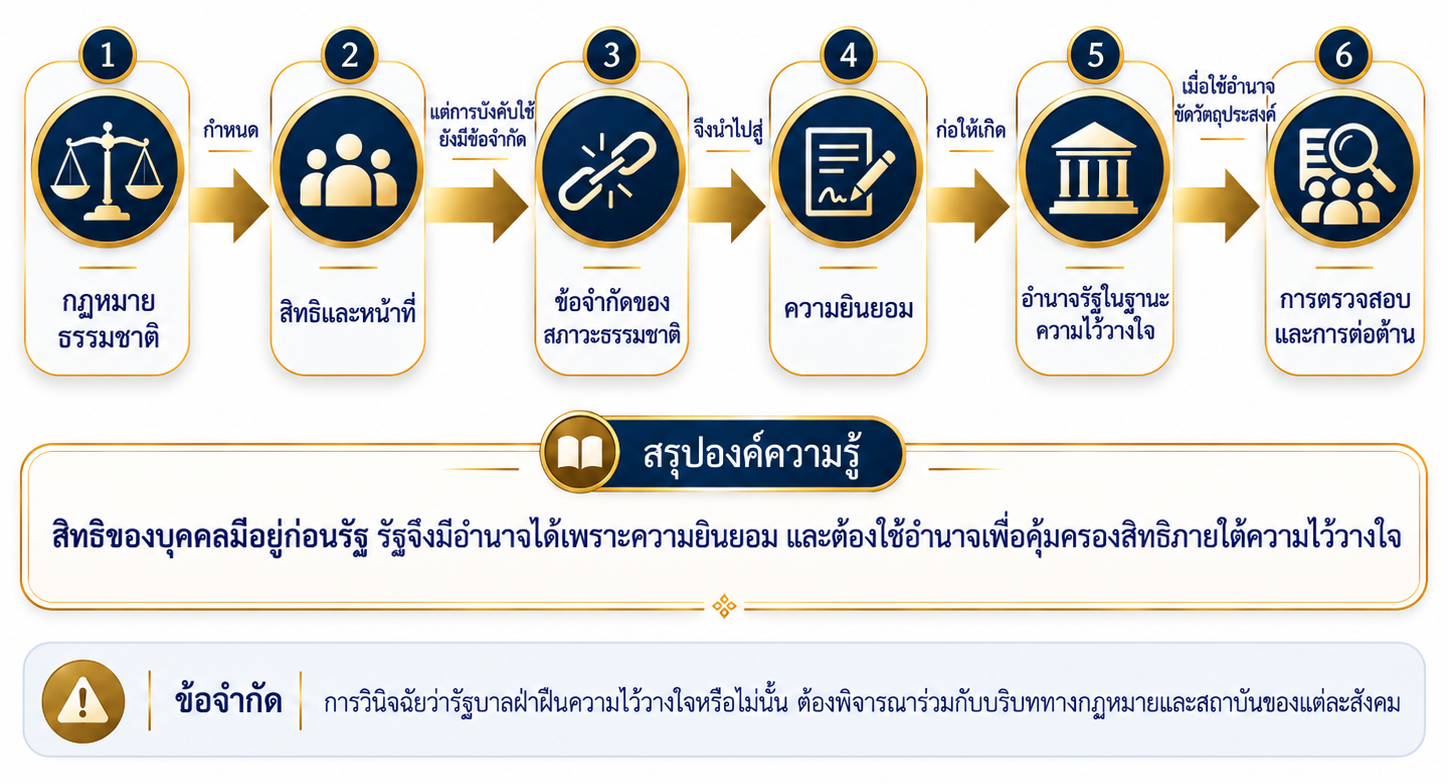
2. Locke’s legal philosophy holds that persons in the state of nature are free and equal under natural law. The rights to life, liberty, and property therefore do not originate from state authorization. Political society is established by consent to address the absence of impartial and settled enforcement of natural law. Political power is consequently entrusted to government for the protection of rights rather than treated as unlimited authority over them.
3. The analysis identifies a sequence linking natural law, rights and duties, problems of enforcement, consent to political society, government as a trust, and the right to scrutinize or resist government when that trust is breached. The strength of Locke’s framework lies in placing rights prior to political authority. Its philosophical difficulty concerns who may determine that a breach of trust is sufficiently serious to justify resistance. Locke’s account should therefore be read by distinguishing moral legitimacy from the continuing legal force of positive law.
Article Details

This work is licensed under a Creative Commons Attribution-NonCommercial-NoDerivatives 4.0 International License.
เพื่อให้เป็นไปตามกฎหมายลิขสิทธิ์ ผู้นิพนธ์ทุกท่านต้องลงลายมือชื่อในแบบฟอร์มใบมอบลิขสิทธิ์บทความ ให้แก่วารสารฯ พร้อมกับบทความต้นฉบับที่ได้แก้ไขครั้งสุดท้าย นอกจากนี้ ผู้นิพนธ์ทุกท่านต้องยืนยันว่าบทความ ต้นฉบับที่ส่งมาตีพิมพ์นั้น ได้ส่งมาตีพิมพ์เฉพาะในวารสาร วิชาการธรรม ทรรศน์ เพียงแห่งเดียวเท่านั้น หากมีการใช้ ภาพหรือตารางของผู้นิพนธ์อื่นที่ปรากฏในสิ่งตีพิมพ์อื่นมาแล้ว ผู้นิพนธ์ต้องขออนุญาตเจ้าของลิขสิทธิ์ก่อน พร้อมทั้ง แสดงหนังสือที่ได้รับการยินยอมต่อบรรณาธิการ ก่อนที่บทความจะได้รับการตีพิมพ์References
พระมหามฆวินทร์ ปุริสุตฺตโม. (2559). วิเคราะห์แนวคิดเรื่องเสรีภาพของจอห์น ล็อค. (วิทยานิพนธ์พุทธศาสตรดุษฎีบัณฑิต). นครปฐม: มหาวิทยาลัยมหามกุฏราชวิทยาลัย.
สมยศ เชื้อไทย. (2563). คำอธิบายวิชานิติปรัชญา. (พิมพ์ครั้งที่ 21). กรุงเทพฯ: วิญญูชน.
สุขสมัย น่าบัณฑิตย์. (2563). ปรัชญากฎหมายธรรมชาติที่มีอิทธิพลต่อรัฐธรรมนูญแห่งราชอาณาจักรไทย พุทธศักราช 2560. (ดุษฎีนิพนธ์พุทธศาสตรดุษฎีบัณฑิต). พระนครศรีอยุธยา: มหาวิทยาลัยมหาจุฬาลงกรณราชวิทยาลัย.
หยุด แสงอุทัย. (2559). ความรู้เบื้องต้นเกี่ยวกับกฎหมายทั่วไป. (พิมพ์ครั้งที่ 20). กรุงเทพฯ: มหาวิทยาลัยธรรมศาสตร์.
Ashcraft, R. (1987). Locke’s two treatises of government. London: Allen & Unwin.
Finnis, J. (2011). Natural law and natural rights. (2nd ed.). Oxford: Oxford University Press.
Locke, J. (1980). Second treatise of government (C. B. Macpherson, Ed.). Indianapolis, IN: Hackett Publishing Company.
Locke, J. (1988). Two treatises of government (P. Laslett, Ed.). Cambridge: Cambridge University Press.
Simmons, A. J. (1992). The Lockean theory of rights. Princeton, NJ: Princeton University Press.
